Types of beehives: which one should a beginner choose
A clear, sourced guide to Langstroth, top-bar, Flow, Warre, and horizontal hives, who each suits, and how to pick your first one.
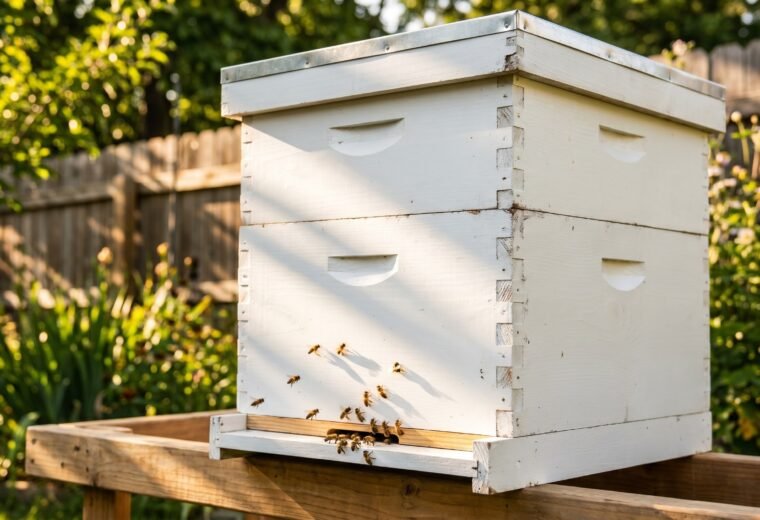
For most US beginners, the right first hive is a 10-frame or 8-frame Langstroth. It is the national standard, parts are interchangeable across brands, your local club runs on it, and almost every how-to you will read assumes it. The other families are worth knowing, and a few genuinely fit certain people better, but pick a Langstroth unless you have a specific reason in this guide to do otherwise.
Notice what a hive actually has to do before you fall for a pretty design. In season, it has to let you open it, lift out comb, and read brood every week or two. It has to let you monitor and treat for mites, and it has to overwinter a cluster. A hive that fights you on any of those will cost you bees, and replacing dead colonies is the recurring bill that surprises new keepers. So the real question is less "which looks nicest" and more "which one will you actually keep bees alive in."
The five hive families, side by side
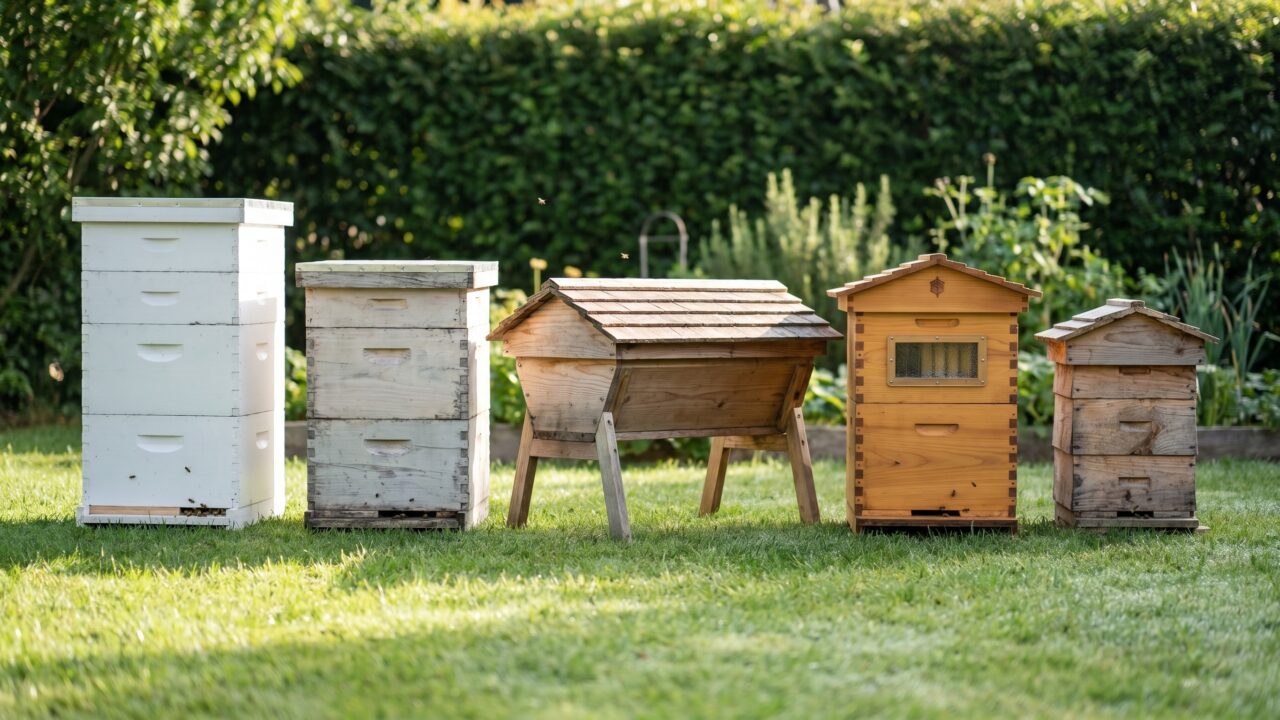
There are really five shapes you will meet in the US: the Langstroth, the top-bar, the Flow, the Warre, and the broader horizontal hive (a top-bar is one kind of horizontal hive). They split along two lines: vertical stacks of boxes versus one long horizontal box, and frames-with-foundation versus bare top bars where bees draw their own comb. Here is how they compare on the things that decide whether a beginner succeeds.
| Hive | Shape | Comb | Lifting | Honey yield | Inspection access | Rough first-hive cost | Best suited to |
|---|---|---|---|---|---|---|---|
| Langstroth (10-frame) | Vertical stacked boxes | Frames + foundation | Heavy: full deep 80+ lb, 10-frame medium 50-60 lb | Highest; expands upward into supers | Excellent; pull any frame, standard tools fit | ~$200-400 kit | Most beginners; anyone who wants club support and resale |
| Langstroth (8-frame) | Vertical stacked boxes | Frames + foundation | About 20% lighter; medium 40-48 lb | High | Excellent, same as 10-frame | ~$200-400 kit | Same as above, for smaller or back-cautious keepers |
| Top-bar (Kenya) | One long horizontal box | Bare top bars, natural comb | Light; lift one comb at a time, no stooping | Lower; less surplus, fragile comb | Good but comb is unframed and can break | ~$200-350 built or kit | Bad backs, hands-off keepers who accept less honey |
| Flow Hive | Vertical (Langstroth-style) with a drain super | Frames; special super taps honey out | Same as Langstroth; still lift boxes | High, like a Langstroth | Excellent in the brood box; the Flow super is for draining, not brood | ~$669-899+ | Buyers who want the tap and accept it is still full beekeeping |
| Warre | Vertical; boxes added at the bottom | Bare top bars, natural comb | Whole-box lifts during nadiring | Lower; designed around the bees over the harvest | Limited; you are not meant to inspect often | ~$200-350 | Natural-comb hobbyists who will not need frame-by-frame control |
Read the table as a triage, not a ranking. The Langstroth wins for a first-year keeper because everything around you assumes it. The others trade away some of that support for a feature you may or may not value: a lighter back, natural comb, or a honey tap.
Langstroth: the default, and why
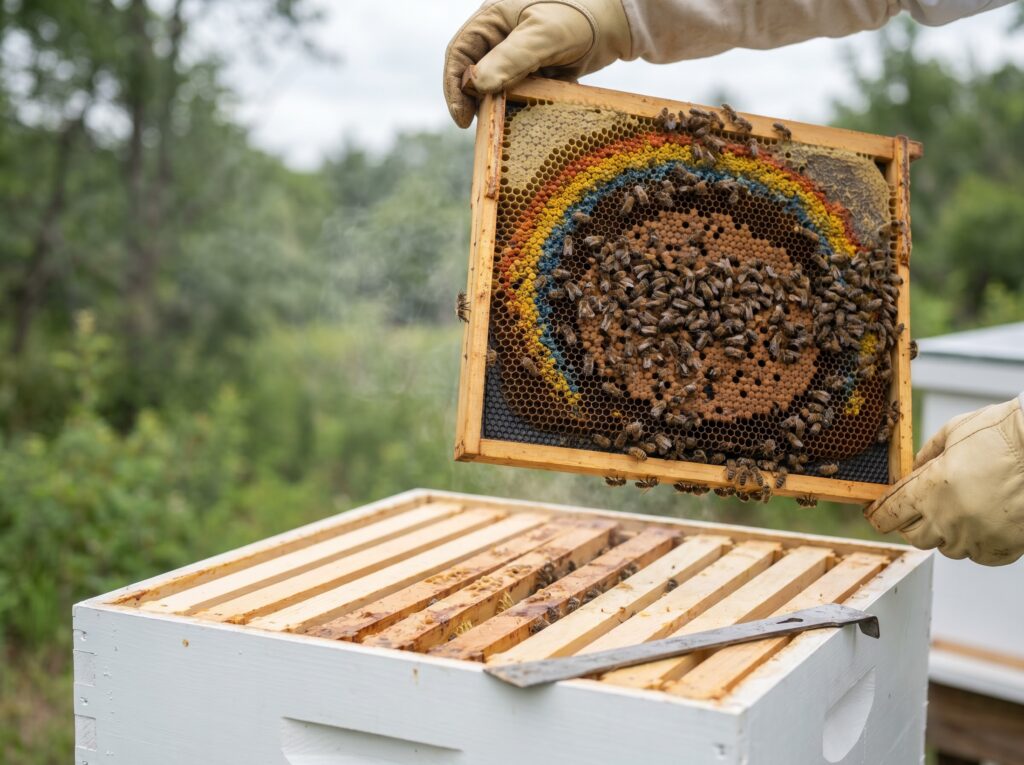
The Langstroth is a vertical stack of boxes holding removable frames, each frame carrying a sheet of foundation that guides the bees to draw straight, liftable comb. The 10-frame version has been the working standard for close to 150 years and is still the most common hive in the country. That standardization is the real prize. A frame from one brand fits another brand's box, your mentor can put hands on your hive and know exactly what they are looking at, and used gear resells.
It earns that status by being easy to inspect. You can lift any single frame, read the brood pattern, find the queen, and run a mite wash without disturbing the rest of the colony. The catch is weight. A full deep can top 80 lb, and even a 10-frame medium honey super runs 50 to 60 lb (University of Arkansas Extension). That is why many new keepers run all-medium boxes or choose the 8-frame size, which comes in roughly 20% lighter at the cost of standing a bit taller. To see how the boxes stack and which frame depths go where, start with how a Langstroth hive is built, and if the weight question is the one nagging you, choosing between an 8-frame and a 10-frame is worth settling before you buy.
Top-bar and horizontal hives: easy on the back, lighter on honey
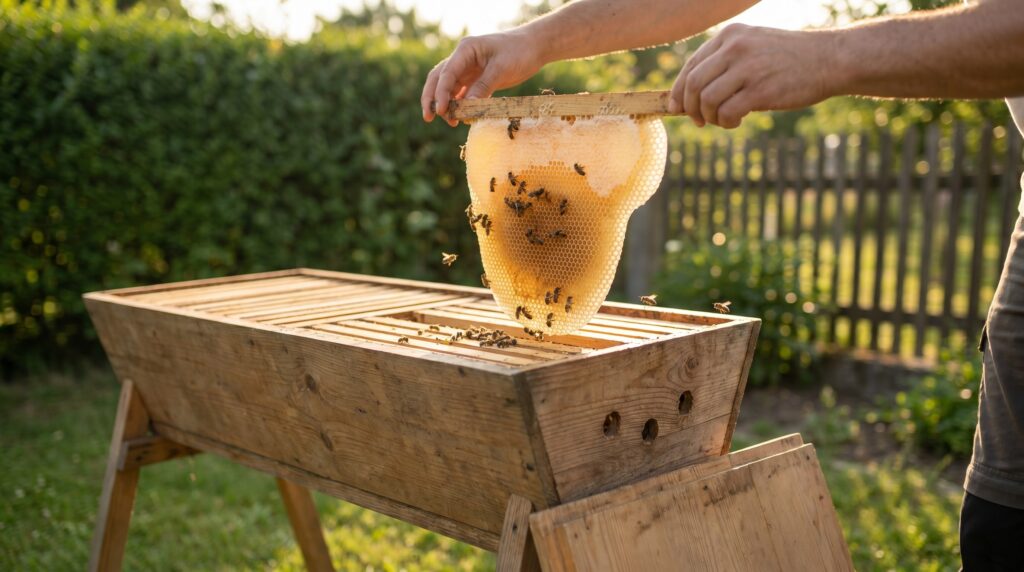
A top-bar hive is one long horizontal box. Bars lie across the top and the bees hang natural comb straight down from each one, with no frames and no foundation. Because nothing stacks, you never lift a heavy box; you lift one comb at a time, and the work happens at waist height. For a keeper with a bad back or shoulder, that is a real advantage, and extension writers in cold regions note there is "essentially no bending over."
The trade-offs are honest ones. Surplus honey runs lower than a Langstroth, the natural comb is fragile and can snap off a bar in summer heat, and the hive is its own ecosystem of non-standard parts, so a Langstroth frame will not drop in. Overwintering can be harder too, because warm air and bees move sideways instead of up. A top-bar is the most common horizontal hive, but the family is wider than that. If a long, low, lift-nothing setup appeals to you, running a top-bar hive without breaking the comb is the next thing to read, and the wider horizontal-hive options include long Langstroths that still take standard frames.
The Flow Hive: a working hive with a honey tap
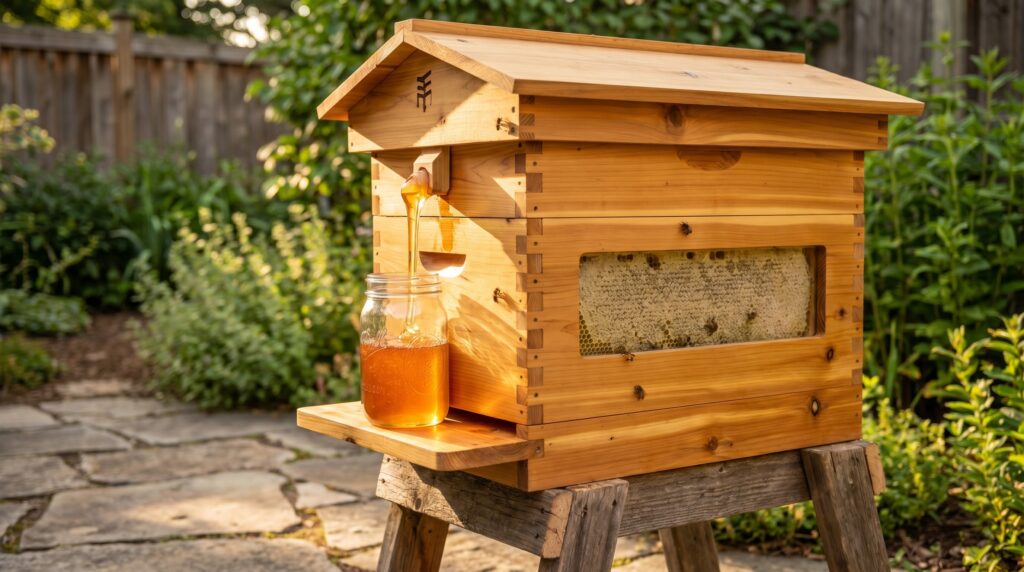
A Flow Hive is a Langstroth-style hive with one special part: a super whose frames split open with a key so honey drains out a tube, no extractor and no pulling frames to harvest. That part works, and it is genuinely clever. What it is not is a way to skip beekeeping. Below that honey super sits an ordinary brood box you still inspect every week or two, and the Flow frames do nothing for the things that actually kill colonies.
The honest accounting matters here because of the price. The Flow Hive Classic starts around $669 and the Flow Hive 2+ runs about $899 and up, set against roughly $200 to $400 for a complete conventional Langstroth kit (Flow Hive manufacturer pricing). For that premium you get the tap and a tidy viewing window. You do not get any help with varroa, swarms, feeding, or overwintering. A full 6-frame Flow super holds up to about 40 lb of honey, but only when the colony is strong enough to fill it, which a first-year colony usually is not. Whether that tap is worth the money is a personal call, and we lay out the full price-versus-payoff math in our honest take on whether a Flow Hive is worth it.
Warre: built for the bees more than for your hands
The Warre is a vertical hive of smaller boxes with bare top bars, designed to imitate the cavity of a hollow tree. The signature move is nadiring: you add new boxes at the bottom, not the top, so the bees build downward the way a wild colony would. The queen roams freely and brood can be reared anywhere in the stack. The whole philosophy is to let bees manage their own comb with minimal interference, which a peer-reviewed comparison framed as "a more natural situation" for the colony.
For a first-year keeper, that hands-off design is the problem. You cannot easily pull a single frame to read brood or run a mite check, and the early years are exactly when you most need to learn by looking. Mites, for their part, do not respect a natural-comb philosophy. A Warre can be a lovely second or third hive for someone who already knows how a colony behaves. As a first hive, in a country losing roughly half its backyard colonies a year, it only makes the steepest part of the learning curve steeper.
How to pick yours
Walk these in order and stop at the first one that decides it. First, will your back tolerate lifting a 50 to 80 lb box? If not, look hard at an 8-frame Langstroth, all-medium boxes, or a horizontal hive. Second, is anyone near you, a club or a mentor, keeping bees? Whatever they run is the hive you will get the most help with, and that is almost always a Langstroth. Third, what do you actually want from the hobby? Maximum honey and maximum control point to a Langstroth, natural comb with less fuss points to top-bar or Warre, and the harvest tap points to Flow. When it comes down to those top three, the Langstroth, top-bar, and Flow head-to-head puts them on one page. Fourth, what can you spend up front, knowing a conventional Langstroth kit is the cheapest path? Figure on a $200 to $400 kit and a separate $140 to $300 for bees. Then add roughly $400 to $850 for the gear no kit fully covers: a suit and gloves, a smoker and hive tool, a feeder and feed, a mite-test kit and treatment, a stand, and a beginner class or club dues. Those three buckets together land a realistic first year somewhere around $750 to $1,500.
For the large majority of people reading this, those four questions land on the same answer: a 10-frame or 8-frame Langstroth. It is not the most beautiful hive or the most natural one. It is the one your first season is most likely to survive, and survival is the whole game in year one. Once you have a hive shape in mind, the next decisions are what the boxes are made of and how you will stock them: every part of a beehive, named and explained sorts out the woodenware, and buying your bees as a package or a nuc covers how you fill it.
One honest note for year one: do not buy a hive expecting honey. A new colony spends its first season drawing comb, and that comb-building burns the very energy that would otherwise have become surplus. Plan on zero to maybe 20 lb the first year. An established hive in a good year gives more like 30 to 60 lb. The hive you choose changes how you work, but it does not change that first-year math.
Questions answered
Is a Langstroth or a top-bar hive better for a complete beginner?
A Langstroth, for most people. Its parts are standardized nationwide, your club and mentor almost certainly use it, and every how-to assumes it. A top-bar is gentler on your back and uses natural comb, but you trade away that support and get less honey. Pick top-bar mainly for back reasons.
What does a Flow Hive actually change compared to a normal Langstroth?
Exactly one thing: the harvest. Instead of pulling honey frames, uncapping them, and running them through a spinning extractor, you turn a key and the honey drains out a tube into a jar. That is the whole feature, and it is a real time-saver on harvest day. Everything else, the weekly brood inspections, mite testing and treatment, feeding, swarm checks, and the lifting of full boxes, is identical to any Langstroth, because below the Flow super sits a conventional brood box. You are paying the premium to skip the extractor, not to skip beekeeping.
How much does a starter hive actually cost?
A complete conventional Langstroth kit runs about $200 to $400. A Flow Hive starts near $669 and climbs past $899. Then bees are separate: roughly $140 to $200 for a package, $180 to $300 for a nuc. On top of the hive and bees, budget another $400 to $850 for the gear no kit fully covers: a suit and gloves, a smoker and hive tool, a feeder and feed, a mite-test kit and treatment, a stand, a second box or extra frames, and a beginner class or club dues. Add those three buckets and a realistic first year lands between $750 and $1,500.
If my first-year colony does build some extra honey, should I harvest it?
Usually leave it on. A first-year colony needs a well-stocked brood nest to survive its first winter, and in most US regions that means roughly 50 to 90 lb of stored honey going into fall, depending on how cold and long your winter runs. Say a strong package or nuc goes in early on a good nectar flow, draws all its comb, and still caps surplus above the brood boxes. You can take that excess, but only what sits in a dedicated honey super, and only once the colony's own winter stores are clearly covered. When in doubt the first year, feed less and harvest nothing. The cheapest dead-colony insurance is leaving the bees their own honey.
- - Apidae / PMC peer-reviewed hive-type studyused for the Langstroth and Warre design descriptions and the natural-comb comparison
- - University of Arkansas Cooperative Extension, woodenware guideused for the 8-frame vs 10-frame and deep vs medium box weights
- - US Beekeeping Survey 2024-2025 (Apiary Inspectors of America with Project Apis m.)used for the 55.6% overall and 51.4% backyard colony-loss figures
- - University of Minnesota Bee Lab, Varroa Mite Testingused for the 300-bee alcohol wash sample, treatment threshold, and late-summer timing
- - Flow Hive (manufacturer spec pages)used for Flow Hive Classic and 2+ pricing and the 40 lb super capacity
- - NC State Extension, How to Become a Beekeeper in North Carolinaused for the package versus nuc descriptions and the institutional lower bounds behind the bee-cost ranges
- - Penn State Extension, An Organic Management System for Honey Beesused for the first-year goal of drawing out comb rather than making surplus honey
- - USDA National Agricultural Statistics Service, Honey (annual report)used for the established-hive yield figure, with per-colony yield averaging 51.7 lb in 2024 inside the stated 30 to 60 lb range