Honey extractors explained: how to pick the right machine for your hive count
Manual vs electric, radial vs tangential, 2-frame to 20-frame: a practical guide to honey extractors so backyard beekeepers buy the right size at the right time.
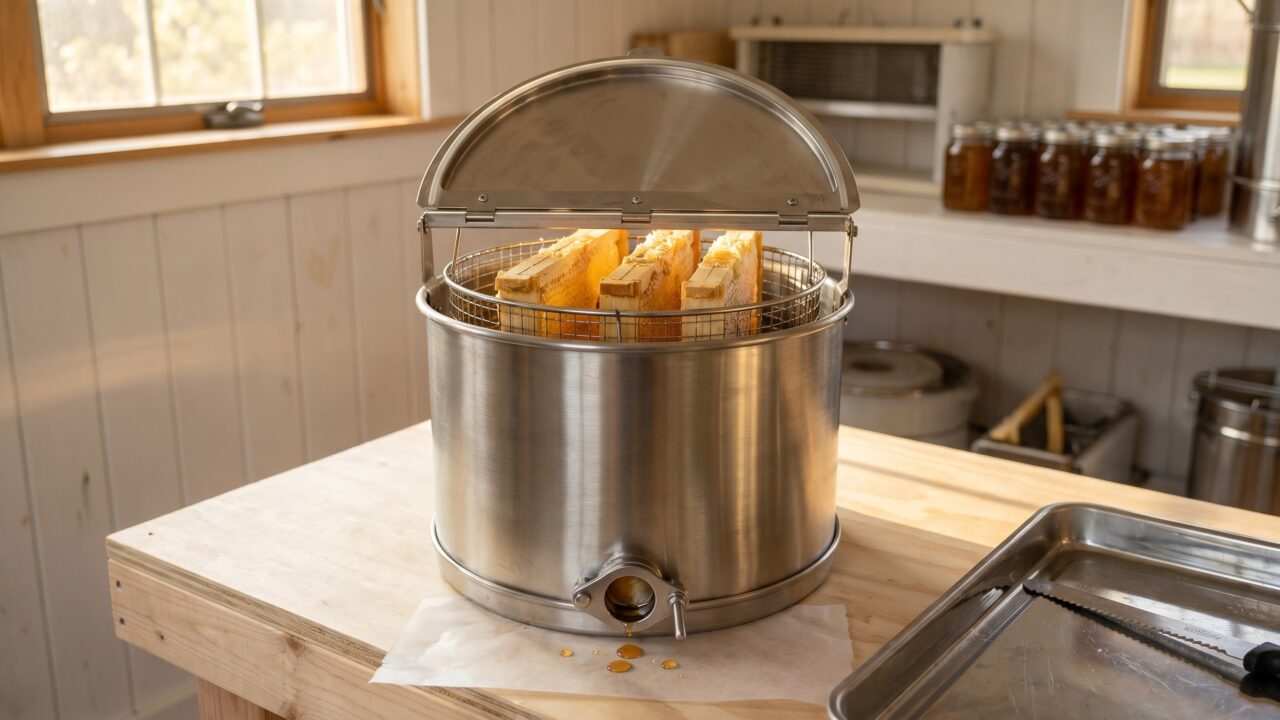
An extractor is a centrifuge. You uncap the comb, slide the frames in, spin, and honey flies outward into a drum with a honey gate at the bottom. The bees get their drawn comb back intact, which matters more than most beginners realize: bees must consume roughly six to nine pounds of honey to secrete one pound of wax (the widely cited figure is around eight pounds, based on research summarized in Coggshall and Morse's beekeeping literature), so saved comb is essentially colony energy banked for the next flow. That is the core case for a centrifugal extractor over crushing the comb.
Whether you need one this season, and which size makes sense, depends almost entirely on how many hives you run and how much honey you actually expect to process. For a single hive in year one, the answer is often "not yet." Read through this guide to understand the machine types, then use the decision table to find your match.
The one question that settles most buying decisions
Before sizing an extractor, ask: how much capped honey am I realistically pulling off each year?
USDA NASS data puts the 2024 national average at 51.7 pounds per colony, but that number comes only from colonies that actually produced harvestable honey. A first-year hive, spending its entire season drawing comb and stocking winter stores, typically yields nothing or a modest 10 to 20 pounds of surplus at best. Oklahoma State University Extension is direct on this point: you are unlikely to harvest significant surplus in year one, and there will be no receipts from the operation until the second year.
Once you have established hives with drawn comb - typically year two and beyond - a single productive colony can push 30 to 60 pounds in a reasonable season, and two or three hives can fill a couple of supers easily. That volume is where an extractor starts paying for itself in comb preservation and processing speed. Two to three medium supers processed by hand with a crush-and-strain bucket takes time and destroys the comb. Spinning the same frames takes maybe 45 minutes and hands the bees back something worth more than the honey itself.
Radial vs tangential: what actually changes at the hive scale
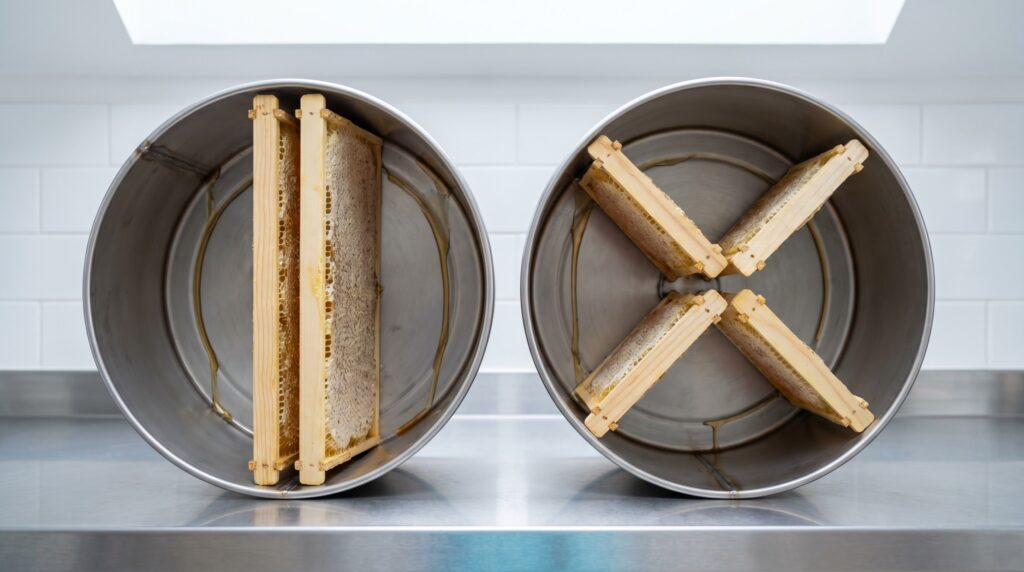
Every centrifugal extractor is either radial or tangential. The difference is how frames sit in the basket.
In a tangential extractor, the comb faces outward - essentially pressed against the drum wall. Honey flies off the outer face first. Then you flip every frame and spin again to clear the inner side. For a 2-frame manual machine, flipping is maybe two minutes of extra work. For a 20-frame load, it becomes a real chore, and there is a comb-breaking risk: spinning too fast before flipping the frames can bow soft foundation outward and collapse it. The standard workaround is to do a slow first pass at low speed, flip, then spin harder. It works, but it requires attention.
In a radial extractor, frames hang like spokes on a wheel with the top bar pointing outward. Both faces drain simultaneously. No flipping. Softer comb handles it better because the centrifugal force pulls honey toward the outer wall rather than pressing the comb against it. At scale - say, nine or more frames - radial is the clear choice for throughput and comb integrity. For a two-hive hobby setup, a radial 3-frame unit is a reasonable upgrade from a tangential 2-frame if you plan to stay in beekeeping long term.
One practical note: radial machines extract deep Langstroth frames and medium frames but work less cleanly with shallow supers, because the shorter frame height leaves more uncapped cells at the outer rim. Tangential machines handle any frame depth cleanly, which matters if you run mixed box depths.
Manual vs electric: where the line actually sits
Manual extractors use a hand crank. Electric machines use a motor with a variable-speed controller. The relevant question is not "which is easier" - it is "how many frames am I spinning in a single session?"
Cranking a 2-frame tangential machine through 20 frames of honey takes somewhere between 20 and 35 minutes of continuous turning, depending on how thick the honey is and how warm your extraction room runs. Warm honey (above roughly 80 degrees Fahrenheit) flows noticeably faster than honey extracted in a cool garage in October. One hive's worth of honey from a strong flow - call it two medium supers, roughly 18 to 20 frames - is manageable by hand. Two hives' worth in the same session starts to feel like a workout. Three or more is genuinely tedious.
Electric motors earn their price at three or more hives, or any time you are processing multiple harvests per season. Variable speed is worth paying for: starting slow lets honey loosen and flow before you open the throttle, and it is much gentler on comb that has been sitting in supers all summer. A fixed-speed motor on soft wax foundation is how you crack a frame and end up pulling chunks of comb out of the drum.
The price gap is real. Manual 2-frame units run roughly $100 to $160 from the main beekeeping suppliers (Mann Lake, Betterbee, Dadant). Entry electric 3-frame models start around $250 to $350. Motorized 9-frame radial machines aimed at small operations run $400 to $700. Larger commercial-scale units climb well past $1,500. These are general market ranges; prices shift by supplier and season, so confirm current pricing directly on the manufacturer's site before buying.
Frame capacity: the sizing chart
The table below maps hive count to a practical extractor choice. It assumes Langstroth deep or medium frames, one full super harvest per hive per main flow, and that your goal is to finish processing in a single reasonable session without destroying your comb.
| Hive count | Frames to process per session | Recommended extractor type | Drive | Rough cost range |
|---|---|---|---|---|
| 1 hive | 9-10 deep or 18-20 medium | 2-frame tangential or 3-frame radial | Manual | $100-$160 |
| 2-3 hives | 18-30 frames per session | 3-frame radial or 4-frame tangential | Manual or entry electric | $160-$350 |
| 4-8 hives | 36-80 frames | 6-9 frame radial | Electric, variable speed | $350-$700 |
| 9+ hives | 80+ frames | 9-20 frame radial | Electric, variable speed | $600-$1,500+ |
These ranges cover machines from the main US suppliers. A 10-frame radial at the low end of the 9+ hive category is still a semi-commercial unit, not a toy. If you are running nine hives as a hobbyist, renting time on a club extractor for a season or two while you decide whether to scale is often the more practical move than buying at this tier outright.
Material and build quality: what to look for
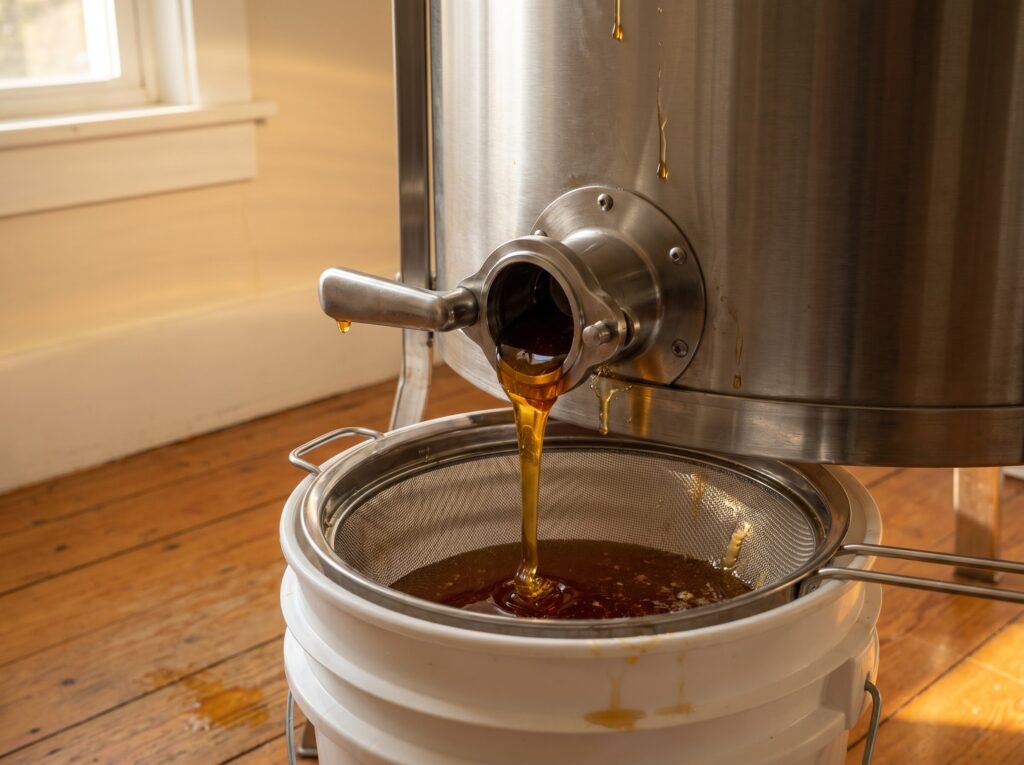
Food-grade stainless steel is the only material worth considering for the drum, basket, and honey gate. Manufacturers typically use 304-grade stainless steel on equipment built for honey contact. Avoid extractors with aluminum baskets or any galvanized metal in the drum: honey is mildly acidic, and prolonged contact with reactive metals can pick up off-flavors. Plastic components in the basket are fine as long as they are rated food-safe; the critical surfaces are the drum interior and the honey gate, which need to be nonreactive and easy to clean.
Gate quality matters more than most buyers anticipate. A poorly fitted honey gate drips between sessions and is nearly impossible to fully sanitize. Look for a gate with a rubber gasket and a positive-lock lever, not a simple plastic spigot. The gate also determines how fast you can drain the drum between loads, which becomes relevant when you are processing multiple supers back to back.
Drum capacity is a secondary consideration. A 20-liter drum fills up after roughly one full load of 9 deep frames if the flow was strong. A 30-liter drum gives you more headroom between drains. For a hobbyist running two or three hives, this rarely matters in practice, but if you plan to process two consecutive loads without stopping to drain, measure the drum volume against your expected yield before buying.
When a beginner should skip the extractor entirely
In year one with a single hive, crush and strain is almost always the right call. The equipment - a 5-gallon food-grade bucket with a honey gate, a second bucket, and a paint strainer bag or double layer of cheesecloth - costs under $40 total. If your first colony does produce a modest surplus of 10 to 15 pounds, crush and strain handles it in under an hour. You lose the drawn comb, but a first-year colony's comb is fresh and uncontaminated, and you get to put money toward equipment you will actually use in year two, like a refractometer to check moisture content before you bottle.
The refractometer point is worth emphasizing regardless of which method you use. Honey above roughly 18.5% water will ferment given time. US Grade A extracted honey requires moisture at or below 18.6% (USDA Agricultural Marketing Service standard). A good refractometer calibrated for honey costs $30 to $50 and takes five seconds to use - far cheaper than losing a batch. As a harvest readiness guide, most beekeepers wait until at least 80% or more of the cells in a frame are capped before pulling supers - the widely used extraction-readiness threshold. (A related but different rule from Mississippi State University Extension is a supering cue: when two-thirds of the combs are nearly full of honey and being capped, that is the signal to add the next super, not the signal to harvest.) Verify moisture with a refractometer before sealing any jar.
The full comparison between crush and strain and centrifugal extraction - including the per-pound economics and when to upgrade - is worked through in the extractor vs crush and strain guide if you want the side-by-side detail.
Renting vs buying: the club extractor option
Most local bee clubs and many state beekeeping associations maintain extractors available for member rental, typically a few dollars per session or included in membership dues. For a beekeeper running one or two hives in years one and two, rental is often the most sensible path. You get a large, clean commercial machine, avoid a capital outlay on gear that will sit idle ten months of the year, and you process your honey in company with people who know what they are doing. The social dimension is underrated as a learning mechanism.
The case for ownership starts when you are harvesting multiple times per season, running four or more hives, or when rental logistics - hauling frames, booking time, cleaning someone else's equipment - consistently add friction to an already time-sensitive task. Extracting must happen while the honey is warm and the bees are in a manageable state; an extractor sitting in your outbuilding removes one scheduling constraint.
Our full beekeeping equipment list covers where an extractor fits relative to protective gear, hive tools, and feeders in the overall budget.
Practical extraction tips that save equipment and honey
Keep your extraction room warm. Honey viscosity drops sharply as temperature rises, and a 75 to 85 degree room will drain frames cleanly where a 60-degree garage leaves a thick layer clinging to the comb. If you do not have a warm dedicated space, extract on a sunny afternoon, let the supers warm up for a few hours near a heat source before you start, or use a warming cabinet if you are processing at scale.
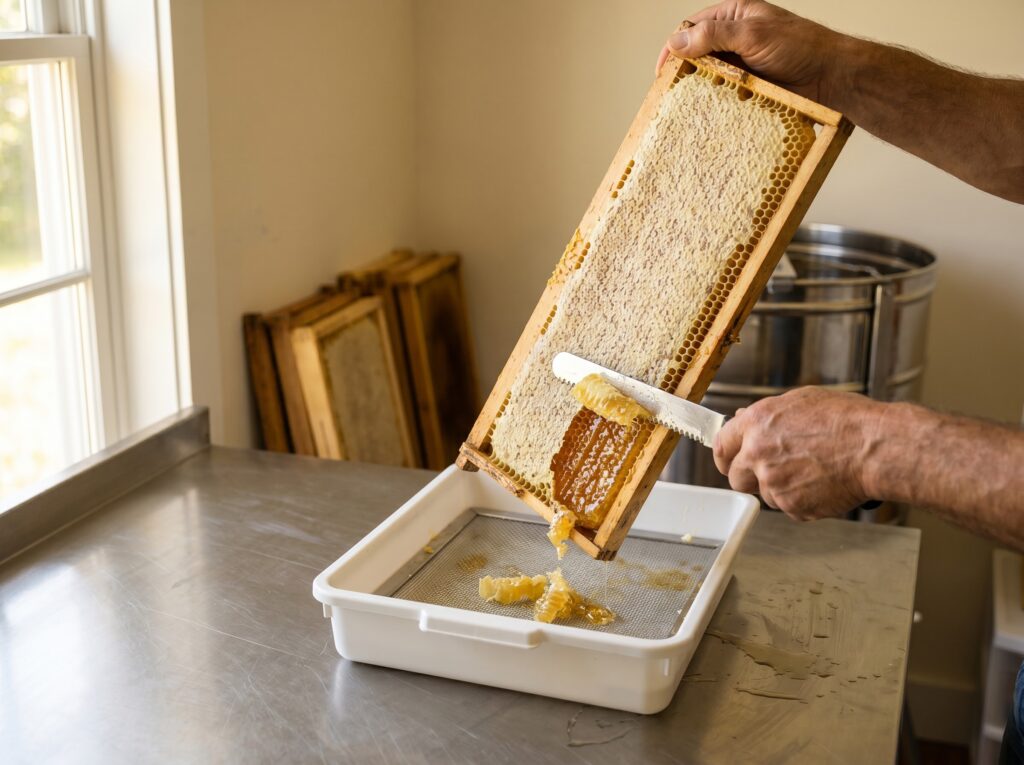
Uncap over a large container with a strainer to catch cappings honey. Cappings are honey-rich - a substantial share of their weight is residual honey that drains slowly over 24 to 48 hours. Do not throw them out; run them through a strainer into a clean bucket and you will recover a meaningful amount. An uncapping tank with a built-in strainer tray handles this automatically, but an upturned wire rack over a 5-gallon bucket works just as well for small batches.
Start your spin slow, especially with fresh comb or plastic foundation. A slow first pass at half speed lets the honey loosen and start flowing before centrifugal force peaks. On a tangential machine, do the slow-pass, flip, slow-pass again before going full speed; comb that collapses in the extractor is comb you are replacing next season, which costs the bees weeks of wax secretion.
Clean the extractor the same day. Honey left in a drum overnight becomes a sticky film that takes ten times longer to dissolve than fresh honey. A hot water rinse followed by warm soapy water (unscented dish soap), then a final rinse with clean hot water and air dry is sufficient. Do not run it through a dishwasher; the thermal cycling stresses the welds, and the detergent residue is difficult to fully rinse from a drum.
The full uncapping and spinning process - including how to set up a clean extraction space, manage bees during pull-off, and strain before bottling - is covered step by step in the uncapping and extracting walkthrough.
Questions answered
Can I use a honey extractor for both deep and medium Langstroth frames?
Yes, most extractors designed for the US market accept standard Langstroth deep (9-1/8 inch) and medium (6-1/4 inch) frames interchangeably. Check that the basket's frame slots accommodate your frame width (standard is the same across both depths). Shallow frames fit most baskets physically but may not spin cleanly in radial machines where the basket arms are spaced for deeper frames.
Do I need a heated uncapping knife or will a cold one work?
A cold serrated knife, drawn through the cappings with a sawing motion, works well for small batches. Heated knives (electric or steam) slice through capped cells with less pressure, which means less disturbed comb and a cleaner uncap on frames where the cappings sit slightly below the frame surface. For occasional hobbyist use, a sharp cold knife is sufficient. A cappings scratcher or fork handles the few cells a knife misses.
How do I know when the honey is ready to extract?
Most beekeepers wait until 80% or more of the cells in a frame are capped before pulling supers - that is the practical extraction-readiness threshold. Capping is a strong indicator that the bees have ripened the honey to a low moisture level, but it is not a guarantee: in high-humidity climates, bees can cap honey that is still above 18.5% moisture. That is exactly why the refractometer check matters. A reading below 18.6% confirms the honey is stable for storage without fermentation risk - a $30 to $50 investment that protects every batch you process.
How long does extraction take for a typical backyard harvest?
For one to two hives, figure roughly one to two hours from pulling supers to having honey in a settling bucket - including uncapping, spinning, and an initial draining through a coarse strainer. Settling and fine straining takes another 24 to 48 hours before bottling. Electric machines are faster per load; the time savings at two-hive scale is real but not dramatic. The bigger variable is how warm your honey is when you start.
- Wikipedia, "Honey extraction"used for centrifugal extraction mechanics, moisture/refractometer guidance, and the 80% capped extraction-readiness threshold
- Wikipedia, "Honey extractor"used for radial vs tangential frame orientation (radial: top bar facing outward; tangential: one comb face outward per pass)
- Wikipedia, "Beeswax" (citing Whitcomb 1946 via Coggshall and Morse 1984)used for the honey-to-wax metabolic ratio (6.6-8.8 lb honey per 1 lb wax; widely cited at ~8 lb)
- USDA National Agricultural Statistics Service, Honey report, March 2025used for 2024 per-colony yield average (51.7 lb)
- Oklahoma State University Extension, "BeekeepingHoney Harvest Methods, Costs and Breakeven Calculations" - used for first-year colony honey yield expectations
- Mississippi State University Extension, "Maximizing Honey Production"used for the supering cue (add a new super when two-thirds of combs are nearly full and being capped)
- Utah State University Extension, "Thriving Hives: Processing and Using BeeswaxCandles and Cosmetics" - used for the beekeeper wax yield figure (about 1-2 lb of wax recoverable per 100 lb of honey harvested)