Harvesting honey: when it is ready, how to pull and process it, and how much to expect
Honey is ready when the comb is mostly capped and under about 18.5% moisture. Here is when to harvest, how to extract it, year-one reality, and wax after.
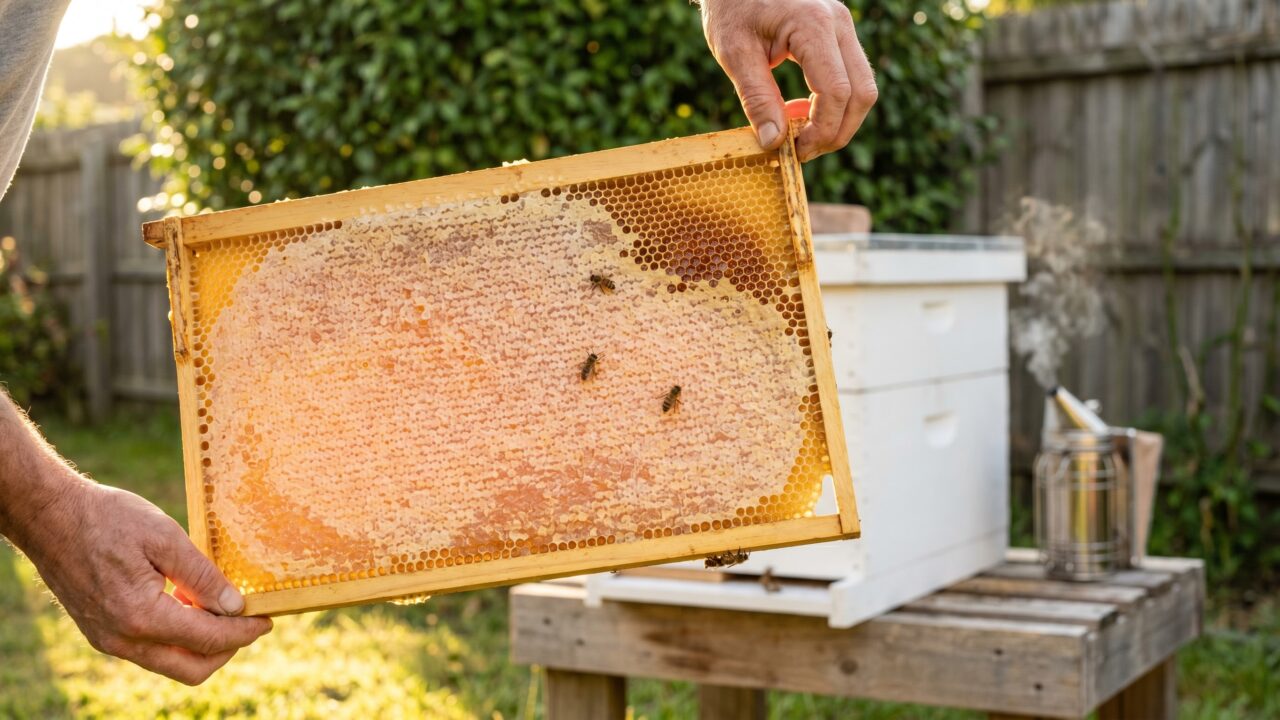
Honey is ready to harvest when the bees have capped most of the cells on a frame and the water in it has dropped to about 18.5% or below. That capping is the colony's own signal that the nectar is ripe and will not ferment in the jar. Get the timing right and harvesting is a clean, satisfying afternoon. Pull it too early, when the honey is still thin and uncapped, and it can ferment on your shelf a few months later.
This page is the map for the whole job: how to read a frame and know it is done, how to get the honey out of the comb, what a realistic harvest looks like (including the year-one answer nobody likes), and what to do with the wax once the honey is gone. Each step links to a fuller walkthrough where you need one. First, the question that comes before all of it.
When the honey is actually ready
Look at the comb, not the calendar. A frame is ready when the bees have sealed the cells with a thin wax cap, which they only do once they have fanned the nectar down to a safe moisture. A common working rule is to harvest a frame that is at least 80% capped, and Mississippi State Extension frames the colony-level version of the same idea: nectar should be left on the hive for weeks for "full ripening and conversion of all stored nectar into capped honey," and a super is treated as filling when "two-thirds of the combs are nearly full of honey and being capped."
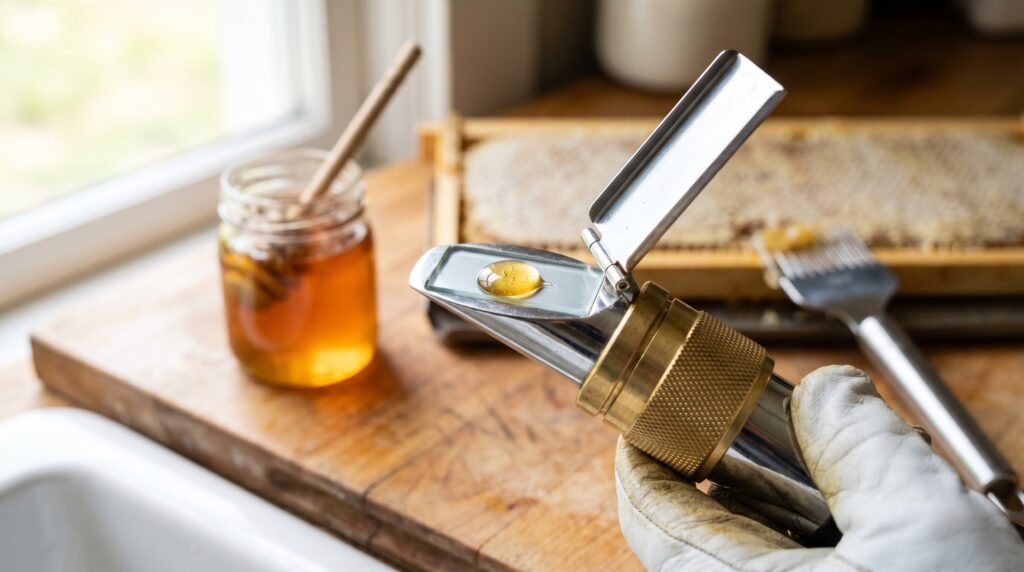
Capping is a proxy for the number that really matters, which is moisture. Honey under roughly 18.5% water will not ferment; honey much above that can. The reliable way to check is a refractometer, a cheap pocket tool that reads water content from a drop of honey. If you want the formal benchmark, U.S. Grade A extracted honey tops out at 18.6% moisture, so think of high-17s to low-18s as your safe window. There is also an old field test, the shake test, where you tip a frame and shake it. If honey rains out of the open cells, it is not cured, so leave it on the hive. The shake test only tells you a frame is clearly not ready; it cannot confirm that one is, which is why a refractometer earns its small cost. The deeper read on capping percentage, the shake test, and reading moisture lives in our walkthrough of knowing when honey is ready to pull.
One timing rule trumps all of this, and it is about safety rather than convenience. Harvest honey supers before you treat for mites with most products. Per the Honey Bee Health Coalition's Tools for Varroa Management, amitraz (Apivar) and thymol (Apiguard) both require removing the honey supers, while formic acid (Formic Pro) can stay on with supers in place. You do not want miticide residue in honey you plan to eat or give away. So the usual sequence is simple: pull your harvest first, then put the colony's mite treatment on the now-empty hive. Time it for late summer, the knockdown Penn State Extension flags as critical for raising healthy winter bees. The product-by-product rules are in our guide to which mite treatments are safe with supers on.
How to get the honey out of the comb
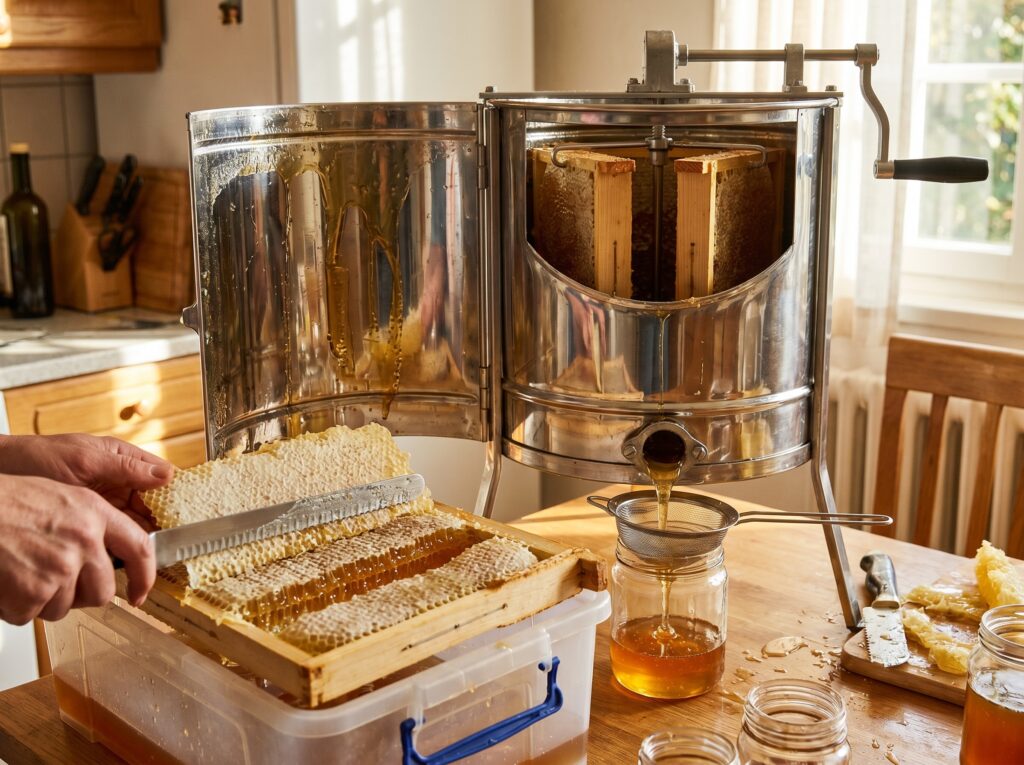
Once the frames are capped and off the hive, you have two honest ways to extract, and the right one depends on how many hives you run and whether you want to save the comb. Both start the same way: you uncap the cells, slicing or scratching off the thin wax seal so the honey can come out.
| Method | What it costs | Saves the drawn comb | Best for |
|---|---|---|---|
| Centrifugal extractor | $150-$500+ (or borrow from a club) | Yes | Two or more hives, or anyone who wants comb back |
| Crush and strain | Under $30 in buckets and a strainer | No | One hive, foundationless frames, or a first harvest |
An extractor is a drum that holds uncapped frames and spins them. As Wikipedia's honey-extraction overview puts it, the machine spins the frames "so that most of the honey is removed by centrifugal force." The honey flings against the wall, runs to the bottom, and drains out a gate. The big payoff is that the comb survives the spin, so you hand it straight back to the bees, who refill drawn comb far faster than they build new wax. That single advantage is why most beekeepers with two or more hives end up borrowing or buying one. We compare the real spinners worth owning in our roundup of extractors that hold up for a backyard apiary.
Crush and strain is the no-machine route. You scrape the whole comb off the frame, mash it, and let gravity pull the honey through a strainer into a bucket overnight. It costs almost nothing and gives you clean raw honey, but it destroys the comb in the process, so the bees rebuild from scratch next season. For one hive, foundationless frames, or a careful first harvest, it is often the smarter start. The full step-by-step, including how fine to strain, is in our guide to harvesting honey without an extractor, and if you are weighing the two head to head, our piece on choosing between an extractor and crush and strain lays out the break-even point.
Whichever method you use, the last steps are the same: strain the honey through cloth or a fine mesh to catch wax bits, let it settle for a day so air bubbles rise, and skim the foam before you bottle. Skip the heat. Honey does not need pasteurizing, and warming it past about 110F starts to cook off the delicate aromas that make local honey worth keeping.
How much honey to expect, and the year-one truth
If this is your first season, plan on harvesting nothing. A brand-new colony spends its first year drawing comb, raising brood, and packing away stores for its own winter, with no surplus to spare. Oklahoma State Extension says it plainly: a beginner "may not harvest any honey your first year," and "there will be no receipts from an operation until the second year." A first-year hive that gives you 0 to 20 pounds is normal, and 0 is the most common result. That is not a failure. It is the colony doing exactly what it should.
From the second year on, an established hive in a good location yields a real crop, but the range is wide and it depends heavily on forage and crowding. Mississippi State Extension gives a useful pair of numbers from the same publication: a yard can "easily produce 90-100 pounds of surplus honey" per hive in a generous area, yet "the honey yield could drop to only 30 pounds per hive" once too many colonies compete for the same flowers. For a backyard hobbyist with one or two hives and decent forage, 30 to 60 pounds in a good year is a fair expectation. Our deeper look at what drives that spread, from nectar flow to box count, is in how much honey one hive really makes.
One practical reason yields swing: you only take the surplus. The colony's own winter stores come off the top before you count a single jar for yourself, and most regions land somewhere in the 70 to 90 pound range. A full two-deep hive needs around 80 pounds to be safe, and even a small colony should not go into winter with much less than 50. How much you leave depends on your climate. A mild southern hive needs less than a colony facing a long northern freeze, so do not over-leave honey if your winters are gentle. Harvest greedily in a hard-winter region, though, and you trade a few pounds now for a starved colony in February, which is no trade at all.
What to do with the wax after
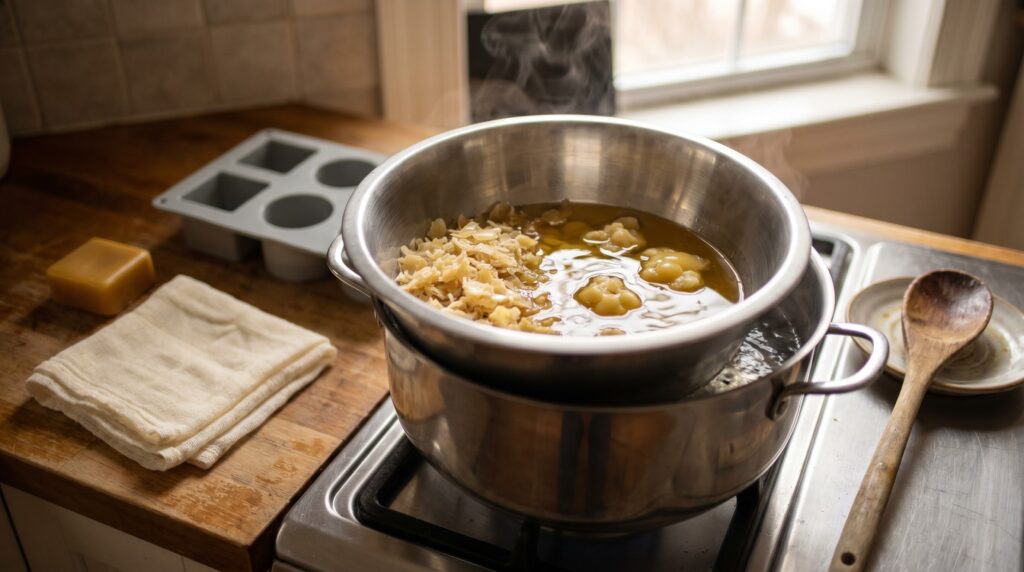
The cappings you slice off are clean, light beeswax, and they are worth saving. The yield is modest and predictable: Utah State Extension notes a beekeeper "can usually harvest about 1-2 pounds of wax for every 100 pounds of honey harvested." So a 40-pound harvest leaves you with not quite a pound of wax, enough for a few candles or a batch of salve and well short of anything you would sell in bulk.
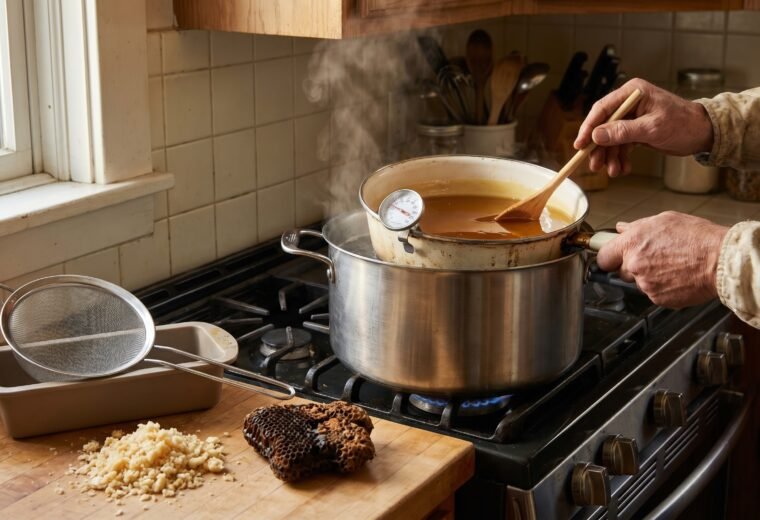
Raw cappings come out sticky and full of debris, so they need cleaning and rendering before use. The gentle method is a double boiler, a heat-safe bowl set over a pot of simmering water, which melts the wax without scorching it. Keep the temperature down. Utah State warns that "if the wax gets hotter than 180 degrees Fahrenheit, you will start to have problems with discoloration," and overheated wax is also a fire risk, since melted beeswax is flammable. Strained warm through cloth, the wax separates from honey and grit and sets into a clean block. The full process, from first rinse to a poured bar, is in our guide to cleaning and rendering beeswax from cappings.
For the actual day-of mechanics, from clearing bees off the supers to uncapping and bottling, our step-by-step walkthrough of harvest day covers the order of operations so nothing turns into a sticky scramble.
A last word on the parts of this job that are not husbandry. Mite treatments are used strictly by their label, sting reactions beyond mild local swelling belong with a medical professional, and selling honey can trigger state labeling and licensing rules. For any of those, follow the Honey Bee Health Coalition, your local extension service, and your state apiary office rather than improvising.
Questions answered
How long can capped honey sit on the hive before I pull it?
Capped, cured honey is shelf-stable on the frame and can wait weeks if you cannot harvest right away, since the wax cap keeps it sealed and dry. The real deadline is your mite-treatment window: you want supers off in late summer so you can knock mites down before winter bees are reared. Pull before nights turn cold, too, because chilly honey runs thick and is much harder to extract.
Should I filter my honey or leave it raw?
Strain it, but do not over-process it. Running warm honey through cheesecloth or a fine mesh catches wax flakes, bee parts, and grit without stripping the pollen and enzymes that make raw honey worth keeping. Skip any fine micron filtering or heating to clarify it, which is what commercial brands do and what dulls the flavor. A simple strain plus a day for bubbles to rise gives you clean raw honey.
How do I store honey so it does not crystallize or ferment in the jar?
Bottle it in clean, dry, airtight glass jars and keep them at room temperature, away from sunlight and damp. Crystallization is harmless and reversible: stand the jar in warm water below about 110F and it turns clear again. Fermentation is the one to avoid, and it only happens when moisture was too high going in, which is why curing under roughly 18.5% before you bottle matters more than anything you do afterward. Do not refrigerate honey, as cold speeds crystallizing.
How do I get the bees off the supers before I carry them in?
Three common ways. A bee escape board, slipped under the supers a day ahead, lets bees walk down into the brood box but not back up, so you lift nearly bee-free boxes. A leaf blower or bee blower clears a super in seconds but is loud and riles the colony. Brushing each frame by hand works for one or two boxes but is slow and stickiest of the three. Most backyard keepers settle on an escape board for a calm, clean pull.
What do I do if my honey tastes off or reads too wet?
Off-flavored honey, often darker fall honey with a strong or smoky note, is fine to eat and works well in baking, marinades, or mead even if you would not put it on toast. Honey that reads above about 18.6% moisture is at real risk of fermenting, so keep it refrigerated and use it quickly, or turn it into mead where fermentation is the point. Going forward, leave thin frames on the hive longer so the bees can finish curing and capping them before you pull.
- Mississippi State University Extension, Maximizing Honey Productionused for when honey is ripe and capped, the two-thirds rule, and per-hive yield ranges
- Oklahoma State University Extension, Beekeeping-Honey Harvest Methods, Costs and Breakeven Calculationsused for the no-honey-first-year and no-receipts-until-year-two reality
- Utah State University Extension, Processing and Using Beeswaxused for the 1-2 lb wax per 100 lb honey yield, rendering, and the 180F limit
- USDA Agricultural Marketing Service, United States Standards for Grades of Extracted Honeyused for the Grade A 18.6% moisture benchmark
- Penn State Extension, Methods to Control Varroa Mites (IPM)used for the alcohol-wash sampling, the action threshold, and the late-summer harvest-then-treat timing
- Honey Bee Health Coalition, Tools for Varroa Managementused for the product-by-product supers-on versus supers-off treatment rule