Installing your first bees: package vs nuc and the first six weeks
How to install your first bees, the package vs nuc differences, and what is normal week by week through the critical first six weeks.
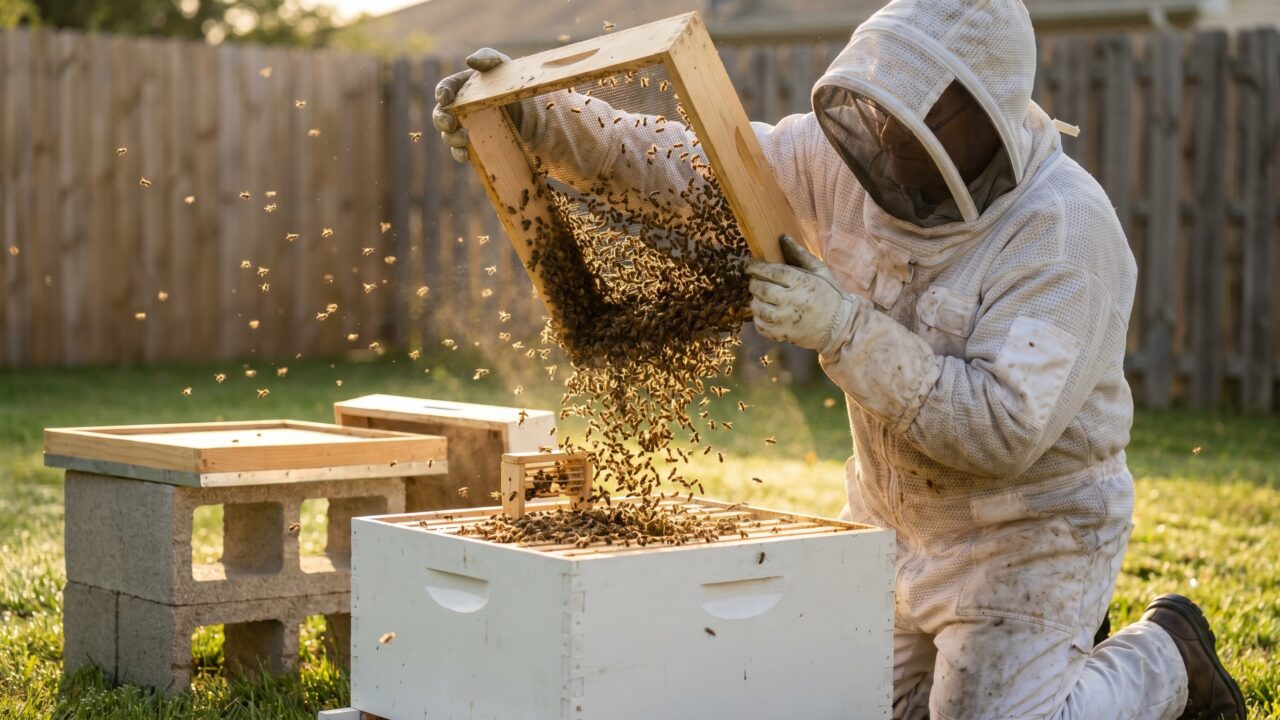
Your bees arrive as a buzzing box, and your job that first afternoon is simple: get the queen safely into the hive, shake the workers in around her, give them syrup, and then mostly leave them alone for several days while they accept her. That is the whole install. What follows over the next six weeks matters more than the install itself, because a new colony is not a working hive yet. It is a crowd of bees that has to build comb from scratch, raise its first brood, and grow before winter. This page walks you through both ways to start, package and nuc, and tells you what normal looks like week by week so you can tell calm progress from a real problem.
If you are still deciding what to buy, the trade-offs between loose bees and a small working hive are laid out in our look at package vs nuc, and the ordering and timing side sits in how to buy bees. This page assumes the box is on its way or already humming on your porch.
Package or nuc: what you are actually installing
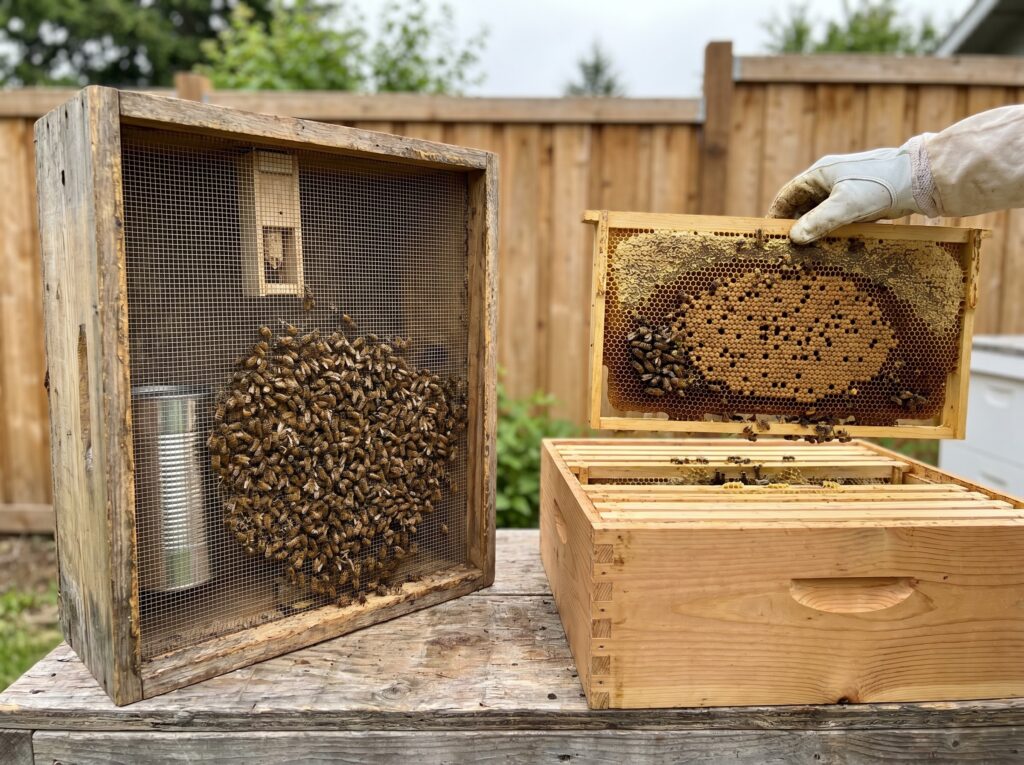
The two starts are genuinely different, and the difference shapes your whole first season. A package is loose bees with a separately caged queen who is not yet theirs. A nuc is a tiny working hive that already runs.
A 3-pound package holds roughly 10,000 to 12,000 worker bees and one mated queen in her own small cage, per NC State and Penn State Extension. Those bees have no comb, no brood, and no bond to the queen yet. They start at zero. A nuc, by Alabama Extension's description, is "five frames with a drawn-out comb, a laying queen, two frames of food stores, and two to three frames of brood." That colony is already laying eggs and rearing young on the day it reaches you.
Here is how the two compare on the things that decide your first six weeks.
| Factor | Package (3 lb) | Nuc (5 frames) |
|---|---|---|
| What is inside | ~10,000-12,000 loose workers + caged queen | Drawn comb, laying queen, brood, food, workers |
| Starting comb | None; draws it all year one | Five frames already drawn |
| Queen status on day one | Caged, not yet accepted | Already laying, already accepted |
| Typical price | About $140 to $200 | About $180 to $300 |
| How you get it | Local pickup or shipped | Local pickup only |
| Feeding need | More, for longer | Some, to settle in |
| Head start | None; build-up is slower | Builds up faster, roughly a several-week jump |
| Best for | Tight budget, learning the full cycle | Faster, calmer first season |
UF/IFAS Extension notes a package "can take longer to establish" because the bees are "starting with nothing," and that you "may have to feed package bees more, and for a longer period, than you would a nucleus colony." A nuc skips that gap. Alabama Extension puts the nuc's edge plainly: it "can provide a jump start on your colony's first year because it is already established and productive when it arrives." Neither start is wrong. A package teaches you the whole arc of a colony for less money. A nuc gives a beginner a gentler, faster first season. Most local clubs sell out of both by late winter, so a spring colony is a winter order, usually placed December through February for April pickup.
Install day, step by step
The mechanics differ by start, and each has its own full walkthrough: the loose-bee shake-in is covered in how to install a package of bees, and the frame transfer is in how to install a nuc. The short version of each is below so you know what the day feels like.
For a package, you suit up in the late afternoon, spray the bees lightly with 1:1 syrup so they cling instead of fly, and remove the feeder can. You pull the queen cage, check that she is alive, and pull the cork from the candy end (not the open end). You wedge her cage between two center frames, candy side up. Then you shake and pour the workers in around her, set the rest of the frames, add a feeder, and close up. NC State says not to worry if "a large number of bees flying around," since they are "largely 'confused' and therefore not defensive." The whole thing takes maybe 20 minutes.
For a nuc, you simply lift the five drawn frames out of the nuc box, bees and all, and set them into the center of your hive in the same order, then fill the outer slots with your empty frames. The queen is already loose and laying, so there is no cage to manage. Add a feeder and close up. It is faster and far less dramatic because the colony is intact.
Both starts get a feeder of 1:1 sugar syrup, mixed as NC State describes: "warm water with granulated sugar in a 1:1 ratio." A package needs that syrup steadily, because every drop of comb has to be built from wax the bees make from sugar. Feeding the right way through these weeks is its own topic, handled in feeding a new package.
The first six weeks, week by week
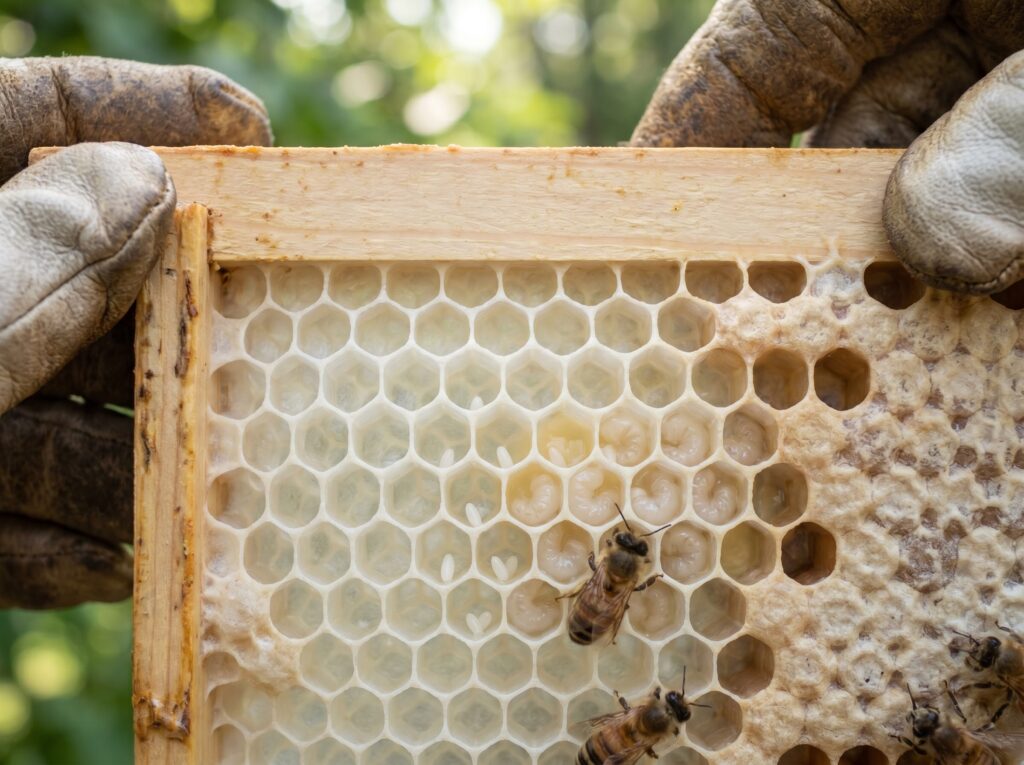
The single most useful skill in these weeks is reading whether the queen is laying and the colony is growing, without opening the box so often that you set them back. New beekeepers tend to peek every day out of nerves, and that does real harm: it chills brood, crushes bees, and rattles a colony that needs calm to build. The schedule below is the rhythm most extension services teach. Treat it as the floor, not a license to dig in more often.
| Stage | What you do | What is normal to see |
|---|---|---|
| Day of install | Install, feed 1:1 syrup, close up | Bees fanning, orienting, taking syrup by evening |
| Days 1-4 | Do not open. Refill syrup from outside only | Steady flight, pollen coming in, no piles of dead bees |
| Day 5 (package) | Quick check: is the queen out of her cage? | Empty queen cage, bees calm, comb starting |
| Day 5-7 (nuc) | Brief peek for eggs and comb on new frames | Eggs and young larvae, fresh white comb |
| Week 1-2 | Confirm a laying queen: eggs standing in cells | Tidy egg pattern, larvae, drawn comb spreading |
| Week 2-3 | Check comb progress and food; keep feeding | Capped brood appearing, several frames drawn |
| Week 3-4 | First new workers emerge (21-day cycle) | Population starts climbing, more foragers |
| Week 4-6 | Assess if a second box is near; first mite check | Most of a box drawn, solid brood, stores building |
A few of those rows deserve a closer look.
Days 1 to 4: hands off
Resist opening the hive. NC State and Penn State both say to leave a new package undisturbed for the first several days so the workers finish accepting the queen through the candy plug. Penn State times the slow release at "two to three days"; NC State says "within one or two days." Open too early and you risk an alarmed colony rejecting or balling her. Watch the entrance instead. Bees flying in and out, some carrying pollen on their legs, means the colony is settling and the queen is likely fine.
Day 5 to week 1: did the queen make it
The first real inspection answers one question: is there a laying queen? NC State sets it at "5 days after installing the package," to confirm the queen is "alive and has been released." For a package, an empty queen cage is the first good sign. Then you look for eggs. A fresh egg stands straight up on the cell floor like a tiny grain of rice, then leans over by about day three before it hatches. Eggs standing upright, then, mean the queen laid within roughly the last three days. That is the proof you want. Penn State expects "evidence of a prolific queen" with "eggs in the cells" about a week after release. If a week passes with no eggs and no sign of a queen, the colony may be queenless, and the move is to order a replacement promptly. Spotting that early is the heart of the first week after installing bees.
Week 3 to 6: the colony turns the corner
A worker bee takes 21 days from egg to adult. So the bees you installed are aging, and for the first three weeks the population actually drifts down before the queen's first daughters emerge. Around week three to four, that first wave of new workers hatches and the colony starts to grow for real. This is why patience pays. UF/IFAS notes it takes "at least a month before the colony is producing more bees." A nuc, already full of brood on arrival, rides through this dip with far less drama.
Mites: the threat you start watching for even in week one
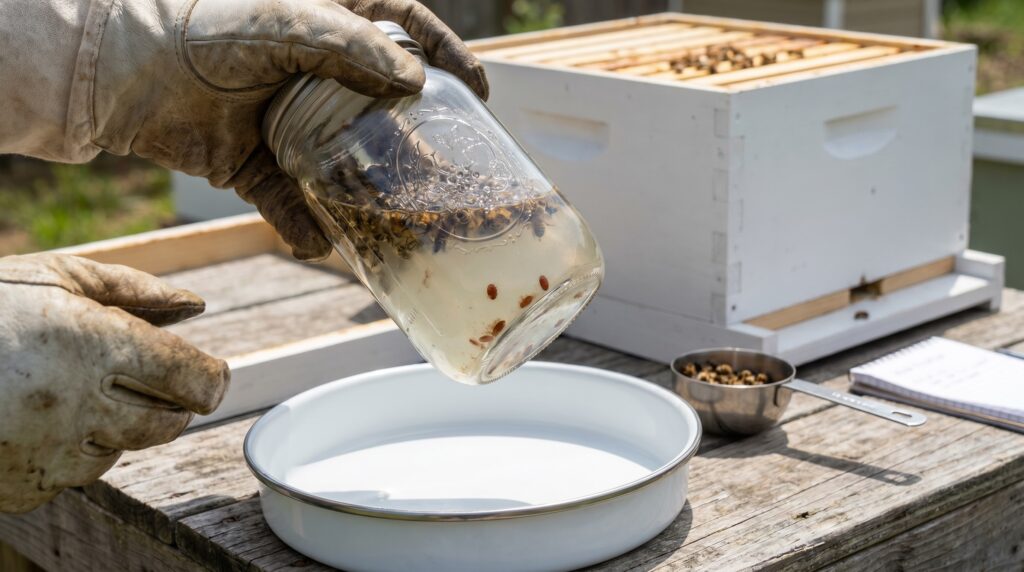
Varroa mites are the number one killer of US colonies, and a new colony is not exempt. Package and nuc bees can arrive carrying mites, and a nuc's brood frames can carry them in. You do not panic over this, but you also do not ignore it until fall. The Honey Bee Health Coalition's monitoring method is a roughly 300-bee sample, which they describe as "about [1/2] cup of lightly packed bees," washed in alcohol to count mites. Once you have a count, the current late-summer action threshold is about 2 mites per 100 bees, or 2 percent; that is the point where the Coalition says to step in. They warn that "losses can be expected even at a 3 percent infestation," so you act at two rather than wait to drift up to three.
For a brand-new colony, the practical move is a baseline mite check once you have enough bees to sample, usually around week four to six, and then to follow a monitoring schedule into late summer. The most important knockdown for any colony comes in late summer, before the long-lived winter bees are reared, because those winter bees must be as clean as possible to carry the hive through. The how-to of sampling lives in the first six weeks timeline, which folds your mite baseline into the same calendar as queen checks and feeding. Any treatment is always applied strictly per the product label; chemical choices and dosing belong to the Honey Bee Health Coalition's guide and your state apiary program, never to guesswork.
What a realistic first year looks like
Set expectations now and you will enjoy the year more. A new colony spends year one building, not producing. A package draws all of its comb from scratch, and Alabama Extension is direct that "any honey produced is typically left for the bee's winter stores instead of being extracted for the beekeeper." Expect roughly zero to 20 pounds of harvestable honey in year one, and often zero. An established hive in a good year makes about 30 to 60 pounds, but that is a year-two-and-beyond number.
Plan for loss, too. Recent US surveys are sobering: the 2024-2025 Apiary Inspectors of America survey put overall colony loss at 55.6 percent, with backyard beekeepers at 51.4 percent. A lot of those deaths trace back to varroa, and to colonies that went into winter too small or too light on stores. None of that is a reason to quit before you start. It is the reason to feed a new colony well, monitor mites, and not rush a harvest. Build the colony first, and the honey follows in later seasons.
Common first-install mistakes
- Opening the hive every day. The biggest beginner error. Calm and warmth let comb and brood develop; constant disturbance sets them back.
- Pulling the wrong cork. On the queen cage, remove the cork from the candy end for a slow release, not the open end, which would free her instantly into a colony that has not accepted her.
- Letting the feeder run dry. A package has no stored food and cannot draw comb without sugar. Keep 1:1 syrup on it until natural nectar flows.
- Panicking on day two over flying bees. Orienting and confused bees are not angry bees. Judge the colony by eggs and comb, not by buzz.
- Ignoring mites because the colony is new. A baseline check in the first weeks beats discovering a heavy load in August.
- Expecting honey in year one. The first season is for building the colony. Treat any surplus as the bees' winter food.
When you are unsure whether what you see is normal or a warning sign, the judgment calls are gathered in the first six weeks timeline, which is the calendar this whole page hangs on.
Questions answered
The queen was already out of her cage when I opened the box. Is that bad?
It can happen if the candy released early or the cage popped open in transit, and it is not automatically a disaster. The risk is that loose workers who have not yet accepted her may ball her. If she is already walking on the frames and the bees are calm and not clustered tightly on her, close up gently and leave them alone for a week, then check for eggs. If you find her dead or the bees are aggressively balling her, contact your supplier, since many replace a queen lost on arrival.
My package has a handful of dead bees on the bottom board. Is that normal?
A thin layer of dead bees, anywhere from a few dozen up to roughly an inch deep across the screen, is normal after the stress of shipping and install. Bees die of old age constantly, and a package has no nurse bees to haul them out yet. Worry only if you see a deep pile of hundreds, a sour or chemical smell, or the survivors crawling and trembling rather than flying, which can point to a bad batch or a pesticide hit. Otherwise, scrape the dead bees off and carry on.
Do I take the empty queen cage out, and when?
Yes, remove it at your first inspection once the queen is released, usually the day-five check on a package. Leaving it in wastes a slot and the bees may build burr comb on it. Before you pull it, glance inside to confirm it is empty and she is not stuck. Set the freed-up space back to a proper frame so the colony has full comb-building room.
It is cold or raining on install day. Should I wait?
Install anyway if the bees have already arrived; they fare worse cooped up in the package than in a hive. Pick the warmest, calmest part of the day, work fast, and skip the leisurely frame-by-frame look. Light rain or temperatures in the 50s Fahrenheit are workable for a quick shake-in. Only postpone for an outright storm or hard freeze, and if you must hold the bees a day, keep the package cool, dark, and lightly misted with syrup.
Do I need to worry about mites in a brand-new colony?
Yes, eventually. New bees can carry varroa, and nuc brood frames can bring mites in. Do a baseline mite check once the colony is big enough to sample, around week four to six, then monitor into late summer. The critical treatment window is late summer, before winter bees are reared.
- NC State Extensionused for package contents, 1:1 syrup ratio, queen release timing, and the 5-day first inspection. https://content.ces.ncsu.edu/how-to-install-a-package-of-honey-bees
- Penn State Extensionused for package bee count, slow queen release over two to three days, and seeing eggs about a week after release. https://extension.psu.edu/installing-packaged-bees
- Alabama Cooperative Extension Systemused for nuc contents and head start, package comb-drawing year one, and first-year honey going to winter stores. https://www.aces.edu/blog/topics/bees-pollinators/establishing-a-honey-bee-colony/
- Honey Bee Health Coalition, Tools for Varroa Managementused for the 300-bee (about half-cup) monitoring sample and the late-summer action threshold of about 2 mites per 100 bees. https://honeybeehealthcoalition.org/wp-content/uploads/2022/08/HBHC-Guide_Varroa-Mgmt_8thEd-082422.pdf
- Apiary Inspectors of America / Auburn University US Beekeeping Surveyused for the 2024-2025 backyard (51.4%) and overall (55.6%) colony loss figures. https://apiaryinspectors.org/US-beekeeping-survey-24-25
- Mid-Atlantic Apiculture Research and Extension Consortium (MAAREC), University of Delaware Cooperative Extension, "The Colony and Its Organization"used for the egg-orientation timing (upright on day one, bending over during the 3-day development period). https://canr.udel.edu/maarec/honey-bee-biology/the-colony-and-its-organization/
- Supplier and regional club price lists (Lappe's Bee Supply, Harry's Honey Pot, SHoney Farm, Charlie Bee Company, Meyer Bees)used for the 2026 package price range ($140 to $200) and nuc price range ($180 to $300) in the comparison table. Prices are general guidance; regional variation is wide. https://lappesbeesupply.com/3-lb-package-honey-bees-with-italian-hybrid-queen