How to winterize a beehive: the checklist that keeps colonies alive
Get the complete winterizing checklist for beehives: mite timing, honey stores by region, ventilation, wind protection, and what actually kills colonies in winter.
Three things kill most winter colonies: a varroa load that built up unchecked in late summer, not enough honey to last until March, and moisture that drips onto a cluster too cold to dry off. Get those three right and the cold itself is rarely what kills the bees. This checklist works through each one in order, then covers the physical changes to the hive - reduced space, windbreak, upper ventilation - that lift a healthy colony's odds through the worst months.
One hard constraint governs everything: finish all inspections and heavy manipulation while daytime temperatures are still above 50F. According to Cornell's apiculture program, opening a colony in the cold is "at best stressful, and at worst, lethal." That 50F ceiling is your deadline, not just a preference.
Step one: varroa mites, timed around winter bee rearing
The fat-bodied "winter bees" reared in late summer are the bees that carry the colony from October to April. They are physiologically different from summer bees - higher stores of vitellogenin in their fat bodies, longer lifespans, different behavior. If they develop inside cells that already harbor mites, they emerge compromised: reduced immune function, shorter lives, and a cluster that shrinks too fast to hold its core temperature through a cold snap in February.
Research by master beekeeper Randy Oliver confirms that bees "infested as pupae do not fully develop physiological features typical of long-lived wintering bees." The damage is done before the bee hatches; no treatment applied in November can undo it. The treatment window to protect the winter cohort is July through mid-August in most of the northern US, which is why Cornell's program calls out a hard deadline: treating for the first time in September or October is "already too late."
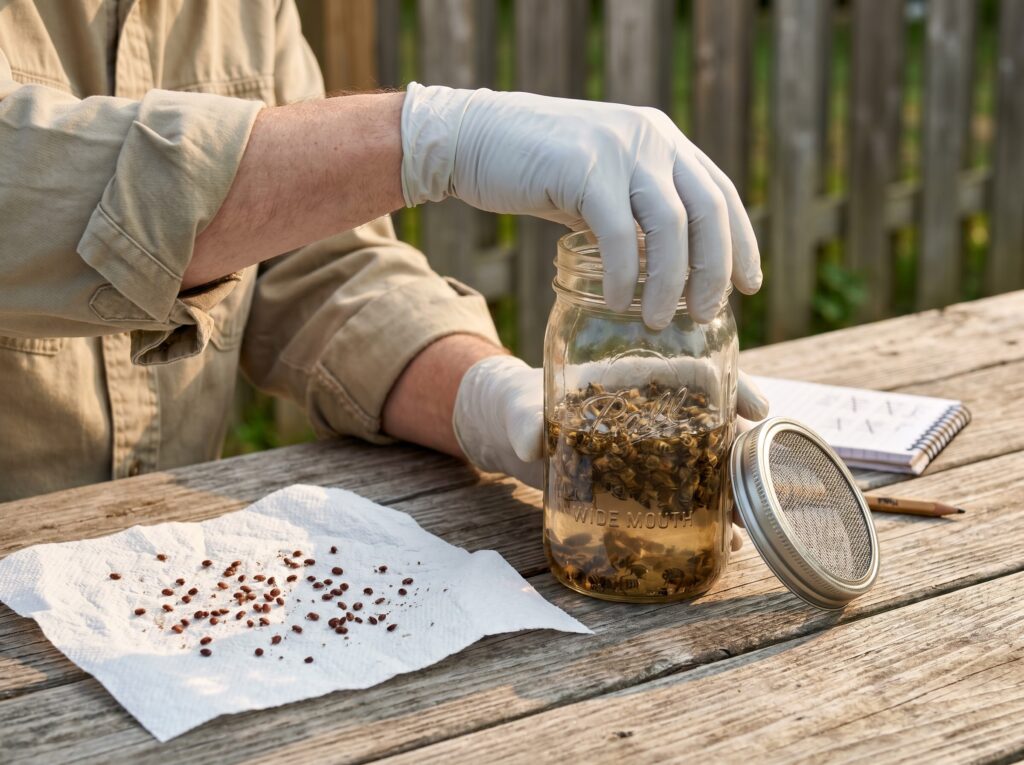
Run an alcohol wash on a roughly 300-bee (about half a cup) sample pulled from brood nest frames. Count the mites in the wash liquid, then divide by three to get your percentage per 100 bees. The Honey Bee Health Coalition's action threshold for late summer and fall is 2% - that is, 2 mites per 100 bees in an alcohol wash. Reach that number in late July or early August and treat the same week. A colony at 1.5% in August can hit 4% by October if untreated - mite populations expand as the bee population contracts heading into fall.
For treatment options while brood is still present: formic acid (Formic Pro) can be applied with honey supers on. NC State Extension guidance gives a temperature window of 50-79F for daily highs; the manufacturer label allows up to 85F, so if you are following extension guidance specifically, stay below 79F. NC State also notes that removal is required if temperatures exceed 82F in the first week. Amitraz strips (Apivar) also require supers off, but note that NC State Extension - the same source cited throughout this article for treatment guidance - states Apivar "has recently proven to be less effective" due to mite resistance and is "not being recommended as a treatment at this time." If you are considering Apivar, check current resistance data in your region before purchasing. NC State Extension research confirms that oxalic acid does not penetrate capped brood, so it "is best applied during a time of broodlessness" - making it well-suited to a mid-winter follow-up treatment rather than a first-line late-summer option. The treatment comparison guide covers application windows, temperature ranges, and PPE requirements for each.
A second mite check in September confirms whether the August treatment held. Colonies entering October above 3% face long odds, regardless of everything else you do correctly. Check the varroa thresholds guide for a full breakdown of monitoring timing and the numbers that trigger action at each season.
Honey stores: how much your hive actually needs
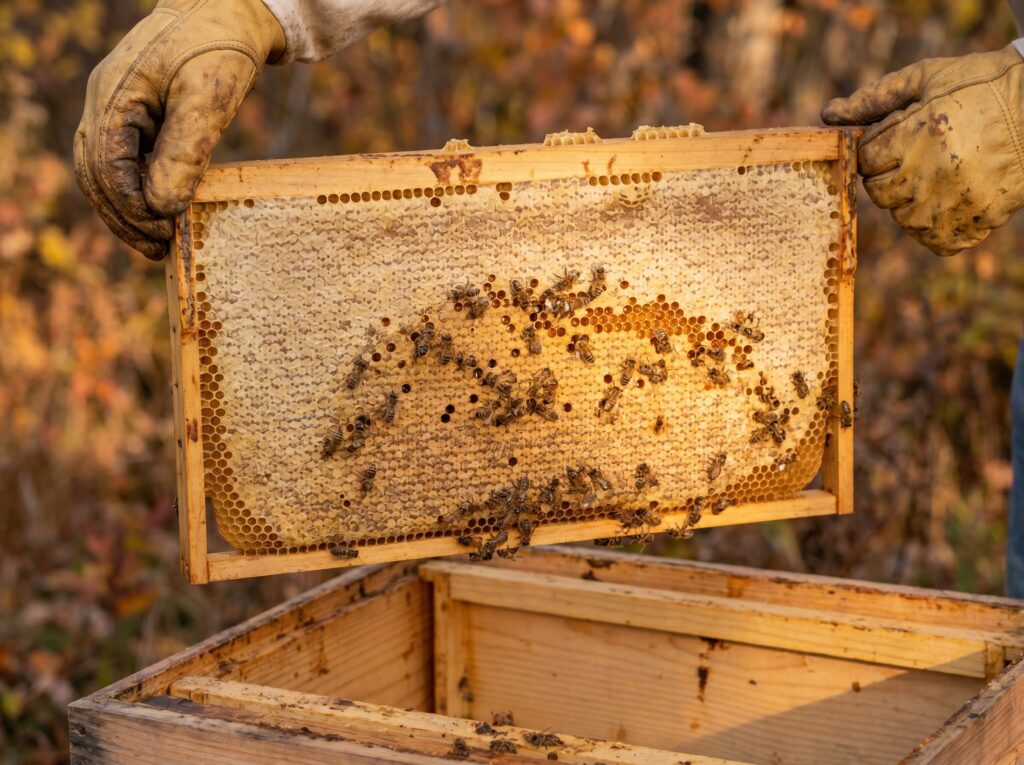
The right number varies by region. A two-deep colony in Minnesota burns through far more stores than one in central North Carolina because the cluster period is twice as long and the bees spend more energy thermoregulating against colder ambient temperatures. Cornell's guidance for cold-climate colonies is specific: leave at least one full deep box's worth of honey, which equals roughly 90-100 lb of total box weight including frames and bees. The ideal total hive weight - bees, furniture, and all stores combined across two boxes - is about 160 lb. UF/IFAS Extension puts the northern store target at about 90 lb of actual honey reserves.
The table below is a starting reference by region. Adjust upward for a hive in a particularly exposed location, or downward if the colony runs a consistent late fall flow in your area.
| Region / climate | Full colony (two-deep or equivalent) | Nuc or single-deep | Notes |
|---|---|---|---|
| Northern US (zones 3-5: MN, WI, ME, NY upstate, ND, MI UP) | 80-95 lb honey | 50+ lb | Cornell minimum: one full deep box (~90-100 lb total box weight including frames, bees, and honey); ideal total hive ~160 lb. UF/IFAS: ~90 lb pure honey reserves. Note: Cornell's 90-100 lb is total box weight, not honey alone; the 80 lb lower figure in this range represents the Cornell pure-honey minimum extracted from that total. |
| Mid-Atlantic / Midwest (zones 6-7: PA, OH, IN, MO, VA, southern WI) | 60-80 lb honey | 40-50 lb | Two-deep standard; heft the back of the hive to confirm weight in October. |
| Upper South / Mountains (zones 6b-7: NC mountains, TN, KY, WV) | 40-60 lb honey | 30-40 lb | Shorter cluster period; brood rearing may restart in late February. Reduce to single-deep where stores allow. |
| Deep South / Gulf Coast (zones 8-10: FL, coastal GA, LA, south TX) | 20-40 lb honey | 15-25 lb | Cluster breaks periodically; brood rearing may continue year-round. Mite management is the primary winter task. |
To estimate what you have, pull the outermost frames of each box and check the capped honey percentage. Fully capped deep frames weigh roughly 6-8 lb each. A faster field method: grip the bottom board at the back of the hive and heft it straight up. A properly stocked two-deep in the North should be heavy enough that you cannot raise the back edge more than a couple of inches with one hand. A hive that comes up easily is light and needs feeding.
If stores are short, fall is your last reliable syrup-feeding window. Use 2:1 sugar syrup (two parts granulated sugar by weight to one part water) rather than the 1:1 spring ratio. The heavier mix requires less energy for the bees to dehydrate and cap. Cornell's program documents the autumn penalty for thin syrup directly: bees "must expend energy to evaporate excess moisture" from 1:1 - the opposite of what a consolidating colony needs. Stop syrup when nighttime temperatures drop consistently below about 50F. At that point switch to fondant, a candy board, or dry sugar placed directly on top of the frames above the cluster if stores are still marginal. The feeding bees for winter guide covers timing by climate zone, and winter feeding with fondant explains the board setup.
Ventilation and moisture: the kill mechanism most beginners miss
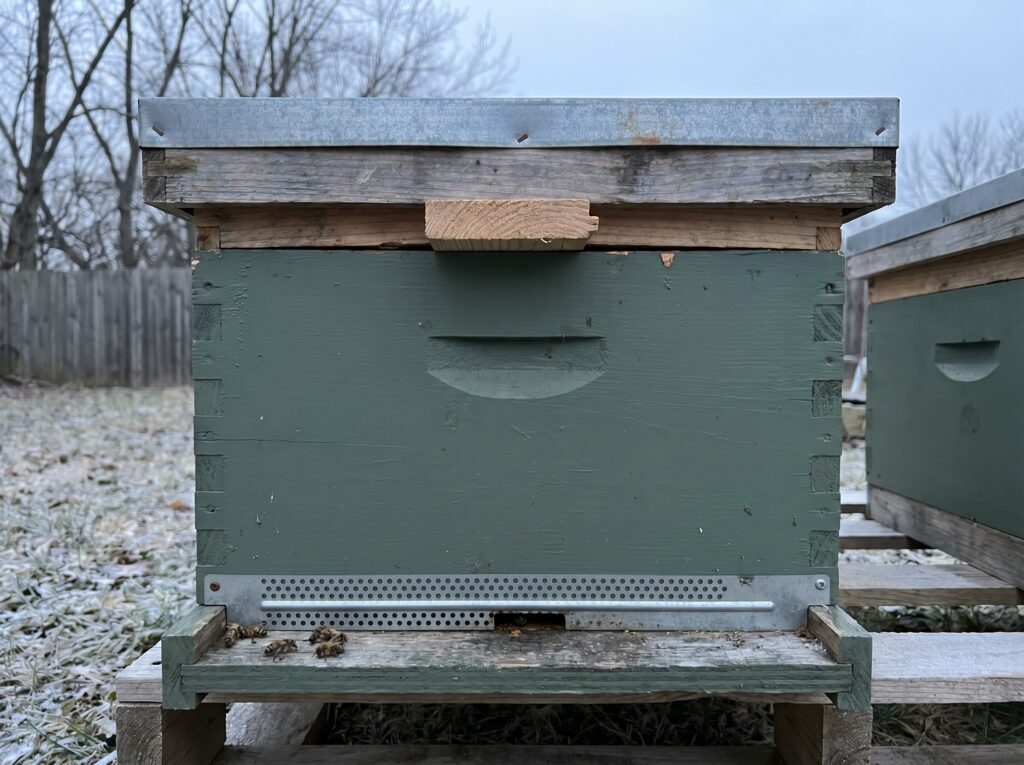
A winter cluster of 10,000-15,000 bees generates a continuous stream of water vapor as they metabolize honey to stay warm. Scientific Beekeeping's research into cluster thermodynamics shows that a colony burning through just a third of a pound of honey per day produces close to half a cup of water vapor in the process. That vapor rises, hits the cold underside of the inner cover or outer lid, condenses into liquid, and drips back down onto the cluster. Cold water on clustered bees in January is almost always fatal - not because of the water temperature, but because wet bees cannot maintain the 95F core the cluster needs.
Cornell's apiculture program lists ventilation as "critical to survival of overwintering bees" and quotes the consequence of getting it wrong plainly: "cold water then drips back down onto the bees. Wet bees in cold weather will soon be dead bees."
The fix requires three things:
- An upper entrance or vent. A notched inner cover, a thin shim between the inner cover and the telescoping lid, or a drilled hole in the upper hive body gives warm moist air an escape route before it condenses. The lower entrance alone is insufficient because cold air settles and the cluster itself blocks upward convection through the bottom. The detailed comparison of insulation materials and quilt-box options is in the hive insulation and condensation guide.
- A moisture-absorbing layer above the cluster. A slab of Homasote board, a pillowcase stuffed with dry wood shavings, or a purpose-made quilt box placed above the inner cover intercepts moisture before it reaches the cold lid. This is most important in climates where the cluster is confined for weeks without a break in temperature.
- A forward tilt. Setting the hive with the entrance side a half-inch to one inch lower than the back lets any condensation that does form drain toward the bottom entrance rather than pooling directly above the cluster.
Keep the lower entrance clear through winter as well. Dead bees accumulate at the entrance throughout the cold months. A blocked entrance stops airflow and can suffocate the colony; a slim stick run through the opening monthly clears the blockage without requiring you to open the hive.
One thing you almost certainly do not need in the mid-Atlantic and transitional zones is heavy foam wrapping. Insulation reduces temperature swings and may lower the colony's thermoregulation energy costs slightly, but it does nothing about moisture and can worsen it by reducing air exchange. In the deep-cold North - Minnesota, northern Wisconsin, northern Maine - most experienced beekeepers wrap with roofing paper primarily to cut wind, not to add R-value. The upper vent stays open regardless of whether the hive is wrapped.
Reducing the hive and blocking wind
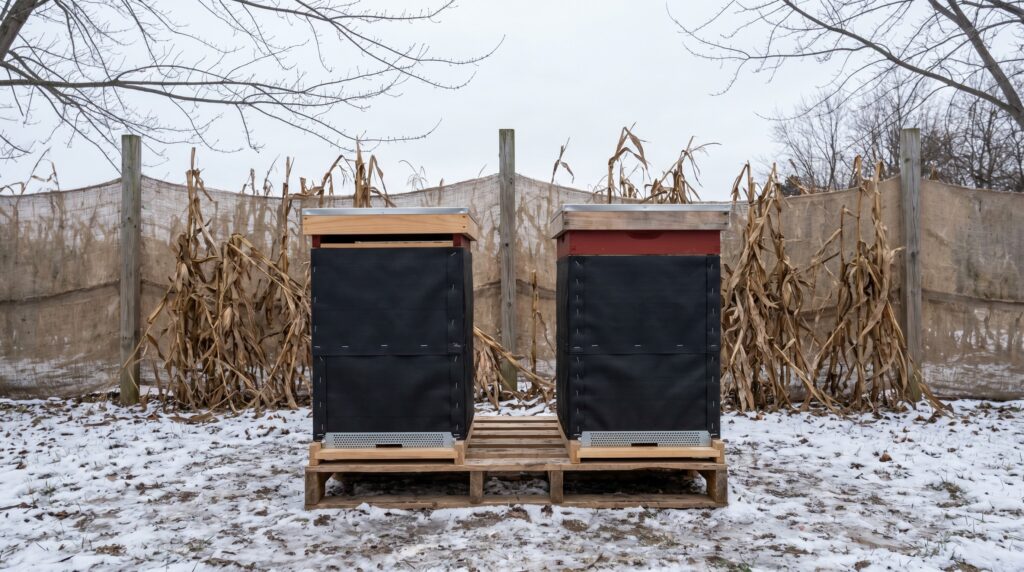
The physical setup changes in fall follow a simple principle: a smaller space is easier for a reduced winter population to heat and defend.
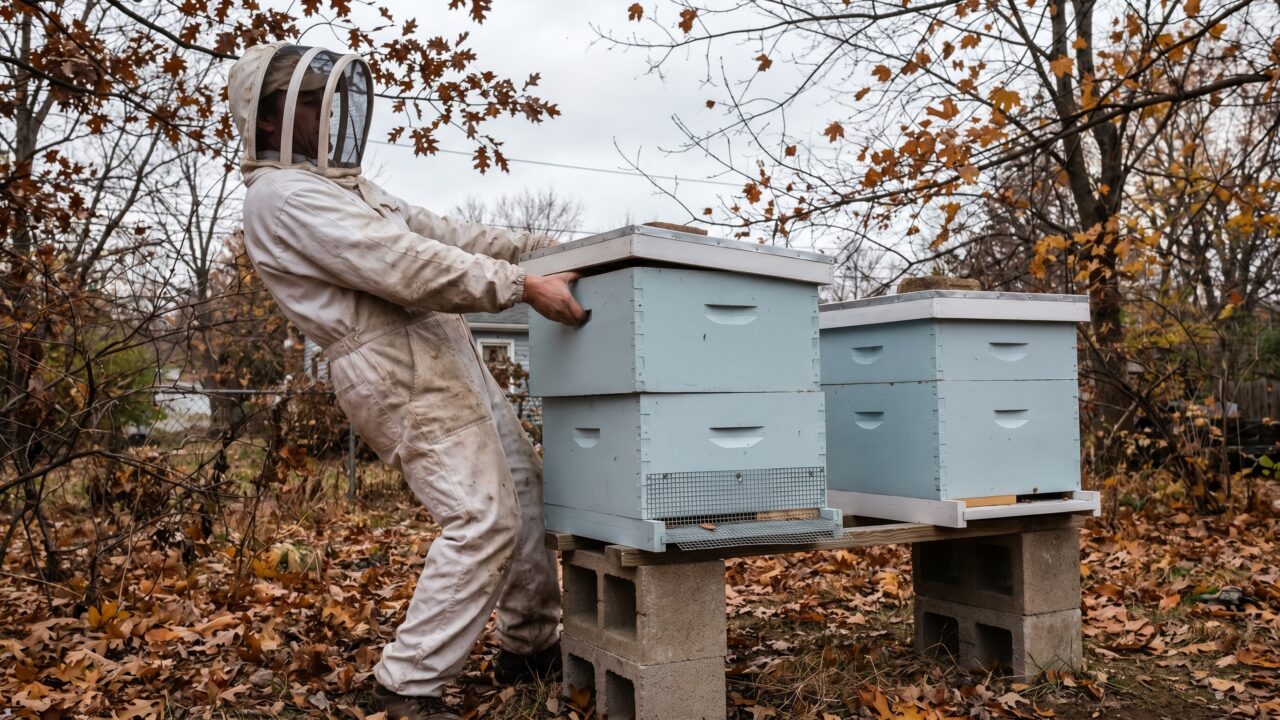
Remove supers and the queen excluder. Every honey super from the summer season comes off before winter. The queen excluder comes off too. A cluster that moves slowly upward through the cold months cannot cross a metal barrier; a queen trapped below the cluster body in January will die of cold before the cluster can reach her. Stack only what the bees need: two deeps in cold climates, a deep and a medium in moderate ones.
Install a mouse guard. Mice can fit through a 3/8-inch opening, and a standard Langstroth entrance is far wider than that. Hardware cloth mouse guards, available from any beekeeping supplier, should go in during September or October when nighttime temperatures first drop consistently. A hive that winters a mouse family loses frames and comb and sometimes the cluster itself.
Use an entrance reducer. A mouse guard handles rodents; an entrance reducer also narrows the space the bees must defend against robbing and reduces drafts entering at the front. Set it to the narrowest slot for winter.
Establish a windbreak. Wind is a significant energy drain on the winter cluster. A windbreak of 40-60% density breaks the airflow without creating strong downward turbulence on the downwind side, and according to Cornell, effective protection extends up to 30 times the windbreak height on the lee side. A modest row of evergreen shrubs or stacked straw bales positioned north and northwest of the apiary accomplishes real work. Point the hive entrance away from the prevailing wind direction. Where no natural windbreak exists, a sheet of plywood or burlap-covered snow fencing works through a single season. Detailed guidance on materials and sizing, including whether wrapping makes sense for your zone, is in the hive wraps guide.
Regional calibration: what shifts by where you live
The steps above apply everywhere. What changes by region is the timing, the emphasis, and one or two physical choices. The full month-by-month task calendar for all four seasons is at beekeeping month by month.
| Region | Priority emphasis | Wrap / insulate? | Last reliable syrup window | Varroa treatment deadline |
|---|---|---|---|---|
| Northern US (zones 3-5) | Maximum stores; moisture management; windbreak; quilt box | Yes - roofing paper or commercial wrap for wind | Late September | Early August (first treatment); September (second if needed) |
| Mid-Atlantic / Midwest (zones 6-7) | Stores at 60-80 lb; ventilation; mouse guard; windbreak | Optional - wind reduction only | Mid-October | Mid-August through September |
| Upper South / Mountain (zones 6b-7) | Stores at 40-60 lb; mite control; mouse guard | Probably not | October - early November | September through early October |
| Deep South / Gulf (zones 8-10) | Mite management year-round; verify brood activity; light stores | No | Syrup available most of winter in mild years | Monitor year-round; treat on threshold |
What actually kills winter colonies - and how to avoid it
Backyard beekeepers in the 2024-2025 national survey lost an estimated 51.4% of colonies over the full year, with winter losses alone running 36.5% (Apiary Inspectors of America). Those numbers are not a fixed tax on the hobby. They reflect what goes wrong when preparation is incomplete, and three causes account for the large majority of losses.
Varroa-damaged winter bees are the leading factor. A colony entering October with a mite count above 3% per 100 bees has been rearing winter bees with suppressed immune function since August. The cluster shrinks too quickly, loses its ability to maintain core temperature, and either starves or collapses before the first warm days of spring. This is the one outcome that cannot be remedied after the fact; it can only be prevented by an on-time late-summer treatment.
Starvation with honey present is less obvious than it sounds. Colonies die with capped honey in the hive when the cluster cannot move laterally fast enough during an extended cold snap to reach the next full frame. The cluster contracts in severe cold and travels slowly - an inch or two per hour at most. A hive configured with a large empty space between the cluster starting position and the nearest honey, or with stores pushed too far to the sides, starves an inch from its food. Pack stores tightly above and immediately beside where the cluster will form: the center of the lower box in a two-deep configuration, with the upper box full of capped honey above it. This is the configuration rationale behind the overwintering guide - getting the box geometry right before the cluster sets in October.
Condensation drip is the one that surprises new beekeepers most. A dry, cold night kills almost no healthy clustered bees - the cluster is an efficient heat generator. A wet night at the same temperature can collapse the cluster within days. The ventilation steps described earlier address this directly. If you take nothing else from this checklist, take the upper vent: it costs a shim and five minutes, and it is more protective than any amount of wrapping.
Bears, skunks, and mice cause real losses in rural areas, but they are secondary to the three above. The preparing-bees-for-winter checklist pulls every item on this page into a single printed reference you can run through hive by hive before the first hard frost.
Checking in through the winter months
Winterizing is not a one-time event. Check the lower entrance monthly to clear dead bee blockages. After any extended cold snap - five or more days below 20F - heft the back of the hive. A hive that suddenly feels lighter than it did in October may be burning through stores faster than expected; add a candy board or fondant on top of the frames immediately without opening the hive.
When daytime temps reach the mid-50s reliably in late winter - February in the South, April or later across the upper Midwest and North - do a quick visual inspection by pulling a top bar. Finding bees clustered near the top of the upper box means they moved all the way up, which often signals the bottom box is empty. Finding silence on a stethoscope pressed to the hive body is the other outcome. Either way, you need to know early. A dead-out discovered in early spring can be cleaned and set up for a new package in April; one left unattended until May hands wax moths and small hive beetles six weeks they did not need.
Questions answered
When is it too late to winterize a beehive?
Once daytime temperatures drop consistently below 50F, you cannot safely open the hive for inspection or heavy manipulation. The mite treatment window for protecting winter bees is effectively closed by late September in northern climates - the winter bee cohort is already reared, and their health was set during August. External adjustments (fondant through the top, clearing the entrance, windbreak placement) remain possible at any temperature.
Do I need to feed my bees before winter?
Only if stores are below the regional minimums. A well-stocked hive with full frames of capped honey does not need supplemental feeding. Adding syrup to a hive that is already at 80 lb introduces excess moisture the bees must work to evaporate. Check actual frame weight; if the hive is light, feed 2:1 syrup until the stores are adequate, then stop. Use fondant or a candy board once nighttime temperatures are consistently below 50F and syrup can no longer be processed efficiently.
Should I insulate or wrap my hive?
In zones 3-5, most experienced beekeepers wrap with roofing paper or a commercial hive wrap primarily to cut wind. In zones 6 and warmer, a good windbreak and proper ventilation accomplish the same goals without wrapping. Heavy foam insulation can trap moisture if ventilation is not simultaneously addressed - and in moderate climates, the moisture risk exceeds the thermal benefit. The upper vent is the higher priority in every region and every climate.
Can I treat for varroa in November or December?
Oxalic acid treatment during the broodless period - typically November through January in most of the US - is effective and well-tolerated by the cluster. NC State Extension confirms that oxalic acid is best applied when broodless because it cannot reach mites under capped brood. It is a useful follow-up check if the late-summer treatment was marginal. What it cannot do is repair the winter bees reared in August and September; those bees are already in the cluster, and their physiological condition was determined when they developed as pupae.
How do I know if my hive survived the winter without opening it?
On a calm day above 50F, stand quietly near the entrance and watch for flight activity. On cold days when bees are not flying, press a stethoscope or your ear against the hive body and tap gently. A healthy cluster will often produce an audible buzzing response, though the technique works best when temperatures are above freezing - in deep cold (below 20F), the cluster may be in a tight, quiet torpor and a weak or absent response is not always a reliable death signal. Silence on a above-freezing day after tapping is a stronger indicator that the colony did not make it. A second signal: a hive that felt heavy in October and now lifts easily in February is in trouble whether you hear buzzing or not - the stores may be gone even if bees remain.
- Cornell CALS Pollinator Network"Overwintering" - used for honey store requirements (90-100 lb minimum full colony; 50 lb nuc; ideal 160 lb total hive), ventilation as "critical to survival," the condensation-drip mortality mechanism, the varroa treatment deadline quote, fall syrup ratio guidance, and windbreak density figures. https://cals.cornell.edu/pollinator-network/beekeeping/overwintering
- NC State Extension"Managing Varroa Mites in Honey Bee Colonies" - used for oxalic acid mechanism (does not penetrate capped brood; most effective broodless; winter is ideal application timing); Formic Pro temperature window (daily highs 50-79F per NC State; removal above 82F in first week); and Apivar resistance caveat (not currently recommended by NC State due to reduced effectiveness). https://content.ces.ncsu.edu/managing-varroa-mites-in-honey-bee-colonies
- Honey Bee Health Coalition"Tools for Varroa Management" (8th edition, 2022); VarroaVault HBHC 2026 guidelines summary - used for the 2% action threshold (2 mites per 100 bees) in late summer and fall to protect the winter bee cohort, and the monitoring protocol of an alcohol wash on a ~300-bee sample. https://honeybeehealthcoalition.org/varroa/ and https://varroavault.com/honey-bee-health-coalition-varroa-guidelines
- UF/IFAS Extension"Overwintering Honey Bee Colonies in Northern Climates" (publication IN1006) - used for northern honey reserve target (~90 lb), winter cluster population thresholds (25,000-30,000 bees adequate; fewer than 15,000 unlikely to survive freezing), and cluster behavior. https://ask.ifas.ufl.edu/publication/IN1006
- Apiary Inspectors of America"2024-2025 Survey Results" - used for backyard beekeeper annual loss rate (51.4%) and winter loss rate (36.5%). https://apiaryinspectors.org/US-beekeeping-survey-24-25