8-frame vs 10-frame Langstroth: weight, capacity, and which one fits your backyard
Side-by-side comparison of 8-frame and 10-frame Langstroth hives for backyard beekeepers: weights, capacity, standardization, and how to decide. (~157 chars)
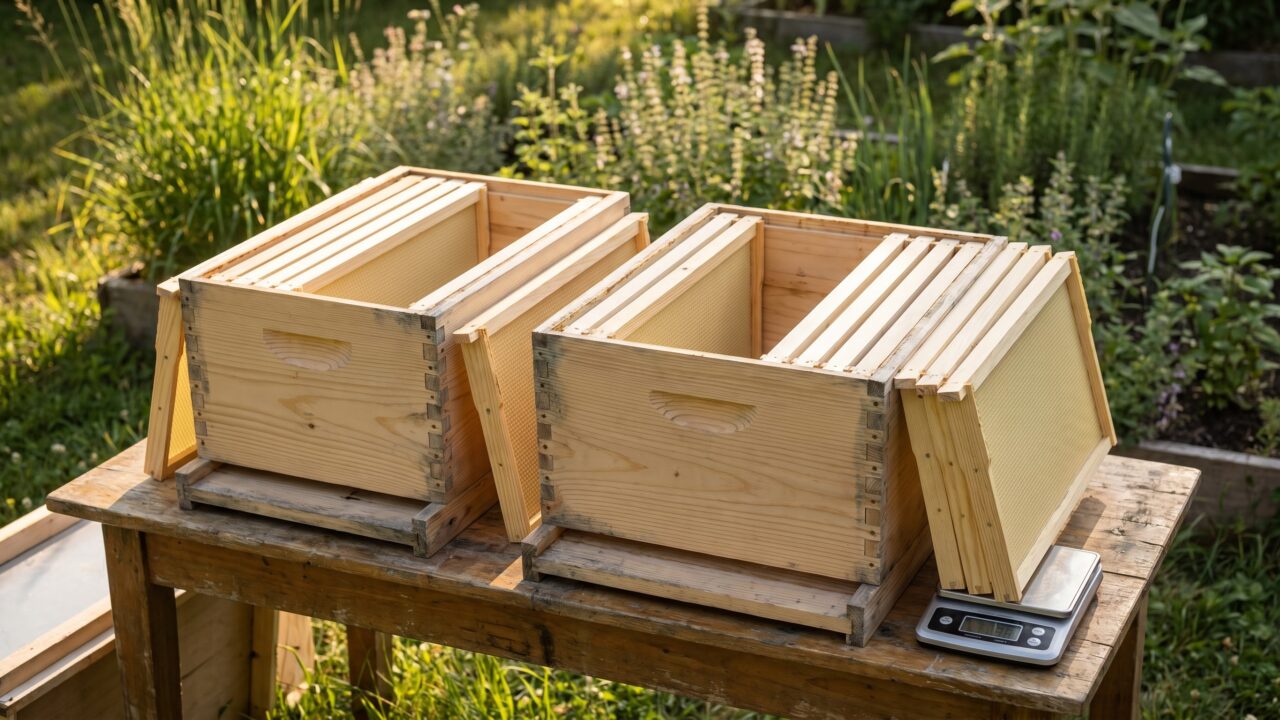
Pick up a full 10-frame deep box packed with capped honey and you are holding somewhere north of 60 pounds, roughly the weight of a first-grader. That single lift is often what sends a new beekeeper toward the 8-frame question. Both configurations run on the same Langstroth principle (frames hanging in a box, bee space everywhere), and bees will work either one without complaint. The difference comes down to what YOU handle every time you open the hive: a wider, heavier box, or a narrower, lighter one that asks you to stack more of them.
If you are brand new, the Langstroth hive is the right starting point regardless of frame count. The 8 vs 10 choice is a secondary decision about ergonomics, equipment supply, and how many boxes you want to manage. Neither format is wrong. Both have real costs you should weigh before you order.
How the two formats actually differ
The internal frame dimensions are identical. A deep frame is 9⅛ inches tall and 19 inches long whether it sits in an 8-frame box or a 10-frame box. The only physical difference between the two box sizes is width. A standard 10-frame deep body is roughly 16¼ inches wide on the outside; the 8-frame version is roughly 14 inches wide. That 2¼-inch difference in width is where all the weight and capacity math lives.
Interior volume tells the story precisely. According to standardized Langstroth dimensions, a 10-frame deep body holds approximately 42.75 liters of interior space; an 8-frame deep holds approximately 35.50 liters. The 10-frame box carries about 20% more volume per tier. That gap compounds as you add boxes for honey supers.
MAAREC (the Mid-Atlantic Apiculture Research and Extension Consortium) is clear on the weight consequence: a full-depth hive body filled with honey "weighs over 60 pounds and is heavy to handle." Experienced beekeepers routinely report a full 10-frame deep reaching 80 pounds or more at peak honey load. The 8-frame equivalent comes in at approximately 64 lb when full, a figure consistent across commercial suppliers and community data from GloryBee, Dadant, and honestbeeltd.com. Still heavy, but meaningfully below what most people consider a true two-person lift.
The table below lays out the comparison across the three standard box depths at both frame counts. Weights are approximate loaded figures for honey supers; brood boxes weigh less because brood is lighter than capped honey.
| Box depth | 10-frame (full of honey, approx.) | 8-frame (full of honey, approx.) | Difference | Interior volume (10-fr vs 8-fr) |
|---|---|---|---|---|
| Deep (9⅝ in) | ~80 lb | ~64 lb | ~16 lb | 42.75 L vs 35.50 L |
| Medium (6⅝ in) | ~50-55 lb | ~40-45 lb | ~10 lb | ~30 L vs ~25 L |
| Shallow (5 11/16 in) | ~35-40 lb | ~28-32 lb | ~7-8 lb | ~24 L vs ~20 L |
Note: deep-box figures reflect maximum honey fill; a brood-heavy deep runs 35 to 50 pounds. The shallow-box MAAREC figure of "about 35 pounds when filled with honey" refers to the 10-frame version.
The capacity trade-off you actually live with
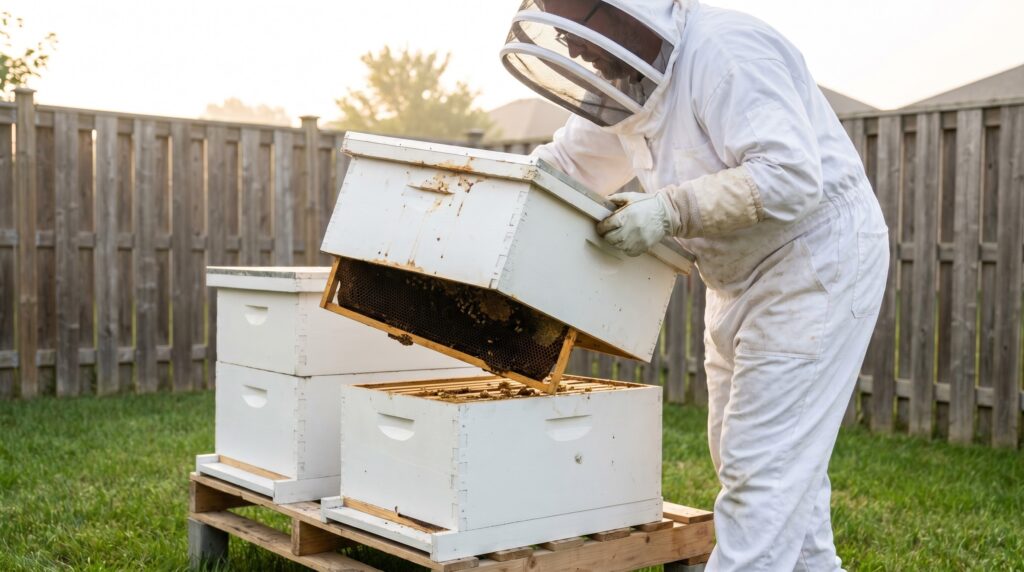
Because each 8-frame box holds roughly 20% less space, a colony that would fill two 10-frame deeps for a brood nest may need two and a half (effectively three) 8-frame boxes to reach comparable brood volume. Same principle applies to honey supers. More boxes means more hive bodies to buy, more propolis-sealed joints to break apart during inspections, and a taller overall stack.
A tall 8-frame stack can become genuinely awkward. If you are pulling a fourth or fifth box during a nectar flow, your reach extends well above shoulder height. A step stool is not unusual with 8-frame setups during peak season. The 10-frame colony, running two deeps and a couple of medium supers, stays lower. For beekeepers with shoulder problems or limited mobility, the lighter individual box often wins against the taller total stack. For anyone managing more than three or four hives in a single yard, the math tilts back toward the 10-frame format's fewer boxes per colony.
Bees do not care about frame count in any meaningful way. They will fill whatever space you give them, working inward from the outside frames. The colony's size, genetics, and forage availability drive production far more than whether there are eight or ten frames per tier. If you are worried the 10-frame format wastes space, consider that a strong colony at peak summer can easily fill all ten frames in a super within a good flow. The concern about "unused frames" is more relevant in weak early-season colonies or in shorter nectar seasons, a conversation that leads into box depth choices as much as frame count.
The standardization problem, and why it matters more than it sounds
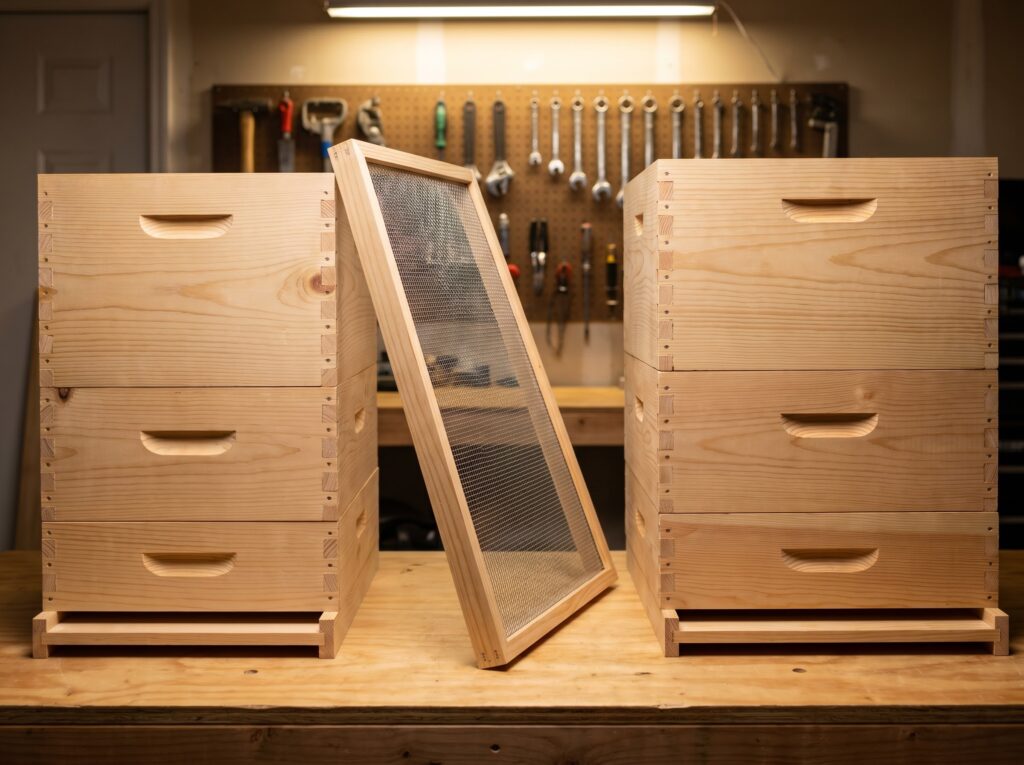
Ten-frame equipment has been the US standard for well over a century. MAAREC puts it directly: "today most beekeepers use the Langstroth or modern ten-frame hive." That market dominance has practical consequences when you are building out an apiary.
When you buy used equipment from a retiring beekeeper, borrow a frame feeder from your local club, or pick up an extra bottom board at a farm store, you are almost certainly looking at 10-frame gear. Accessories (top feeders, queen excluders, pollen traps, entrance reducers with specific slot widths) are designed around the 10-frame footprint first. Eight-frame versions exist from the major suppliers (Mann Lake, Dadant, Betterbee all carry them), but the selection is narrower and the used-equipment pool is thinner.
Mann Lake's product pages include a plain compatibility warning: "8 frame equipment is narrower than 10 frame, and not always compatible with other 8 frame equipment as dimensions vary slightly by manufacturers." That last clause is the hidden catch. Ten-frame wooden boxes from different manufacturers generally stack and fit together because the standard has been stable so long. Eight-frame boxes from Betterbee and 8-frame boxes from a different supplier may not be perfectly interchangeable. If you go 8-frame, buy everything from one source.
This standardization gap also affects mentorship. Most beginner starter kits are built around 10-frame equipment. If your local beekeeping club runs demonstration hives or lends out equipment, those will almost certainly be 10-frame. Working alongside a mentor on a different format adds a small but real friction. You cannot borrow a quick brood frame to verify what laying looks like if your frame size does not match.
Which setup fits a two- or three-hive backyard operation
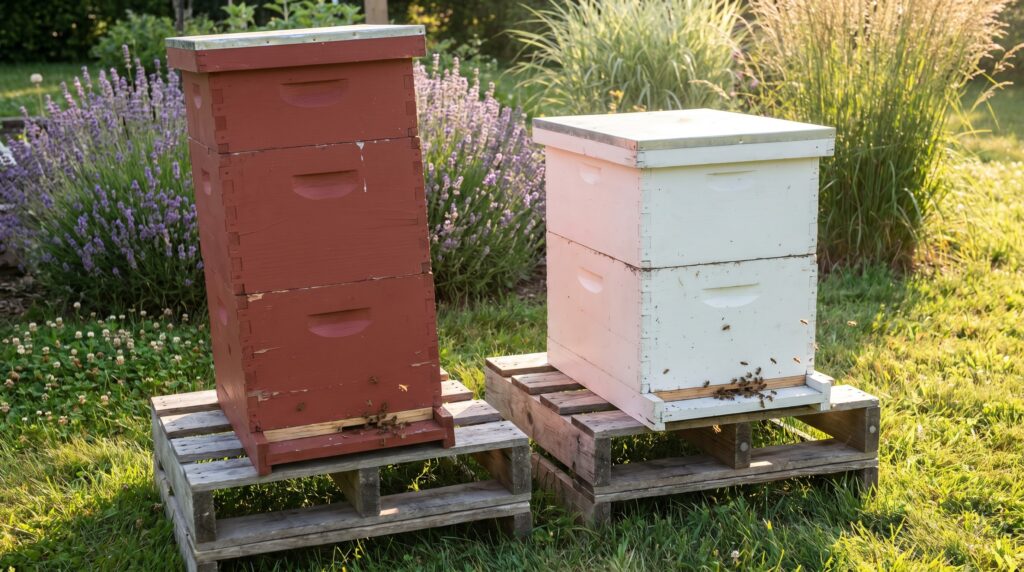
Most backyard beekeepers in the US run two or three colonies, consistent with Apiary Inspectors of America survey data showing the majority of respondents keeping fewer than five hives. At that scale, both formats are fully manageable. The honest verdict depends on three things: your physical situation, your supply chain, and whether you plan to expand.
Choose 8-frame if lifting matters. Back trouble, shoulder surgery, or a physical condition that makes a 60-plus-pound lift risky are legitimate reasons to start there. Lighter boxes mean you are more likely to actually inspect on schedule, and consistent inspection is the single most important management habit. A hive that gets inspected every 10 days by someone running 8-frame gear is better off than one inspected sporadically because the beekeeper dreads the weight. The 8-frame format also suits gardeners who want a compact hive footprint in a tight yard, since the box base is approximately 45 square inches smaller than the 10-frame equivalent (standard exterior dimensions: roughly 14 in x 19 7/8 in for the 8-frame vs 16¼ in x 19 7/8 in for the 10-frame).
Choose 10-frame if you want the path of least resistance on everything else. Equipment is everywhere, mentors know it, used gear is cheap, and you will never wonder whether a borrowed item fits. The extra 10 to 15 pounds per box is real, but many beekeepers manage it comfortably by using medium supers for honey rather than deeps, which keeps honey-super lifts in the 50-pound range rather than the 80-pound range. That approach is worth reading about separately in the context of deep vs medium boxes.
One choice to make before you order anything: the two formats are not compatible with each other. A 10-frame cover does not fit an 8-frame box. You cannot borrow a 10-frame super and set it on an 8-frame brood box. Whatever you pick, stay with it across your entire apiary. Mixing formats creates exactly the kind of accessory and replacement headache that frustrates beekeepers in year two and three.
A practical decision guide
Run through these four checks before placing your first equipment order. Your answers will point you to one format more clearly than any general recommendation can.
- Can you safely lift 60 to 80 lb from waist height? If yes with confidence, 10-frame works fine. If no, or if the answer might change in the next five years, 8-frame is worth the trade-offs.
- Are you buying new or used? New equipment is available in both formats from major suppliers. Used equipment is predominantly 10-frame. If budget matters and you plan to grow the apiary with secondhand boxes, 10-frame gives you far more options.
- Do you have a mentor or club? Most clubs demonstrate on 10-frame hives. Learning on the same format you use at home makes it easier to apply what you see. If your mentor runs 8-frame, match that instead.
- How many hives do you plan to keep? Two or three hives over the long term: either works. A dozen or more in a serious hobbyist setup: 10-frame reduces the total box count and keeps stack heights manageable. Commercial operations are almost universally 10-frame for exactly this reason.
The beginner overview covers all the equipment categories that come before this decision. The hive-type comparison is worth reading if you are still deciding between a Langstroth and a top-bar or Warré design; those are a different class of choice than 8 vs 10 frame.
Whatever format you choose, run your first full season before second-guessing it. Most beekeepers who switch formats do so in year two or three, once they understand their own management style well enough to know what the weight difference actually means in practice. The bees will not tell you which box they prefer.
Questions answered
Can I mix 8-frame and 10-frame boxes on the same hive?
No. The external widths are different by about 2 inches, so covers, bottom boards, and boxes from one format will not seat properly on the other. This is a hard incompatibility, not a minor fit issue. Choose one format and use it throughout your entire apiary.
Will my bees produce less honey in an 8-frame hive?
Per box, yes -- each 8-frame box holds about 20% less honey than its 10-frame counterpart. Per colony at comparable stack height (for example, three 8-frame boxes vs two 10-frame boxes for a similar total volume), production is roughly equivalent. A colony filling three 8-frame deeps has approximately the same overall capacity as one filling two 10-frame deeps, so the yield difference shrinks to nearly zero once you account for stack height. The colony's genetics, local forage, and mite management drive honey yields far more than box width.
Is 8-frame equipment harder to find?
It is less common. All major US suppliers carry it, and online availability is solid. What you will find limited is the used-equipment market. Retired beekeepers selling off gear, club auctions, and farm-store clearance sales skew heavily 10-frame. If budget matters and you want to grow your apiary with secondhand boxes over time, 10-frame is the easier path.
Do 8-frame hives overwinter better?
The claim is that the narrower box better fits the winter cluster, which is often estimated to span roughly 8 frames in diameter as temperatures drop. The argument is plausible: a colony in a narrow box does not have frames of empty comb beside the cluster that can never be reached in cold weather. Whether this translates to meaningfully better survival rates in practice has not been documented in controlled studies. Good mite management, adequate winter stores, and moisture ventilation matter far more than box width for colony winter survival.
What does a starter 8-frame kit cost compared to a 10-frame kit?
Prices are very close. A basic assembled single-deep hive kit with cover, bottom board, and frames runs roughly $160 to $175 from major suppliers in either format. The 10-frame version sometimes runs a few dollars less because it is the higher-volume product, but the difference is not meaningful. Full first-year costs (including bees, protective gear, tools, and feed) are in the same $750 to $1,500 range regardless of which frame count you choose.
- MAAREC (Mid-Atlantic Apiculture Research and Extension Consortium, University of Delaware cooperative extension)used for hive body weight figures (full-depth over 60 lb, shallow about 35 lb) and 10-frame standard status
- Mann Lake Ltd. (manufacturer spec pages)used for kit pricing ($163-$170), kit weight (35.70 lb), and the compatibility statement about 8-frame vs 10-frame box width and cross-manufacturer fit
- UF/IFAS, University of Florida (4-H Honey Bee Project Book)used for confirmation that Langstroth hives accommodate 8 to 10 frames and are the most common hive type in use today
- Wikipedia, Langstroth hiveused for standardized interior volume figures (10-frame deep ~42.75 L, 8-frame deep ~35.50 L) and interior width dimensions
- Apiary Inspectors of America / Auburn University, 2024-2025 National Beekeeping Surveyused for colony loss context (2024-2025 season: ~55.6% overall colony loss; ~51.4% for backyard beekeepers) and as a proxy for typical backyard hive count distribution
- GloryBee blog ('Eight is Great Because of Weight'); Dadant 8-frame product pages; honestbeeltd.com FAQ on box weightsused for the ~64 lb consensus figure for a full 8-frame deep box
- beeprofessor.com Langstroth hive dimensions guideused for standard exterior footprint dimensions confirming the 8-frame vs 10-frame base area difference (~45 sq in)