Feeding bees: when to feed, what syrup to mix, and how much they need
When and how to feed honey bees: 1:1 and 2:1 syrup ratios, feeding a new colony, fall and winter stores, and the day you must stop.
Feed your bees when they cannot feed themselves, and stop the moment they can. That covers four real situations: a brand new colony with no comb and no stores, a summer dearth when flowers dry up, a fall hive that is light going into winter, and a cold-weather emergency when a cluster is about to run out. The mix changes with the season. Light 1:1 syrup in spring and summer pushes comb and brood. Heavy 2:1 syrup in fall packs the boxes for winter. Below about 50F, liquid syrup stops working, so you switch to fondant or dry sugar. And the day honey supers go on for your own harvest, the feeders come off.
The single most expensive feeding mistake is the opposite of starving them. It is leaving syrup on after you have added supers, so sugar water ends up in jars you wanted to be honey. We will get to that. First, read the colony.
Read the colony before you reach for syrup
Bees feed themselves better than we feed them. A hive with capped honey on the outer frames and a steady nectar flow does not need a feeder, and feeding it anyway can crowd the brood nest and trigger swarming. So the question is never just "should I feed," it is "do these bees have enough to do the job in front of them right now."
Heft tells you most of it. Lift the back of the hive an inch. A light hive that rises easily is low on stores. A heavy one that barely budges has reserves. Inside, you are looking for capped honey in the corners of frames and bees with somewhere to put more. A new package has none of that, which is the whole reason it gets fed. As Penn State Extension puts it, a fresh package "lacks honey, pollen, and comb from which to grow and expand," so the keeper has to supply the calories until the bees build their own pantry.
Three triggers tell you to feed: no stored food (a new colony), a nectar gap where flowers have stopped, or a fall weigh-in that comes up short. If none of those is true, leave the lid on.
Light syrup or heavy syrup: the ratio is the whole answer
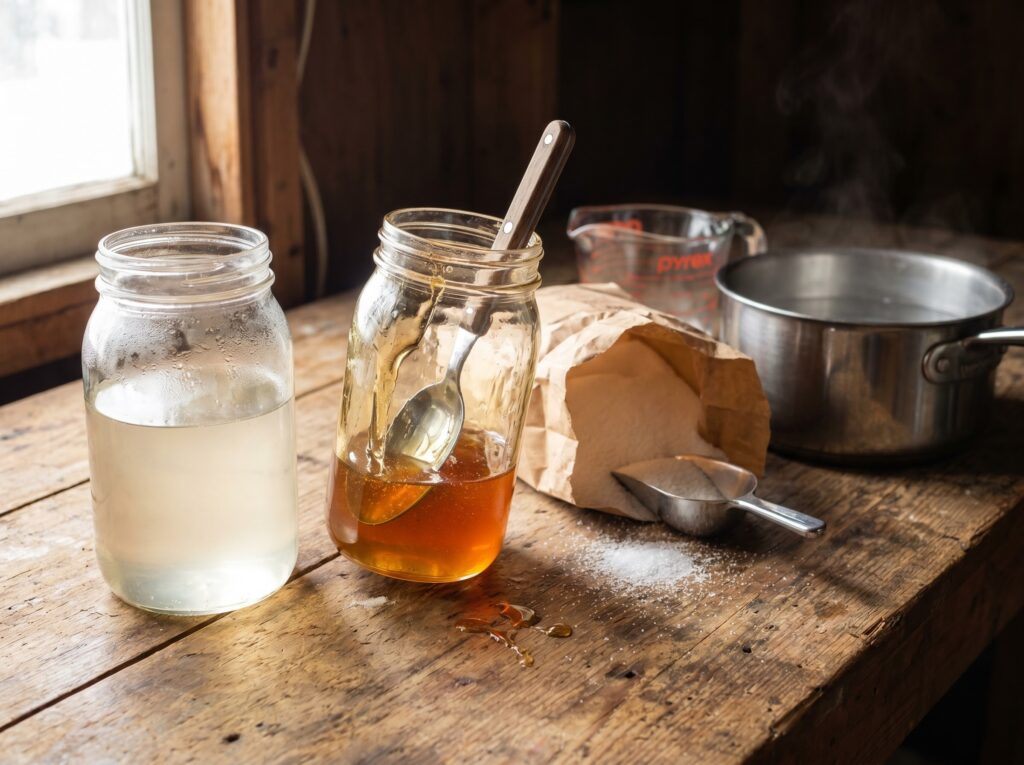
The recipe is just sugar and water in different proportions, and the proportion sets the job. Light syrup is one part sugar to one part water; the Alabama Cooperative Extension System describes it as "1 lb. of sugar to 1 lb. (2 cups) of water." Bees use light syrup for immediate needs, building comb, and feeding brood, which is exactly what spring and a new colony call for. Heavy syrup is two parts sugar to one part water by weight. Because it carries less water, bees do not "spend valuable time drying out the syrup to store for winter," so it goes into the comb fast as fall reserves.
Use plain white granulated cane sugar dissolved in warm (not boiling) water. Skip raw, brown, or powdered sugar and anything with additives; the extra solids are hard on a bee's gut over winter. Here is the quick decision table.
| Situation | Mix (sugar : water) | What it does | Typical window |
|---|---|---|---|
| New package or nuc, no comb | 1 : 1 (light) | Fuels wax and comb building, feeds brood | From install until natural flow |
| Spring buildup, weak colony | 1 : 1 (light) | Stimulates brood rearing | Early spring |
| Summer dearth (flowers gone) | 1 : 1 (light) | Holds the colony over until forage returns | Mid to late summer gap |
| Fall, hive light on stores | 2 : 1 (heavy) | Packs winter reserves, dries down fast | Early fall while warm |
| Cold weather, below ~50F | Solid (fondant or dry sugar) | Emergency calories the cluster can reach | Late winter |
Sugar dissolves into less space than you might expect, so the finished syrup runs heavier than the water alone. As a practical rule of thumb, a US gallon of 1:1 syrup weighs about 10 lb, made of roughly 5 lb of sugar dissolved into 5 lb (about 0.6 gallon) of water. Dissolve 5 lb of sugar, top up with warm water to a gallon, and you have close to a full gallon of finished syrup. For batch sizes, gallons needed, and how the ratio shifts the final volume, the breakdown on our syrup mixing page runs the numbers for each season.
Feeding a brand new colony
A new colony eats steadily for weeks because it is building everything from scratch. UGA Extension's install guidance is plain: feed 1:1 syrup and "feed your bees sugar syrup continuously until natural nectar flows begin." A package starts with zero comb, so every drop of energy goes into wax. A 5-frame nuc arrives with drawn comb and a laying queen, so it needs less, but a nuc dropped into a fresh box of bare foundation still benefits from syrup until it has filled the new frames.
Plan on feeding a package for roughly the first month or two, refilling as fast as the bees take it down. Watch for the colony to start ignoring the feeder; that is the sign forage has arrived and they prefer the real thing. The full first-week and first-month rhythm, including when to peek and when to leave them alone, sits in the new-colony feeding walkthrough, and the install steps themselves are covered when you set up that first package or nuc.
An honest expectation for year one: a new colony usually makes no surplus honey for you. It spends the season drawing comb and building population. That is normal, not a failure, and feeding is part of getting them strong enough to survive their first winter.
Fall feeding and winter stores
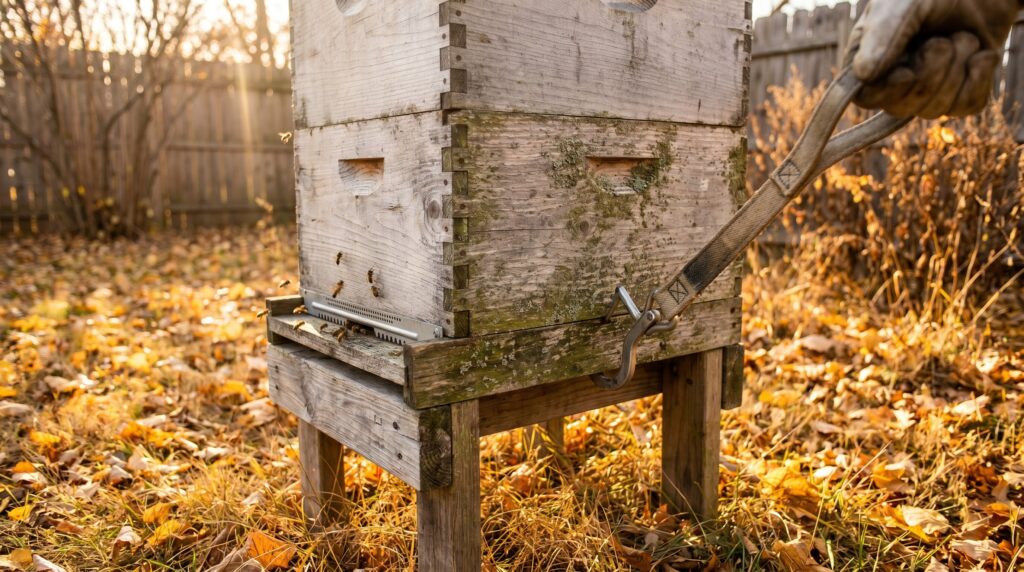
Fall is the high-stakes feeding window. The colony needs enough capped stores to cluster and eat its way through to spring, and the only way to know is to weigh it. Heft the hive or use a luggage scale on the back edge. Targets vary by region. In milder Arkansas, the state extension figures "an average size bee colony needs 45-50 pounds of honey for a 'normal' winter," while Alabama's guidance points to "approximately 60 lbs. (1 medium super) of honey stored to survive through winter." Cold northern climates run higher, commonly into the 80 to 90 lb range. That longer cluster season is also why northern keepers wrap and insulate their hives, while southern ones rarely need to.
| Region | Rough winter stores target | Notes |
|---|---|---|
| Deep South / mild winter | 45 to 50 lb | Short cluster season, less wrapping needed |
| Mid-South / moderate | ~60 lb (about one medium super) | Common all-purpose target |
| Northern / long cold winter | ~80 to 90 lb | Long cluster, often wrapped or insulated |
If the fall weigh-in comes up short, feed heavy 2:1 syrup while daytime temperatures are still above 50F, and keep feeding until the hive hits its regional target. UGA's rule for a light fall hive is direct: "If they are light on stores, feed them a heavy syrup (two parts sugar:one part water)." A Penn State organic-management trial aimed for "a total weight of 120 pounds, or 60 pounds of stored food," feeding by the gallon only until the bees reached that mark. Start early. Once nights turn cold, bees stop taking syrup, and a hungry hive in November has run out of road.
What kills overwintering colonies more often than cold itself is starvation and moisture. Bees cluster and generate their own heat, so the real danger is running out of food within reach of the cluster, or drowning in the condensation that collects overhead. Stores are half of that picture. The ventilation and wrapping half lives in the winter-stores guide.
Feeding in the cold: fondant, dry sugar, and candy
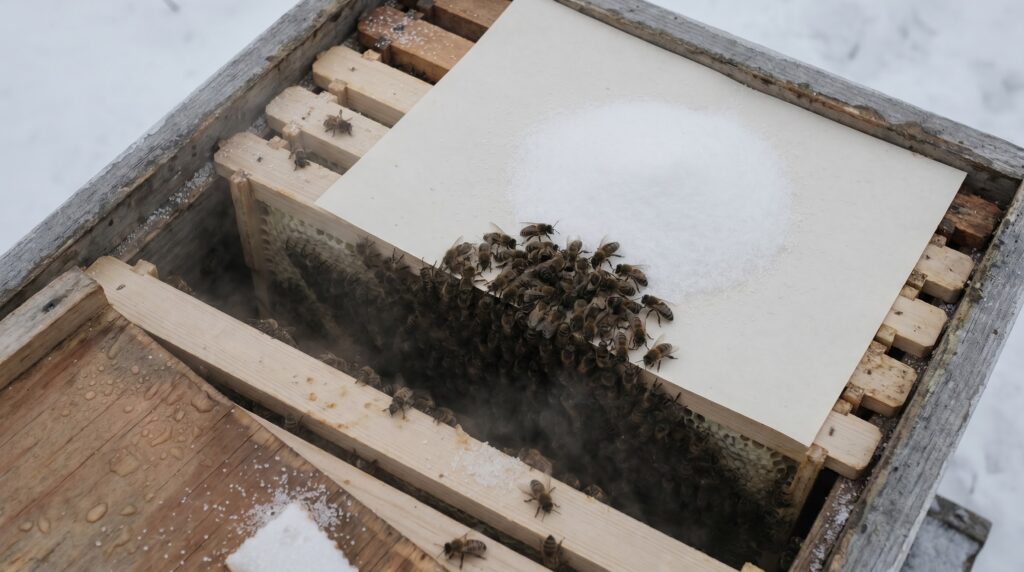
Cold changes the feed itself. Below about 50F, liquid syrup is the wrong tool; the Alabama guidance splits it cleanly, with "liquid feed... when temperatures are above 50° F" and "solid feed... when temperatures are below 50° F." Bees clustered against the cold cannot break to process watery syrup, and an open feeder of cold liquid can chill them or go unused.
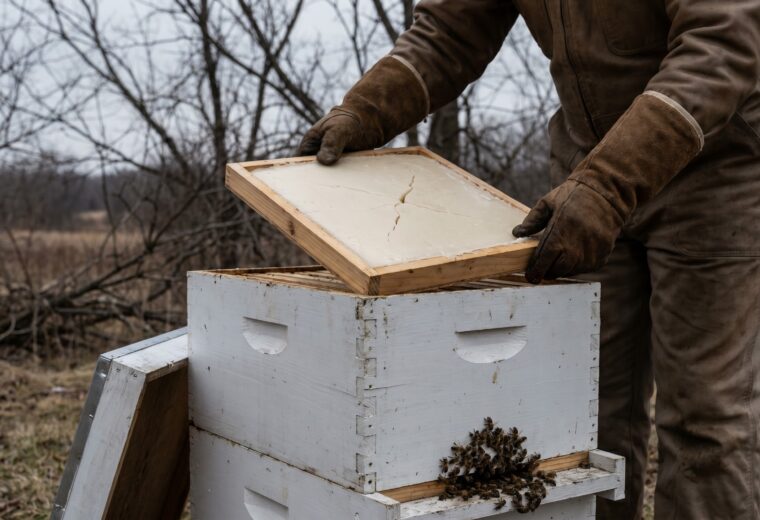
So winter feeding goes solid. Penn State notes that northeast keepers "provide winter feed as fondant or hard sugar, which is placed on top of the uppermost frames inside the hive," directly above the cluster where the bees can reach it. Three workable forms:
- Dry sugar on a sheet of paper over the top bars, off to one side so bees come up the edge. Arkansas extension describes pouring "a cup or two of dry sugar onto the paper" as emergency feed.
- Fondant or a candy board laid over the cluster. Hive humidity softens the surface enough for bees to eat it, which makes it good insurance even before they are starving.
- Slightly moistened sugar, added 3 to 4 lb at a time and refreshed on monthly winter checks.
Solid feed is a backstop, not a winter food plan. The goal is to enter winter with enough capped honey that you never need it. If you find yourself adding sugar in January, the colony was light in October. The fondant and candy-board details, including pour temperatures and placement, are laid out in the fondant page.
When to stop feeding
Stop feeding syrup before your honey supers go on, full stop. This is the rule that protects your harvest. If a colony is storing nectar to make the honey you plan to eat or sell, and you are also pouring in sugar water, the bees will pack that syrup into the same comb. Your "honey" becomes diluted with feed. Alabama extension is specific: "when an established colony is in the process of storing honey, all feeders should be removed," and "any frames with sugar syrup stores should be marked so that they are not taken during the honey harvest."
So the sequence is: feed in spring and during dearth, pull the feeder and supers go on for the flow, harvest, then feed again in fall for winter stores. A colony in a strong natural flow does not need feeding regardless, and feeding through a flow just crowds the brood nest. The full set of stop signals, including the new-colony case and what to do if you fed late, is in the stop-feeding guide.
Getting feed to the bees
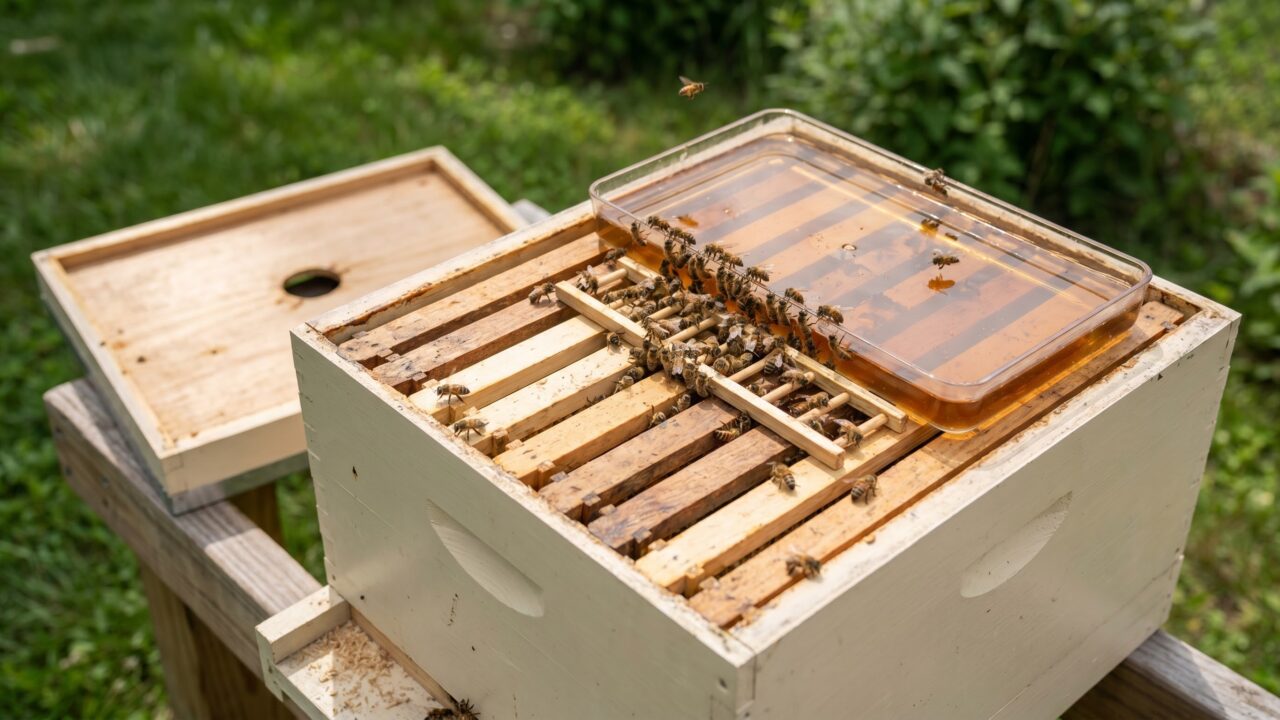
How you deliver feed matters almost as much as the recipe, because the wrong feeder in the wrong season drowns bees, starts robbing, or never gets reached. An entrance feeder is easy but invites robbing and cannot be reached by a winter cluster at the top of the hive. A hive-top or frame feeder sits inside, closer to the bees, with less robbing risk. For winter solids, the feed goes directly on the top bars under the cover. Matching the feeder to the season is its own decision, covered in the feeder comparison.
A few delivery habits that prevent trouble: add a float or rough surface so bees do not drown, feed toward evening to reduce robbing frenzy, keep feeders clean to avoid mold, and reduce the entrance on a weak colony you are feeding so stronger hives cannot rob it dry.
Questions answered
Can I feed my bees honey from another hive?
Be careful. Honey from your own healthy colony is fine, but honey from another keeper's hive, a dead-out of unknown cause, or store-bought honey can carry American foulbrood spores and other pathogens that survive for years and infect your bees. Spores do not bother people but can wipe out a colony. When in doubt, feed sugar syrup instead; it carries no disease risk.
What sugar should I use, and can I use brown or raw sugar?
Use plain white granulated cane sugar in warm water. Avoid brown, raw, powdered, or additive sugars; the extra solids burden a bee's gut, especially over winter when they cannot take cleansing flights. Plain white sugar dissolves clean and stores well.
Why are my bees ignoring the feeder?
Usually because they have something better. A strong natural nectar flow makes plain syrup unappealing, which is often a good sign you can stop feeding. Other causes: the syrup has gone moldy or fermented, the feeder is too far from the cluster for them to reach in cool weather, or the colony is too weak and small to use it. Check for an active flow first, then clean the feeder and move it closer to the bees.
Does feeding cause robbing, and how do I prevent it?
It can. Spilled syrup and the smell of an open feeder draw robber bees from other colonies, and a weak hive can be robbed out fast. To prevent it: feed inside the hive with a hive-top or frame feeder rather than an open entrance feeder, avoid spills, feed toward evening when flying slows, reduce the entrance on any weak colony you are feeding, and never leave syrup pooled in the open yard.
- Alabama Cooperative Extension System, "Supplemental Feeding for Honey Bees"used for the 1:1 and 2:1 syrup ratios, the 50F liquid-versus-solid threshold, the remove-feeders-before-harvest rule, and the ~60 lb winter-stores target
- UGA Cooperative Extension, "Honey Bees and Beekeeping" (B1045)used for feeding a new package, continuous feeding until the flow, and feeding heavy syrup to a light fall colony
- Penn State Extension, "Honey Bee Management Throughout the Seasons"used for winter fondant and hard-sugar feeding and the diligence a fresh package needs
- University of Arkansas Cooperative Extension, "Cold Comfort" (UA Bee Blog)used for regional winter-stores numbers (45 to 50 lb), clustering at 55F, and emergency dry-sugar and candy-board feeding
- Penn State Extension, "An Organic Management System for Honey Bees"used for the 60 lb stored-food fall target and adding 3 to 4 lb of dry sugar as winter emergency feed
- Cornell University College of Agriculture and Life Sciences, "Overwintering" (Pollinator Network)used for the northern winter stores target of 80 to 90 lb for a full two-deep hive