Feeding bees for winter: how much honey they need, when to feed, and what to do if stores run short
Learn how many pounds of honey bees need by region, why 2:1 syrup beats 1:1 in fall, how to weigh your hive, and how to feed a hungry colony in mid-winter.
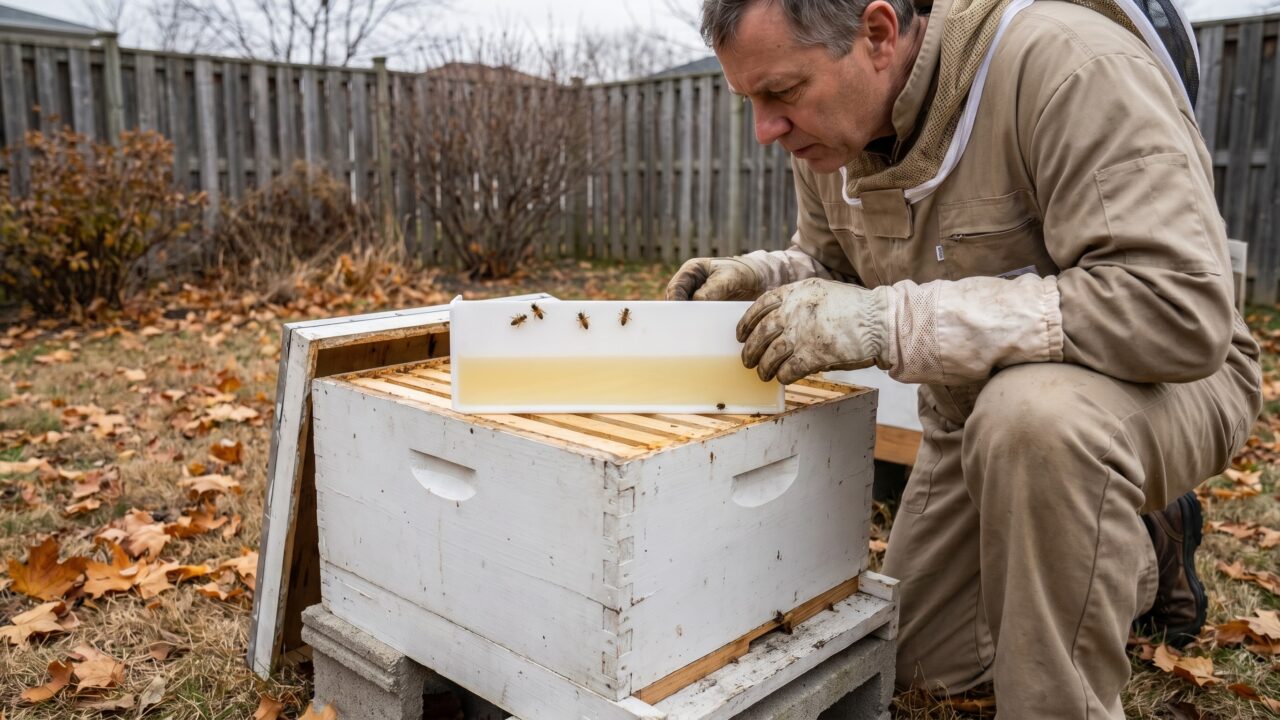
By late September, the feeding window in most of the US is closing fast. If your colony is light on stores, you have a narrow stretch of warm days to fix that with syrup - and once temperatures drop below about 50 degrees F and stay there, syrup is no longer an option. Knowing how much honey a colony actually needs, and what to do when it falls short, is the kind of management that separates hives that make it to April from ones that do not.
A standard two-deep Langstroth colony in the northern US needs at least 80 to 90 pounds of capped honey before winter sets in. Southern colonies can get by on considerably less. If stores are low in fall, feed a 2:1 sugar syrup immediately. If stores run short in the middle of winter, dry sugar, fondant, or a candy board placed directly on the top bars can keep a colony alive until spring.
How much honey a colony actually needs by region
The floor varies more than most beginners expect, because it tracks how long bees stay clustered and how cold it gets. Cornell's pollinator network puts the minimum for a full-size hive (two deep Langstroth boxes or the equivalent) at 80 pounds of honey. UF/IFAS extension, writing for northern climates broadly, pegs the target closer to 90 pounds. Either figure points to the same practical reality: a full standard hive going into a northern winter should be heavy.
Region changes everything. The table below pulls together guidance from university extension programs across US climate zones.
| Region / climate | Cluster duration | Minimum stores - full colony | Minimum stores - nuc or 5-frame hive | Notes |
|---|---|---|---|---|
| Northern (Zone 4-5: Upper Midwest, upstate NY, New England) | 5+ months | 80-90 lb | 50 lb | Cornell / UF-IFAS guidance; 90 lb is the safer target |
| Mid-Atlantic / mid-South (Zone 6-7: PA, NC mountains, mid-Ohio) | 3-4 months | 40-60 lb | 30-35 lb | NC State High Country guidance: 40-50 lb floor for mountainous Zone 6; allow up to 60 lb for colder Zone 6 sites with longer cluster periods |
| Warm South / transition zone (Zone 7b-8: piedmont NC, TX, lower Midwest) | 1-2 months of tight clustering | 40-50 lb | 20-25 lb | Fall and mild-winter forage reduce draw-down |
| Gulf Coast / Florida (Zone 9+) | Little to no hard cluster | 20-30 lb | 15 lb | UF/IFAS notes year-round activity; monitor monthly rather than pre-loading stores |
A nuc needs proportionally less - but it also has far less margin. Cornell puts the floor at 50 pounds for a nuc going into a cold northeastern winter. At that size, a three-week cold snap with no breaks for the cluster to move to adjacent frames can exhaust stores quickly.
These figures are for sealed, capped honey. Uncapped or partially cured nectar does not count toward the target and can ferment over winter, which harms the colony.
Fall syrup vs. winter dry sugar: choosing the right feed for the season
The distinction matters because bees cannot process syrup when temperatures drop. Below roughly 50 degrees F, a feeder full of liquid is inaccessible, and adding moisture inside a cold hive can cause condensation problems that are at least as dangerous as starvation.
Fall syrup: 2:1, not 1:1
In fall, the ratio shifts from the spring standard. Where spring feeding uses a 1:1 mixture to mimic thin nectar and stimulate brood rearing, fall feeding uses 2:1 - two parts cane sugar to one part water. Cornell's overwintering guidance is clear about the reason: the thicker mixture "diminishes the amount of evaporation necessary to cure the syrup," which saves the bees energy they will need later. Cornell also advises against giving 1:1 syrup in fall, because the extra moisture forces the bees to work to evaporate it, burning reserves they cannot afford to waste.
Start this process right after your honey harvest is pulled - in the northern US that is typically late July through August. This gives colonies six to eight weeks to ripen and cap the syrup before the cold window closes. In upstate New York and similarly cold climates, Cornell's guidance is to begin evaluating stores in early September and plan on finishing all liquid feeding no later than the end of September. Feed 2:1 syrup through whatever feeder you use - entrance feeder, top feeder, or division board feeder - until the colony stops taking it or overnight temperatures consistently fall to 50 degrees F or below. Further south, the window extends by several weeks, but the principle holds: stop before the cold makes syrup useless.
One practical note: aggressive fall feeding can stimulate brood rearing at a time when you want the colony winding it down. If stores are already adequate, resist topping them off with syrup. More brood late in the season means more Varroa-susceptible sealed cells at the same moment mite-knockdown treatments should be doing their work. Our month-by-month beekeeping calendar lays out that August-September management sequence in detail.
Winter feeding when syrup is off the table
Once the cluster has formed and temperatures are reliably cold, the choices narrow to dry or semi-dry feeds that bees can access without absorbing liquid. Three options are in regular use across the US.
Dry granulated sugar (mountain camp method). Pour two to four pounds of plain white granulated sugar directly on the top bars or on a sheet of newspaper laid over the frames. The sugar is hygroscopic - it absorbs moisture that accumulates in the upper hive from bee respiration and hive air, which reduces excess moisture buildup and the risk of drip-down onto the cluster, though it does not prevent condensation on the cold cover itself. An Oregon State University Honey Bee Lab expert confirms this method is easy, requires no cooking, and functions as both a food source and a partial moisture sink. Bees access it as the cluster moves upward through the hive.
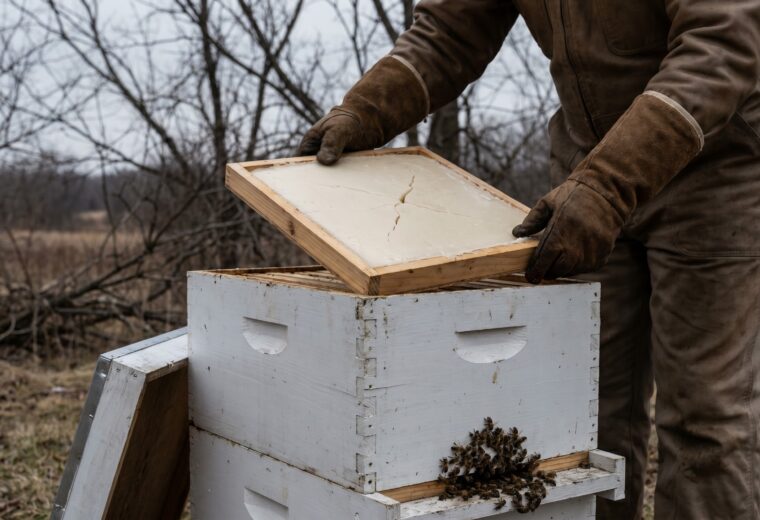
Fondant or candy board. A stiff sugar fondant placed over the top frames offers the same upward-access advantage as dry sugar but in a more coherent block. Penn State's seasonal management guidance describes placing fondant or hard sugar on top of the uppermost frames, where "the cluster moves up through the hive" and "gradually gains access to the supplemental feed." A simple candy board can be made from roughly 10 pounds of sugar and 1 cup (8 ounces) of water worked to a wet-sand consistency and packed into a shallow rim or board - the approach the Oregon State lab recommends. Let it set overnight before placing it above the frames. Details on making and positioning a candy board are in our winter fondant guide.
Emergency 2:1 syrup in late winter. If temperatures warm above 50 degrees F for a few days in late February or March - common in Zone 6 and warmer - and the colony is light, a gallon of warm 2:1 syrup in a top feeder can buy time. Cornell specifically advises having a few gallons of 2:1 feed or fondant ready to deploy "as early as February" for nucs and any colony that wintered light.
One item to skip in early winter: pollen substitute patties. Most extension programs advise against placing them before late January or early February in cold climates, because early patties stimulate brood rearing before spring treatments can safely begin, which drives up Varroa pressure at the worst possible moment.
Estimating what your hive actually has
Counting frames is the most reliable quick method. Standard Langstroth frames hold roughly 6 pounds of honey when fully capped (deep box), 4 pounds (medium), or 3 pounds (shallow). A colony in two full deep boxes with all ten frames fully capped would theoretically carry about 120 pounds - but few colonies finish fall with every frame capped edge to edge. Count the capped frames, estimate the fraction filled on partially capped ones, and do the arithmetic. A double-deep hive coming out of a late-summer harvest with only a half-full upper box and a full lower box is carrying perhaps 60 to 70 pounds - short of the 80-pound minimum for the North.
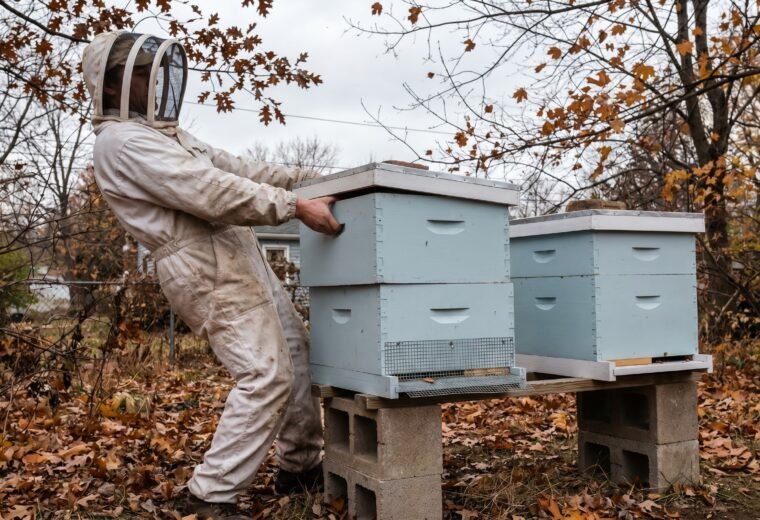
A heft test gives a faster read without opening the hive. Slide one hand under the rear of the bottom board and try to rock the hive forward. Per UF/IFAS extension guidance, if the hive is difficult to rock with one hand, it likely has enough reserves for winter. A hive that lifts easily is light and needs attention. This check takes 20 seconds and can be done on cold days without disturbing the cluster.
A hanging scale or a bathroom scale with a plywood base delivers actual numbers. Subtract the known weight of your equipment (bottom board, boxes, inner cover, lid - typically 40 to 60 pounds for a double-deep setup with empty frames; weigh your own gear on setup day before the colony is installed, since wood species and box count vary) from the total hive weight. The remainder is bees plus honey. Bees weigh only a few pounds at winter cluster size, so the honey approximation from a scale reading is close enough for management decisions.
All three approaches work better together than any one alone. A frame count gives you a theoretical number; a heft test confirms whether the hive feels right; a scale removes the guesswork when the heft feels ambiguous. For a complete fall prep workflow that integrates this weight check with mite treatment timing, insulation, and ventilation decisions, the winterizing a beehive guide covers the whole sequence.
Emergency winter feeding: what to watch for and when to act
Starvation in winter follows a predictable pattern. The cluster starts in the lower portion of the hive and moves both laterally and vertically as it eats through frame after frame. During deep cold the cluster tightens and loses the ability to move sideways to adjacent frames - meaning bees can starve with capped honey on frames they cannot reach horizontally. When bees exhaust stores near the top with no more honey above or beside them, the colony starves. A dead-out in late February with bees clustered tightly at the very top of the upper box, heads buried in empty cells, usually means starvation. There is often still capped honey in the lower box, inches away and unreachable.
Check hive weight once a month through winter. On a mild day (above 40 degrees F), gently lift the rear of the hive. If it is noticeably lighter than it was in November, the colony is burning through stores faster than expected. Open the lid briefly and look at the top bars - if bees are visible near the top and the frames around them look bare, act immediately.
Place two to three pounds of dry sugar or a fondant block directly over the cluster on the top bars. Work on the mildest available day and move quickly. The colony does not need inspecting; it needs calories close to the cluster. Cornell advises being ready from late February onward, but in a cold year or a colony that started winter light, January is not too early to check.
A colony that takes emergency feed through February and early March will often pull through once the first pollen sources open. The concern is food and moisture. Clusters survive cold reliably when they have stores. Cornell's overwintering guidance addresses the condensation point directly: "Wet bees in cold weather will soon be dead bees." A notched inner cover, a shim creating a small upper entrance, or a quilt box absorbs moisture before it can collect on a cold lid and drip down onto the cluster. The broader picture - insulation, wraps, ventilation rims, entrance reducers - is covered in our guide to overwintering bees.
Questions answered
Can I feed bees sugar syrup in December?
Only if temperatures in your area reliably stay above 50 degrees F during the day. In most of the northern US, December syrup is effectively useless - the cluster cannot move to a feeder, and adding liquid moisture to a cold hive increases condensation risk. Use dry sugar, fondant, or a candy board instead.
What happens if I give bees too much food going into winter?
The real risk is timing, not quantity. Feeding syrup late into fall can stimulate a new round of brood rearing, which puts Varroa-susceptible sealed cells in the hive at the same moment mite treatments should be finishing - a genuine harm to colony health going into winter. Setting that aside, moderate overfeeding of stores is mostly a lost opportunity cost: the bees store what they can and ignore the rest. The practical rule is to feed enough to hit your target weight early, then stop rather than topping off indefinitely.
How do I know if my hive died from starvation vs. cold?
Starvation dead-outs typically show bees clustered tightly at the very top of the upper box, heads in empty cells, with little or no capped honey near the cluster. Cold-killed colonies tend to have bees scattered more loosely. Varroa-collapse dead-outs often show a small scattered cluster with spotty or sunken brood visible even in late fall.
Is it okay to feed bees with honey instead of sugar?
Only if the honey is from your own disease-free hives. Commercial honey and honey from unknown sources carries a risk of American foulbrood spores - harmless to humans but lethal to brood. University extension programs uniformly advise against feeding bees store-bought honey.
When should I stop feeding bees in fall?
Stop liquid feeding when overnight temperatures consistently stay below 50 degrees F, or when the colony is no longer taking the syrup down. In upstate New York and similar climates, Cornell's guidance points to the end of September as the reliable outer limit. Further south the window extends several weeks, but the trigger is temperature, not the calendar.
- Cornell CALS Pollinator NetworkOverwintering bees - used for winter honey store minimums (80 lb full colony, 50 lb nuc), 2:1 fall syrup guidance, feeding window timing, condensation risk, and emergency late-winter feeding
- UF/IFAS ExtensionOverwintering Honey Bee Colonies in Northern Climates (ENY-161) - used for 90-lb northern honey reserve benchmark, heft-test hive assessment method, and 2:1 syrup ratio confirmation
- NC State ExtensionFall Tips for Small-Scale Beekeepers in the High Country - used for mid-South honey store figures (40-50 lb) and conditional fall feeding guidance
- Penn State ExtensionHoney Bee Management Throughout the Seasons - used for northeast winter feeding methods (fondant and hard sugar on top frames, cluster movement pattern)
- Ask Extension / Oregon State University Honey Bee Labused for dry-sugar candy board recipe and moisture-management benefit of hygroscopic sugar