What is a Langstroth hive? Parts, dimensions, and why it dominates US beekeeping
The Langstroth is the standard US beehive. Learn every part, exact box and frame dimensions, bee space, foundation types, and how to pick your configuration.
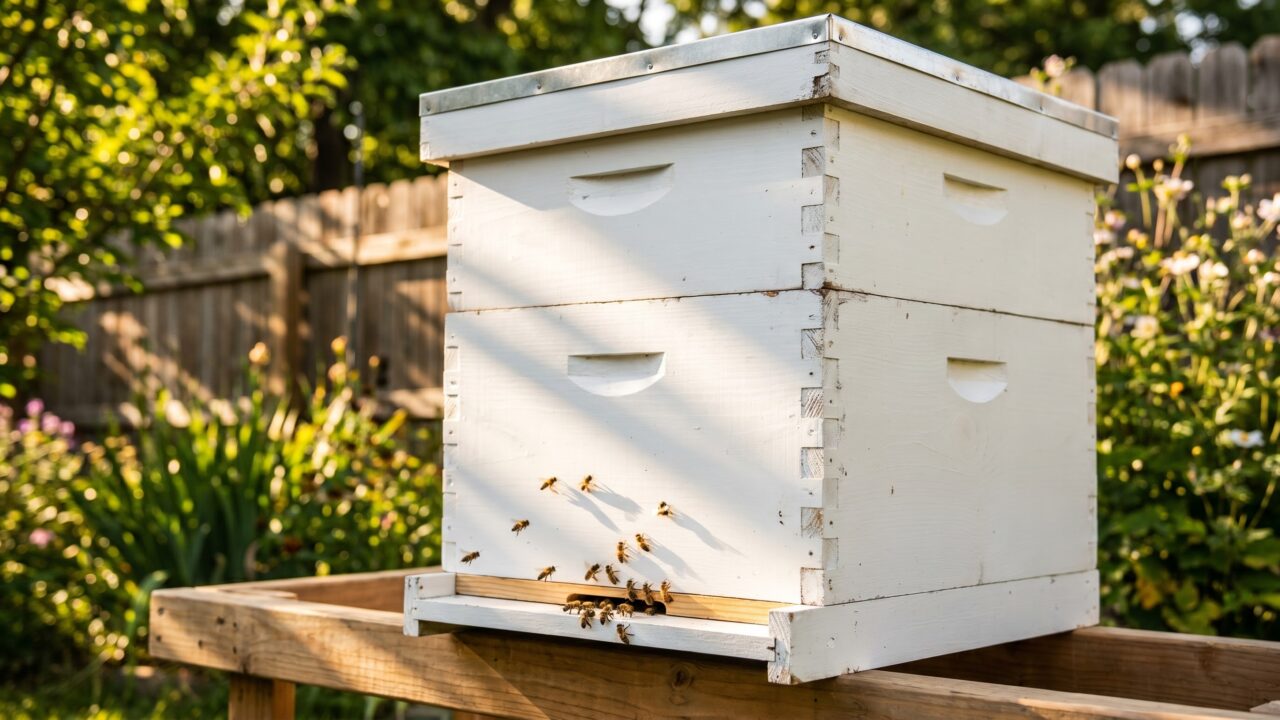
Most of what you'll read, buy, and borrow advice about in US beekeeping is built around one design: a stack of rectangular wooden boxes held together by a gap the width of a pen cap. That gap is called bee space, and it is the reason the Langstroth hive works the way it does. Everything else - the removable frames, the interchangeable supers, the whole supply chain behind it - follows from that single measurement.
Reverend Lorenzo Langstroth patented the design in 1852 after noticing that honey bees will neither build comb into a space between 1/4 and 3/8 inch, nor seal it shut with propolis. Keep every gap inside a hive in that narrow band and the frames hang free. Slide any frame straight out, inspect it, treat it, move it to another hive, and slide it back. Before that, beekeepers had to cut or break comb to see inside a colony - which meant killing bees and setting back the hive every time. Cornell University Library's Langstroth collection describes the result plainly: "a box enclosing parallel hanging frames, each movable and interchangeable, with all suspended parts being surrounded by bee space, is a perfected home for bees and a perfected tool for their keeper."
That movability is still the core advantage. It makes inspection possible, mite monitoring practical, and honey harvesting clean. It is why the Langstroth remains the default hive for US beekeepers - hobbyist and commercial alike - and why the supply chain behind it is so deep and inexpensive compared to any alternative.
The parts of a Langstroth hive, from the ground up
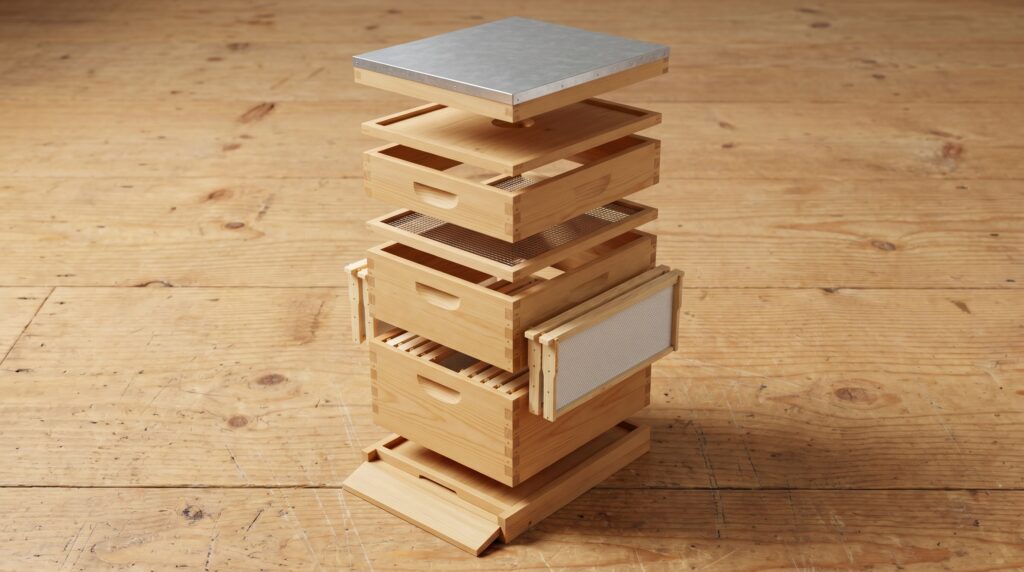
A complete hive has seven or eight distinct components. Understanding what each one does tells you what to watch during inspections and why problems show up where they do.
Hive stand
Not always sold as part of a kit, but worth having. Lifting the bottom board a few inches off the ground keeps moisture from wicking up through the wood and makes it harder for skunks to scratch at the entrance. Cinderblocks, a purpose-built stand, even a couple of 4x4 scraps work fine.
Bottom board
The floor of the hive. Solid bottom boards are a single piece of wood with a landing strip and entrance slot. Screened bottom boards replace the wooden floor with a wire mesh over a sticky or removable tray, which lets mites that fall off bees drop out of the hive rather than remounting. Many beekeepers use screened boards year-round for ventilation; others switch to solid boards in winter to reduce drafts. Both work. The entrance slot typically comes with a removable wooden reducer - a notched block that narrows the opening so a small spring package or a fall colony can defend against robbing bees.
Hive bodies (supers)
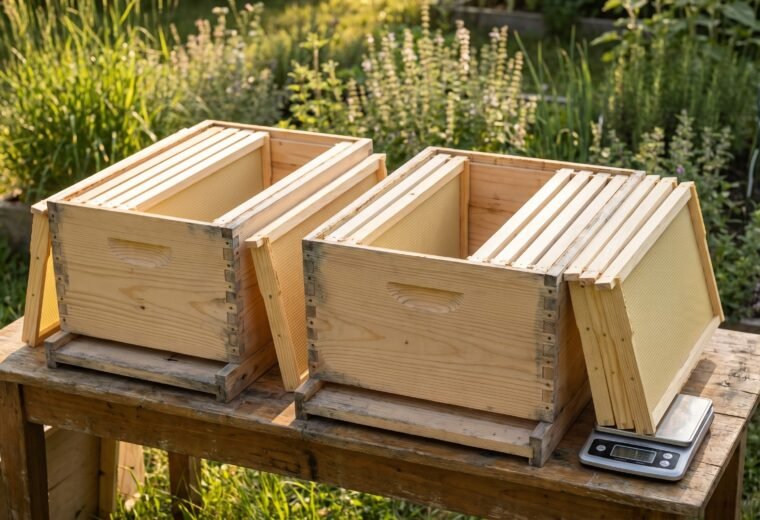
The boxes are the heart of the system and where most of the configuration decisions happen. Three sizes exist, each named by its depth:
| Box name | Box depth | Frame depth | Common use | Approx. full weight (10-frame) |
|---|---|---|---|---|
| Deep (brood body) | 9 5/8 in | 9 1/8 in | Brood nest; winter cluster | 80-90+ lb |
| Medium (Illinois) | 6 5/8 in | 6 1/4 in | Honey supers; all-medium brood | 50-60 lb |
| Shallow | 5 3/4 in | 5 3/8 in | Honey supers; comb honey | 35-40 lb |
All three share the same internal footprint: 18 3/8 inches long by 14 3/4 inches wide (for a 10-frame box). That standardized footprint is the whole point - any box stacks on any other box from any compliant manufacturer, and frames are interchangeable within the same depth.
The eXtension network's beekeeping articles note that mediums are sometimes called "Illinois supers" and give rough per-frame honey yield estimates: a deep at about six pounds, a medium at about four, and a shallow at about three. These are ballpark figures, not guarantees - actual yield varies considerably with nectar flow, colony strength, and geography, and some regions see well below or above these averages. Even so, run those numbers on a full 10-frame deep and you arrive at roughly 60 pounds of honey alone, plus the weight of the wood box, wax comb, and bees - which is why a fully loaded deep regularly hits 80 to 90 pounds or beyond. That weight matters practically: if lifting a 90-pound box off a hive on a warm August afternoon sounds like a bad idea, it probably is, and that concern drives a lot of configuration choices.
For more on how box count and frame count affect weight and management, the 8-frame vs 10-frame comparison covers the trade-offs in detail, and deep vs medium boxes works through the all-medium system specifically.
Frames
Each frame is a rectangle of wood (or plastic) sized to hang from a pair of grooved rails inside the box. The top bar rests on those rails and sets the bee space: the gap between the top bar and the rail, and between adjacent top bars, should stay at or very near 3/8 inch. Bees build comb down from the top bar, filling the interior of the frame. A deep frame (9 1/8 inches) gives the queen room for a large brood area; a medium frame (6 1/4 inches) is smaller but far lighter when full. The top bar is 19 inches long, but it does not fit inside the 18 3/8-inch internal box length - instead, the frame lugs (the small ears at each end of the top bar) hang over the rabbet ledges milled into the top inside edge of the box wall. The frame spans across the box opening; the internal box length and the top bar length are two different measurements that do not need to match.
Foundation
Foundation is the sheet that sits inside the frame and gives bees a starting template for comb. Mann Lake's product documentation describes it as "sheets of beeswax or plastic embossed with a honeycomb pattern placed in each frame to serve as a base for the bees to make honeycomb." Without foundation, bees build freehand - sometimes crooked, sometimes bridging between frames, always harder to inspect cleanly.
Two main types exist in practice:
- Wax foundation: Pure beeswax sheets, often with embedded wire for support. Bees accept wax foundation readily and draw it out faster in most conditions. It is fragile in transit and can melt in a hot car or warp if stored improperly.
- Plastic foundation: A rigid plastic sheet, usually coated with a thin layer of beeswax. More durable and easier to handle. Acceptance by bees can be slower, particularly in a new package. Adding an extra coat of melted beeswax to the surface before installation improves take-up significantly.
Foundationless frames are a third option - bees build natural comb with no template. The cells are drawn to the bees' preference, which some beekeepers value. The trade-off is more cross-comb risk and frames that are harder to handle without breaking.
For a direct comparison of plastic and wax, see the plastic vs wax foundation rundown.
Queen excluder
An optional but common addition: a flat grid of metal or plastic with openings sized so worker bees pass through freely but the queen - who is longer - cannot. It sits between the brood boxes and the honey supers, keeping eggs out of the frames you plan to harvest. Some beekeepers use them consistently; others skip them and manage brood in supers by other means. Worth having at least one when you start.
Inner cover
A thin board that sits on top of the uppermost box. It has a center hole and usually a notched edge that can serve as an upper entrance or ventilation gap. The main job is to create a dead-air buffer between the colony and the outer cover, which reduces condensation dripping back down onto the cluster in winter. Bees tend to propolize the inner cover to the box below it, so a hive tool is always needed to separate it cleanly during inspections.
Outer (telescoping) cover
The weather cap. "Telescoping" means the sides drop down around the top of the inner cover, shedding rain away from the joint. Most are topped with a sheet of aluminum to prevent rot. The telescoping cover is not meant to be used as an entrance - it sits loose by design so bees can be smoked without trapping hot air.
Bee space: the measurement that makes it all work
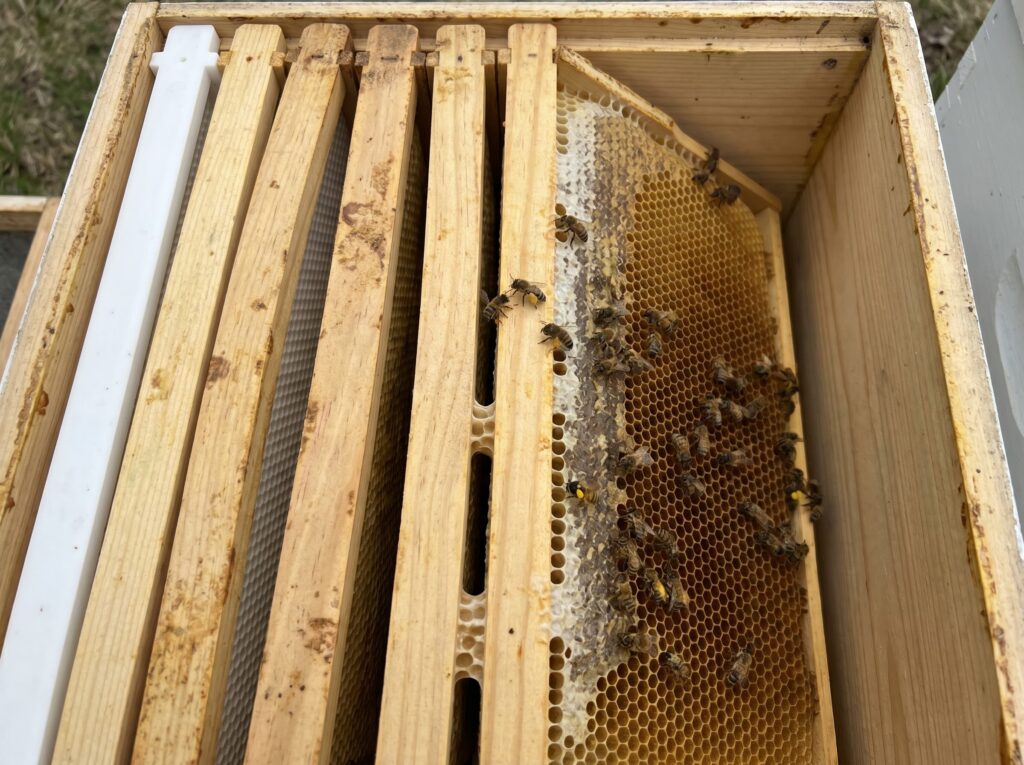
Langstroth's discovery, described in eXtension's beekeeping resources, was precise: bees fill any gap smaller than 1/4 inch with propolis and build connecting comb in any gap larger than 3/8 inch. Keep every clearance between 1/4 and 3/8 inch - the eXtension network notes 5/16 inch as the value most accepted by beekeepers - and the bees treat each frame as its own discrete unit. They do not glue frames together. They do not build brace comb across the gap. The frames stay removable.
This is not a theoretical nicety. It is the operational basis of every inspection, every mite wash, every split, and every harvest you will ever do. When a hive has not been opened for a while, bees do fill the frame tops with a thin propolis film and occasionally start small bridge combs - which is why a hive tool is part of every inspection kit. But the structure stays workable. A hive built to a different gap tolerance would require tearing comb to inspect, which destroys brood, wastes the colony's labor, and makes disease monitoring nearly impossible.
Why the Langstroth dominates and what that means for you
A few factors keep the Langstroth in its position, and they compound each other in ways that matter to a beginner shopping for equipment.
Supply depth is the first. Because the Langstroth has been the US commercial standard for generations, almost every beekeeping supplier stocks it - Dadant, Mann Lake, Betterbee, and hundreds of regional suppliers. A single basic kit (one deep body, covers, bottom board, 10 assembled frames) runs about $150 to $170 from a major supplier. A full starter setup with two deeps, a super, and protective gear lands roughly in the $200-to-$400 range for the equipment side alone, before bees, treatments, and feed. Used equipment is easy to find at bee club auctions, though it must be inspected carefully for disease history.
Parts interchangeability is the second factor. A medium super you buy this year will fit the deep body you buy next year from a different manufacturer, as long as both build to the same Langstroth standard. That modularity lets you expand gradually: start with one deep, add a second deep when the colony fills it out, add a medium honey super for your first harvest attempt. The whole system grows with the colony instead of requiring a redesign.
Local knowledge is the third, and often underrated, factor. Your local bee club, your state apiarist, your nearest master beekeeper - nearly all of them keep Langstroths and think in Langstroth terms. When you ask about a configuration, a swarm-prevention approach, or a mite-treatment protocol, the answers assume Langstroth equipment. That shared vocabulary has real value when you need help at 7 PM on a warm spring evening because your colony just swarmed.
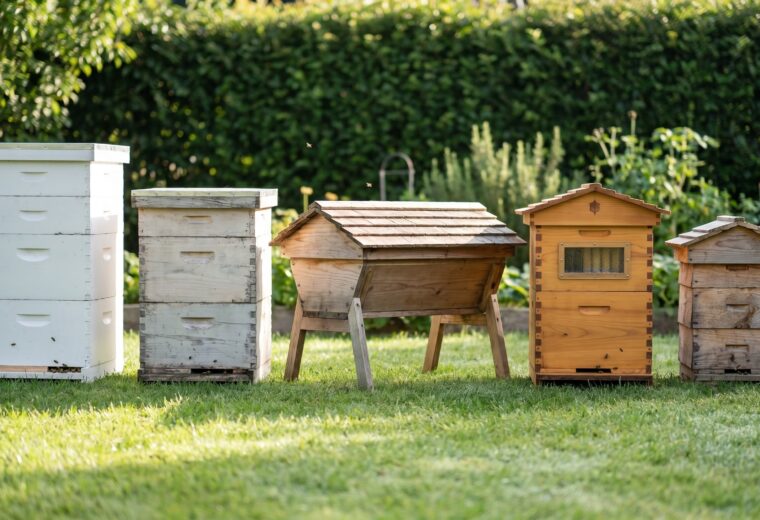
For a look at how the Langstroth compares to top-bar, Warré, and Flow setups, the types of beehives overview covers the full field.
Deep vs medium: the configuration that matters most
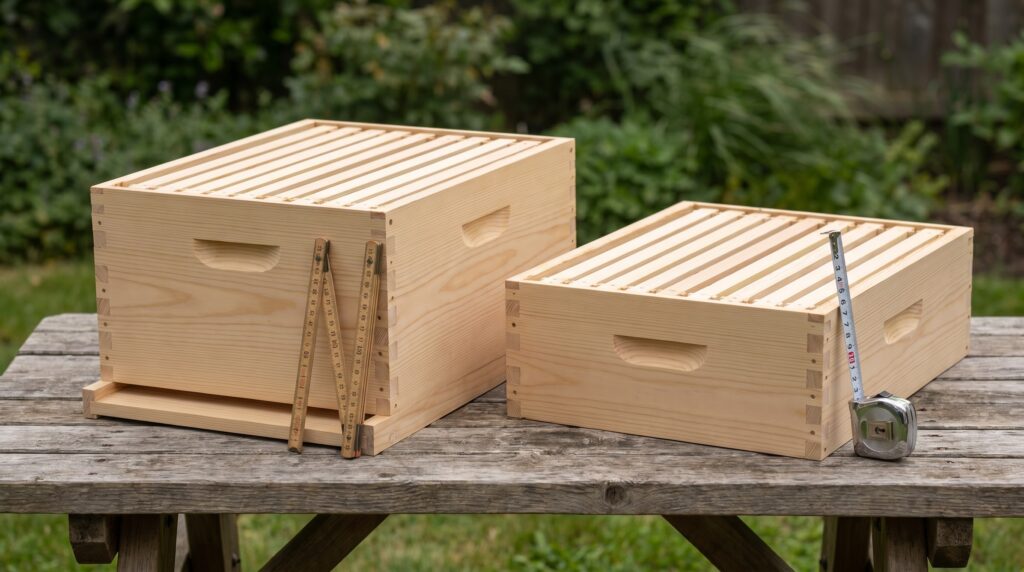
Most beginner advice defaults to "two deeps for the brood nest, mediums for honey supers." That is a sound setup with a lot of institutional support. The eXtension beekeeping resources specifically recommend "two deep or three medium supers" as the best brood-rearing space, noting that one deep plus a medium or one deep plus a shallow represents the minimum workable brood area.
The case for two deeps is straightforward: the queen has maximum laying room, the colony builds heavier winter stores more easily in a northern climate, and the configuration is the most common - meaning every piece of advice you find will map onto it cleanly. The downside is a full deep. At 80 to 90 pounds, a fully loaded 10-frame deep is a significant lift, and the second deep goes on top of the first one. Some beekeepers manage this indefinitely; others find it becomes a real physical constraint over time.
The case for all-mediums is increasingly well-documented. Penn State researchers running an organic management trial used standard Langstroth equipment with all medium boxes, treating the bottom three as the brood nest and reaching a three-medium winter configuration. Every box in the apiary becomes interchangeable - frames, supers, everything runs on the same depth. A full medium tops out around 50 to 60 pounds: still substantial, but in a different category from a deep. The trade-off is colony count: more boxes are needed to equal a two-deep brood volume, which adds some cost at startup and requires slightly more active management of box addition in spring.
A single deep plus a medium brood nest sits between the two approaches - more common in the South and mid-Atlantic where winter stores requirements are lower, less common in the upper Midwest where colonies need significant reserves to cluster through March.
The honest guidance here is regional. Before settling on a configuration, ask three experienced beekeepers within 30 miles of your apiary what they run and why. Local winter length, nectar flow timing, and the weight tolerance of the person working the hive all shape the right answer in ways that no general article can resolve for you.
One number beginners get wrong
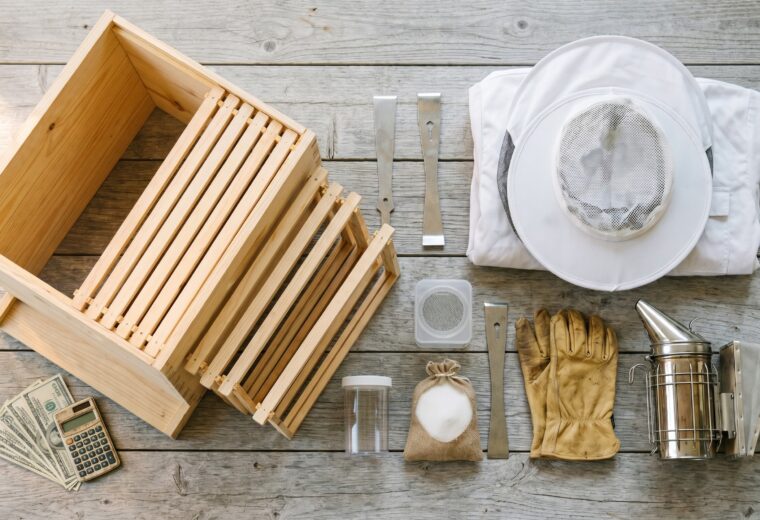
When a new beekeeper sees a hive kit priced at $150, the instinct is to calculate total startup cost from there. That is the wrong starting point. The kit covers one deep body, frames, covers, and a bottom board. A working first-year setup typically needs at minimum: a second deep body (so the colony has room to build winter stores), bees (a 3-lb package runs $140 to $200; a 5-frame nuc runs $180 to $300 depending on region and supplier), a bee suit and gloves, a smoker and hive tool, a mite test kit, and oxalic acid for fall treatment. Add it up realistically and first-year all-in costs run $750 to $1,500 depending on what you buy new versus used and whether your local club offers discounts on bees.
The full cost breakdown covers every line item, and the parts of a beehive page goes deeper on individual component choices if you are deciding between wood types, plastic versus wooden frames, or screened versus solid bottom boards.
What the Langstroth does not do
The hive is a tool, not a caretaker. A Langstroth hive does nothing automatically about varroa mites, which remain the single largest cause of colony loss in the United States. It does not prevent swarming. It does not monitor stores. It does not tell you when the colony is queenless. The movable frame design makes all of those things manageable - you can inspect, test, treat, and intervene - but only if you open the hive and look. A Langstroth left uninspected through a summer will have the same outcome as any other hive left uninspected: a good chance of a varroa-killed colony by November.
That is the correct frame for understanding what the hive's design buys you. It buys access. What you do with that access is the work of beekeeping.
Questions answered
How many frames does a standard Langstroth hive hold?
The standard US Langstroth comes in 8-frame and 10-frame widths. A 10-frame box holds 10 frames with correct bee space between each. An 8-frame box holds 8 frames and produces a lighter box - roughly 20% less weight when full - at the cost of slightly less volume per box. Both widths are widely available and use the same frame lengths.
Can I mix deep and medium boxes in the same hive?
Yes, and many beekeepers do. The most common mixed setup is two deeps for brood below and mediums added above for honey supers. The boxes stack and seal properly as long as all are the same frame width (all 10-frame or all 8-frame). Mixing frame depths within the brood area is not recommended: it complicates frame management and makes inspections harder to read at a glance.
What is the inside width of a standard Langstroth box?
A standard 10-frame Langstroth body has an internal length of 18 3/8 inches and an internal width of 14 3/4 inches. Those dimensions are consistent across the three box depths (deep, medium, shallow), which is what allows any box to stack on any other. The frame top bar is 19 inches, but it does not sit inside that length - the lug ends hang over the rabbet ledges at the top of the box wall, so the top bar spans across the box rather than fitting within the internal measurement. The 8-frame variant has the same length but a narrower internal width, which is why it holds fewer frames rather than shorter ones.
Do I need a queen excluder?
Not strictly required, but useful. A queen excluder placed between the top brood box and the first honey super keeps the queen from laying eggs in frames you intend to harvest. Some beekeepers skip them because they can also restrict worker traffic during a strong flow. If you are running your first hive, starting with a queen excluder is reasonable - it makes harvest cleaner and reduces the chance of finding brood in your honey frames.
Is the Langstroth hive good for beginners?
Yes, with one honest caveat about the learning curve: reading a Langstroth frame takes practice. A beginner opening a hive for the first few times will see a dense mass of bees, comb, and activity and need to learn how to spot eggs, larvae at different ages, capped brood versus capped honey, a queen cell, and signs of disease - all while working quickly and calmly. That skill takes a season or more to develop, and it is the real entry challenge of the Langstroth, not the equipment itself.
- eXtension / Bee Health Extension"What is bee space and why is this important to beekeeping?" - used for bee space measurements (1/4-to-3/8-inch range, 5/16-inch practical standard) and propolis/comb behavior
- eXtension"Wooden Components of a Modern Bee Hive" - used for box size names (deep/medium/shallow, Illinois super), recommended brood-box configurations (two deeps or three mediums), and honey yield per frame
- Cornell University LibraryL. L. Langstroth's Journal exhibition - used for the historical description of the Langstroth hive design and its significance to modern beekeeping
- WikipediaLangstroth hive - used for specific box and frame dimensions (deep 9 5/8 in, medium 6 5/8 in, shallow 5 3/4 in; internal box footprint; frame lengths), patent date, and dominance in US beekeeping
- Penn State Extension"An Organic Management System for Honey Bees" - used for the all-medium-box brood-nest approach (three mediums as brood nest, three-medium winter configuration)