How much does it cost to start beekeeping in your first year
Real first-year beekeeping costs run about $750 to $1,500. Here is the itemized breakdown, one-time vs recurring, package vs nuc, and a calculator.
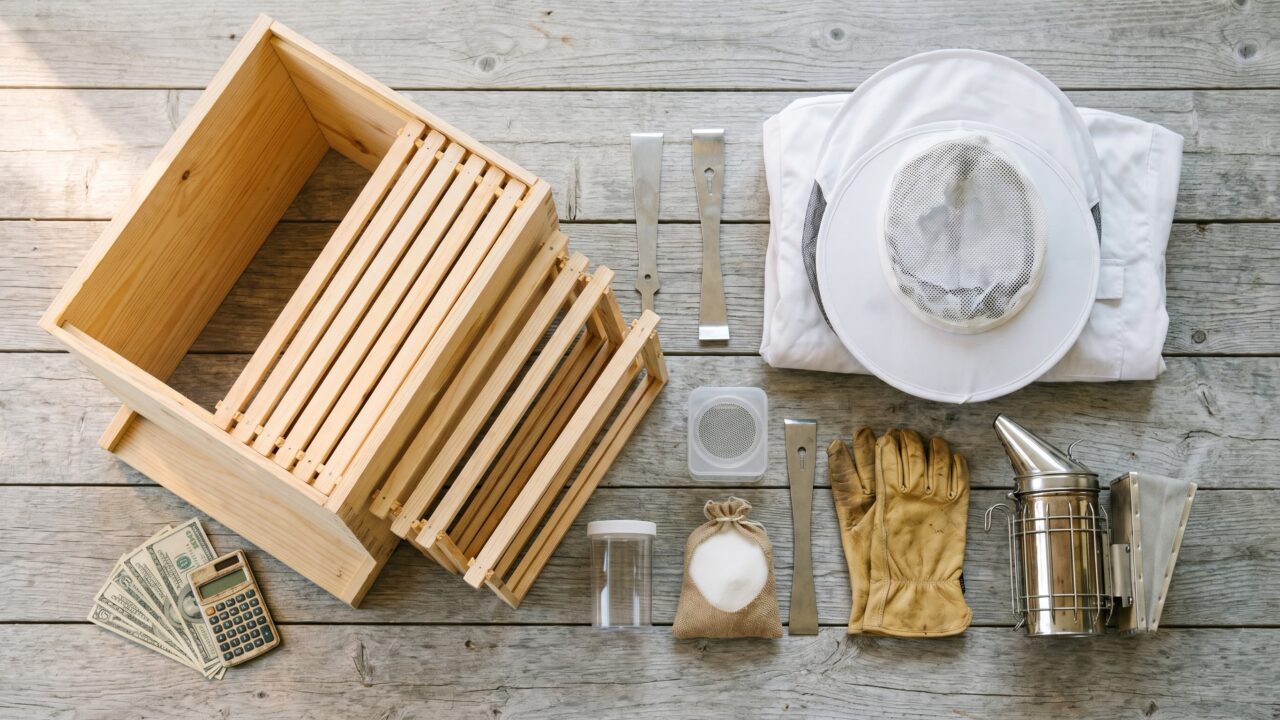
Plan on about $750 to $1,500 to start beekeeping the right way in your first year, all in. That covers one or two hives, the bees, protective gear, a few hand tools, and the first season of mite treatment and feed. The $150 starter kit you saw advertised is one line on that bill, not the bottom of it. Spend the next ten minutes here and you will know what your number actually is before you order anything.
The spread is wide because two real decisions move it: one hive or two, and a cheap package of bees or a more expensive nuc. Below is the itemized list, then a quick way to total your own setup. We will also be honest about the part nobody puts on the sticker, which is that your first year usually returns no honey at all.
What you actually pay for in year one
A first-year setup breaks into three buckets: the woodenware (the hive itself), the bees, and everything you wear and hold while working them. Add a small recurring bucket for mite treatment and feed that starts in year one and never really stops.
Here is a per-item breakdown for one hive, using figures from university extension sources. Treat these as US mail-order ranges; local clubs and group buys often come in lower.
| Item | Typical cost | One-time or recurring | Notes |
|---|---|---|---|
| Langstroth hive kit (1 hive) | $200-$400 | One-time | Basic to deluxe; bottom board, boxes, frames, covers. The US standard. |
| Bees: 3-lb package | $140-$200 | Recurring if it dies | Loose bees plus a caged queen, starting from zero comb. |
| Bees: 5-frame nuc (instead) | $180-$300 | Recurring if it dies | A small working hive on drawn comb. A head start, local pickup only. |
| Bee suit or jacket | $70-$150 | One-time | Buy the ventilated kind if you run hot. |
| Gloves | $20-$30 | Low recurring | They wear out and get sticky. |
| Smoker | $30-$50 | One-time | One of the three tools you genuinely need. |
| Hive tool | $10-$20 | One-time | Pry bar and scraper. Buy two; you will lose one. |
| Mite test kit (alcohol wash cup) | $15-$40 | One-time | The single most useful $30 you spend. More below. |
| First-year mite treatment | $15-$50 | Recurring every year | One or two rounds, always per the label. |
| Sugar and feeder for first-year feeding | $30-$60 | Recurring | A new colony has to be fed to draw comb. |
Run those numbers for a single package-started hive and you land near the low end, roughly $530 to $1,000 of gear and bees. Oklahoma State Extension published one worked example at about $684 for a beginner setup, which sits right in that pocket. Add a second hive, or swap the package for a nuc, and you climb toward the $1,000 to $1,500 top of the band. That is the honest shape of the answer, and it matches what most new US beekeepers report spending. If you want to see whether a bare-bones kit can really carry you, we walk through what a sub-$200 kit does and does not include in our look at whether a $150 starter kit is enough.
One-time vs recurring, so year two surprises you less
Most of that first-year bill never comes back. The suit, smoker, hive tools, boxes, and mite-test cup are bought once and last for years. What recurs is smaller but real: mite treatment every single season, feed when a colony runs light, replacement gloves, and the cost nobody wants to plan for, which is replacing bees that died over winter. Budget something like $50 to $200 per hive per year after the first, treatment and feed included, before any dead-out replacement.
Package or nuc: the choice that swings your bill
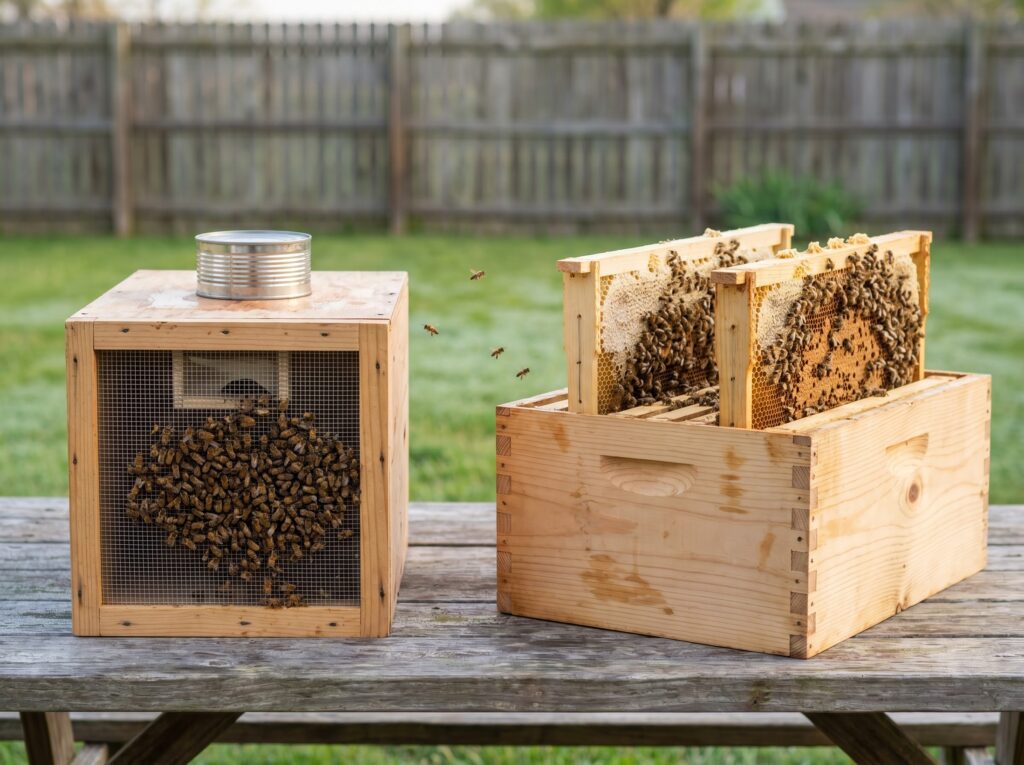
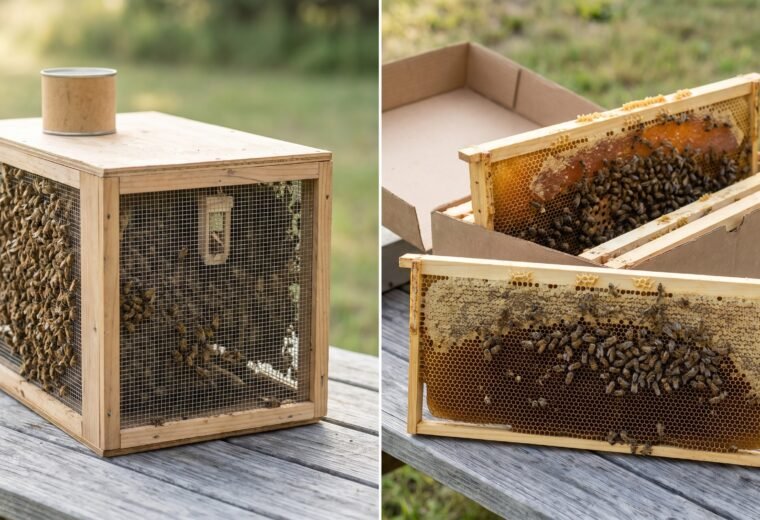
This is the decision that moves your number the most, and it is not only about price. A package is about three pounds of loose bees shaken into a screened box with a separately caged queen, sold for roughly $140 to $200. It starts from nothing: no comb, no brood, no stores. You install it, feed it hard, and the colony builds everything from scratch.
A nuc is a small but complete hive. NC State Extension describes a five-frame nuc as around 10,000 adult bees on drawn comb, with brood, some honey and pollen, and a laying queen already accepted by the colony. It runs higher, about $180 to $300, and it is local pickup only because those frames have to match your boxes. The trade is straightforward: you pay $40 to $100 more for weeks of head start and, in NC State's words, a colony "less likely to fail." We lay the two side by side in our comparison of packages and nucs, and a free third option, a caught swarm, costs nothing but finds you on its own schedule.
One timing note that catches every first-year beekeeper: bees are a winter purchase. Suppliers sell out months ahead, and Oklahoma State Extension advises ordering "the fall prior to the spring they are needed." You are buying in November and December for an April or May pickup.
One hive or two, and why two is usually the better buy
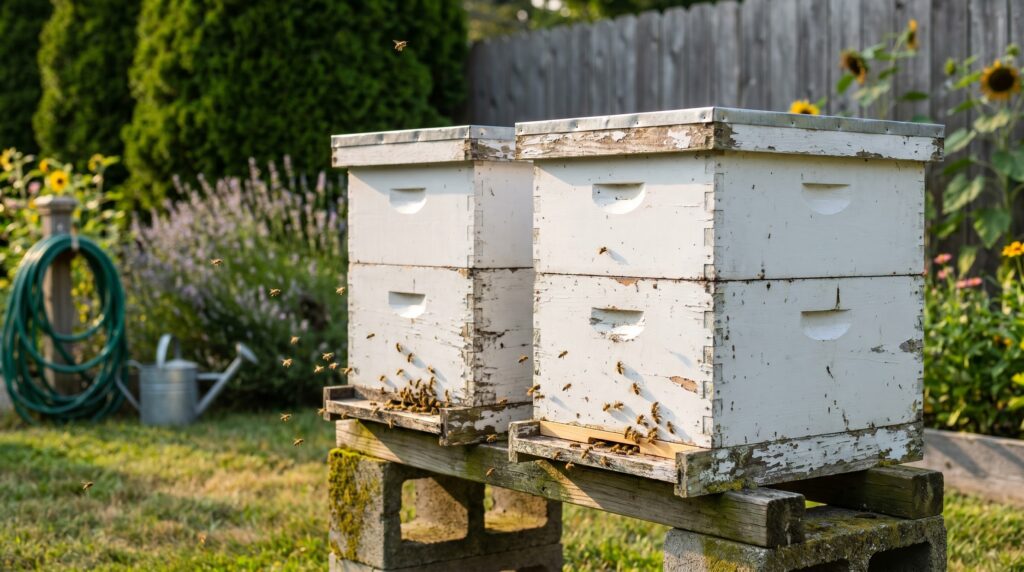
Two hives cost more up front, near the top of that $750 to $1,500 range once you double the woodenware and the bees. Still, nearly every extension service tells beginners to start with two, and the reason is practical rather than financial. NC State Extension puts it directly: two colonies give you "a frame of reference to compare." When one hive looks off, the other shows you what normal looks like. And if a queen fails, a strong second hive can donate a frame of eggs to save the first.
There is a survival math behind that advice. US colony losses have been brutal lately. The national survey for the 2024-2025 season recorded about 55.6% of managed colonies lost overall, with backyard beekeepers specifically losing about 51.4%, and backyard losses in recent years have run roughly 40 to 55%. With a single hive, a bad winter ends your beekeeping. With two, the odds that at least one pulls through climb sharply. We weigh that cost against the resilience it buys in our breakdown of starting with one hive versus two.
The honey reality: budget for zero in year one
Here is the part that reframes the whole budget. Your first year almost certainly produces no harvestable honey. A new colony spends the entire season drawing comb, raising brood, and packing away stores for its own winter. Oklahoma State Extension is plain that a beginner "may not harvest any honey your first year," and that there are "no receipts from an operation until the second year."
An established hive in a good year yields somewhere around 30 to 60 pounds of surplus. A first-year colony yields 0 to maybe 20, and 0 is the common outcome. So if your reason for keeping bees is a pantry full of jars by autumn, adjust the timeline now. This is also where the Flow Hive question comes up. That hive runs about $669 to $739 and pours honey straight from a tap, which is genuinely clever. What it cannot do is manage your mites, your swarms, or your inspections, and a first-year colony still has little or nothing to pour. We dig into whether that price is worth it in our take on the Flow Hive.
The cost nobody itemizes: keeping the colony alive
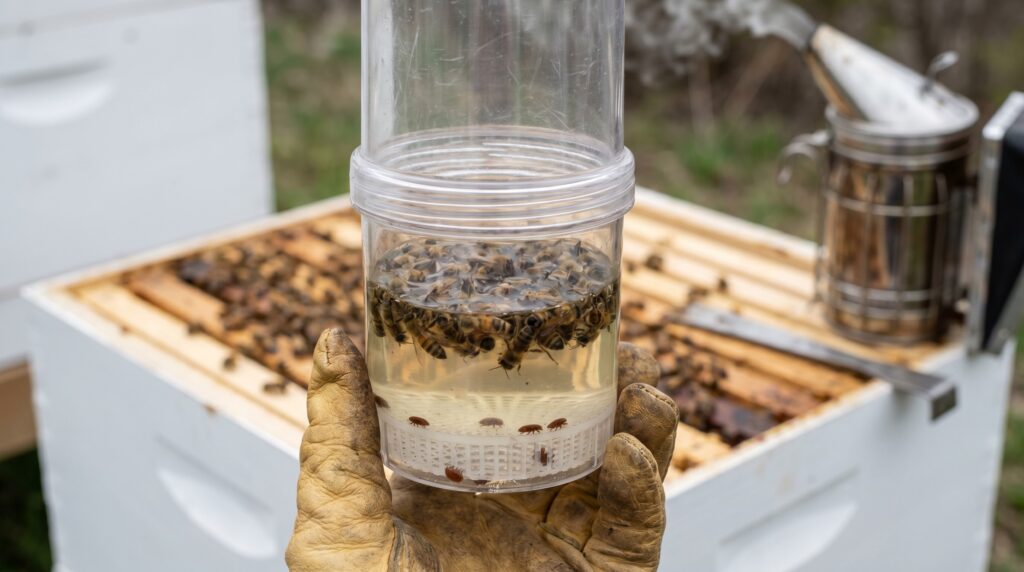
One recurring cost decides whether beekeeping stays cheap or turns expensive over time, and that is mite control. Most blown first-year budgets trace straight back to skipping it. Varroa is the leading killer of US colonies, and Penn State Extension calls it "the most influential of all of the pests and diseases of the European honey bee." A colony that dies of mites in October becomes a $140 to $300 re-buy the following spring. That is why the $30 test cup is the best value on the whole list.
Monitoring itself is simple and cheap. You wash a half-cup sample, about 300 bees, in alcohol and count the mites that drop. Penn State's guidance is to keep your hive at or below roughly 2 mites per 100 bees, and to knock the population down in late summer, before the colony rears the long-lived winter bees that have to survive until spring. The treatments themselves vary in cost and rules, and every one is used strictly per its label. Oxalic acid works best when the hive is broodless and calls for proper protective gear. Formic acid (Formic Pro) works in roughly 50 to 85F weather and can stay on with honey supers in place. Amitraz (Apivar) and thymol (Apiguard) require the supers off first. There is a working comparison in our guide to comparing varroa treatments.
Treatment dosing, sting reactions, and what is legal where you live are not areas to improvise. Follow the Honey Bee Health Coalition and your extension service for chemicals, get any sting reaction beyond mild local swelling looked at by a medical professional, and check your own state and HOA rules before the bees arrive.
Total it for your own setup
Here is a quick way to build your real number instead of trusting a range. Pick a row for each line, add them, and you have a defensible first-year budget. The anchors below sit mid-range on purpose, so if you find a $140 package or a $400 hive, swap your real figure in.
- Hives: $300 per hive for the woodenware (use $400 for a deluxe kit). One hive or two.
- Bees: $140 per package, or $200 per nuc. Multiply by your number of hives.
- Protective gear: about $120 once (suit plus gloves), whether you run one hive or two.
- Tools: about $90 once (smoker, two hive tools, a mite-test cup).
- First-year treatment and feed: about $80 per hive.
Worked example, two hives with packages: ($300 x 2) + ($140 x 2) + $120 + $90 + ($80 x 2) = $1,250. Swap to two nucs and you are near $1,370. Drop to a single package-started hive and the same method gives $730. Every one of those lands inside the $750 to $1,500 band, which is exactly why that band is the honest answer. If you would rather see where this sits in the larger picture of getting started, the full path is laid out in our beginner's guide to beekeeping.
Questions answered
What does beekeeping cost each year after the first?
Far less, because the gear is already bought. Plan on roughly $50 to $200 per hive per year for mite treatment, occasional feed, and replacement gloves. The wild card is a dead-out: if a colony does not survive winter, add $140 to $300 to replace those bees in spring, which is the single biggest swing in any year-two budget.
Is a nuc worth the extra money over a package?
Often, yes. A nuc typically costs $40 to $100 more than a package but arrives as a working colony on drawn comb with a laying queen, so it builds faster and, per NC State Extension, is less likely to fail. A package is cheaper but starts from nothing.
Will I make my money back from honey?
Not in year one, and rarely fast. Expect no harvest the first year and about 30 to 60 pounds from an established hive in a good year afterward. Most hobby beekeepers treat the honey as a bonus, not a payback on the startup cost.
How often do I have to test and treat for mites?
Test monthly through the active season with the alcohol-wash cup, and step it up to every couple of weeks heading into late summer when mite loads spike. Most beekeepers treat once or twice a year, timed before the colony rears its winter bees, and the treatment you can leave on with honey supers in place (formic acid) differs from the ones that need supers off (amitraz, thymol), so check the label before you open the box.
- NC State Extension, How to Become a Beekeeper in North Carolinaused for hive-kit, package, and nuc prices and the two-hive recommendation
- Oklahoma State University Extension, Beginning Honey Beekeeping Equipment and Associated Costsused for the example startup total, required tools, fall-ordering timing, and no-honey-year-one
- Penn State Extension, Methods to Control Varroa Mites (IPM)used for varroa as the top killer, the 300-bee monitor, the 2-per-100 threshold, and treatment rules
- Apiary Inspectors of America, 2024-2025 US Beekeeping Surveyused for the recent national colony-loss figures
- Flow Hive (Honeyflow), Flow Hive Classic product pageused for the Flow Hive price and what it does and does not include