The mite test kit: what you actually need (and what you can skip)
Varroa mite test kits are the cheapest insurance in beekeeping. Compare the alcohol wash and sugar roll, see what to buy, and learn how to act on the number.
The number that separates a colony making it to April from a deadout you discover on a cold February morning is not a single figure - it shifts by season. In February, one mite per 100 bees is enough to warrant treatment; the late-summer and fall action threshold is about two per 100 bees, per current Honey Bee Health Coalition guidance - the figure to act on before winter bees are reared. A varroa mite test kit costs less than a single dinner out, and no piece of equipment in the hive body, the veil, or the smoker does as much work per dollar. If you are new to beekeeping and wondering what to put on your list after the basics, this is the item.
The question is which kit, and whether you even need to buy one or can build what you need from things already in the kitchen. This guide covers both sampling methods, the equipment each requires, where the two approaches differ in cost and accuracy, and how to make the number you get actually mean something.
Why testing matters more than any other tool you own
Varroa mites feed on bees' fat bodies and spread lethal viruses, and the damage is almost invisible until it is severe. A peer-reviewed study tracking treated and untreated hives found that "adult bees, which are infested by V. destructor as pupae, do not fully develop physiological features typical of long-lived winter bees compared with non-infested workers" - meaning the colony that looks fine in September may already have doomed its winter bees. Penn State Extension states plainly that mite loads and viral titers rise together through the season, and that "controlling mites in the fall is a major factor linked to overwintering survival in honey bees."
This is why a test kit is not optional equipment for a hobbyist who cares whether the colony survives. Backyard beekeepers lost 51.4% of their colonies in the 2024-2025 survey year, against a 14-year average of 41.4%. You cannot treat your way out of what you have not measured. Our overview of how varroa damages colonies covers the biology in more detail, but the short version is: mite load is the one variable a backyard beekeeper can actually measure and act on.
The two methods: alcohol wash and sugar roll
Every reliable monitoring method comes down to pulling about a half cup of bees from a brood frame and dislodging the mites riding on them, then counting what comes off. The alcohol wash and the sugar roll do the same job differently, and choosing between them is a genuine trade-off, not a matter of one being flat-out better in all situations.
Alcohol wash
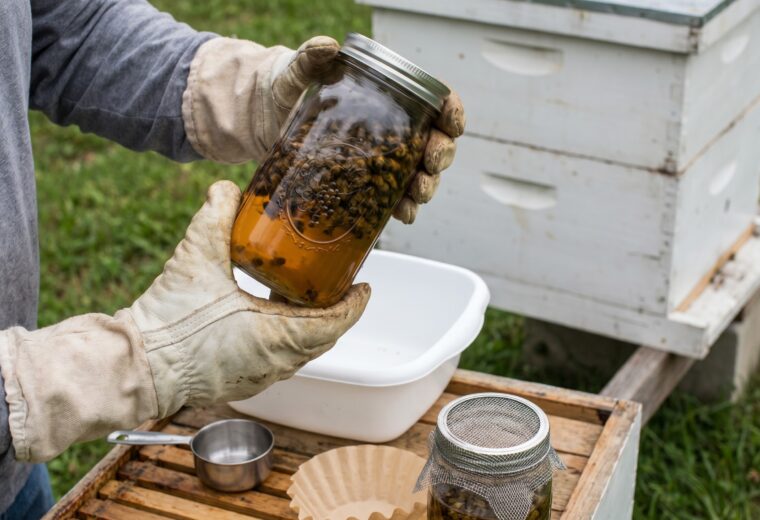
Penn State Extension is unambiguous: "Alcohol washes are the most accurate method for monitoring mite populations." The alcohol dislodges nearly every mite from every bee in the sample, so the count you get is close to the true infestation rate. The cost is that the bees die. For a colony of 30,000 to 50,000 workers in the active season, losing about 300 bees is a rounding error on the population. Most beekeepers who test before a treatment decision use the wash for exactly this reason: when the number matters, you want it right.
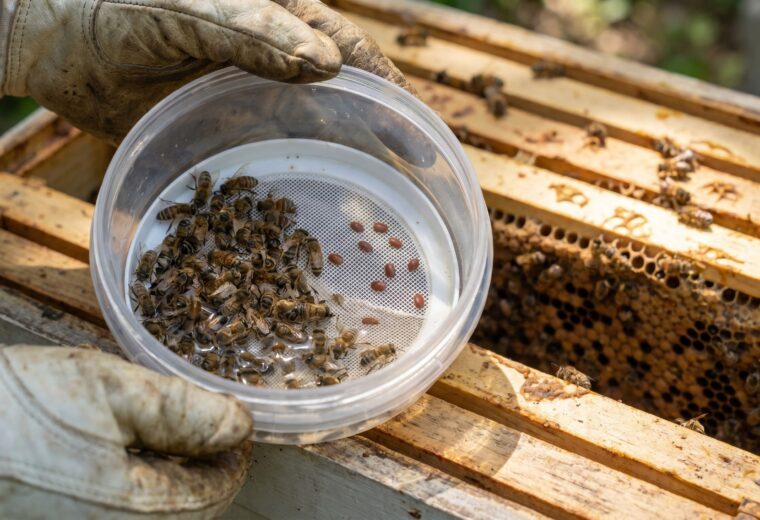
Mississippi State University Extension describes the standard method as sampling a half cup of nurse bees from the broodnest. The bees go into 70% isopropyl alcohol in a sampling container, get agitated for three to five minutes, and the alcohol is poured through a mesh strainer into a white pan where the mites are counted. The calculation is straightforward: divide total mites by the number of bees in your sample, multiply by 100, and you have the infestation rate as a percentage. If you count 12 mites from a sample of 300 bees, that is 4%, well above the late-summer action threshold of 2 per 100 bees.
A note on sample size: a standard half-cup scoop yields roughly 300 bees, which is the figure used across this site and by Penn State Extension. What does not change is the math: you divide your mite count by whatever your actual sample was. The rate per 100 bees is the number that drives the decision.
Sugar roll
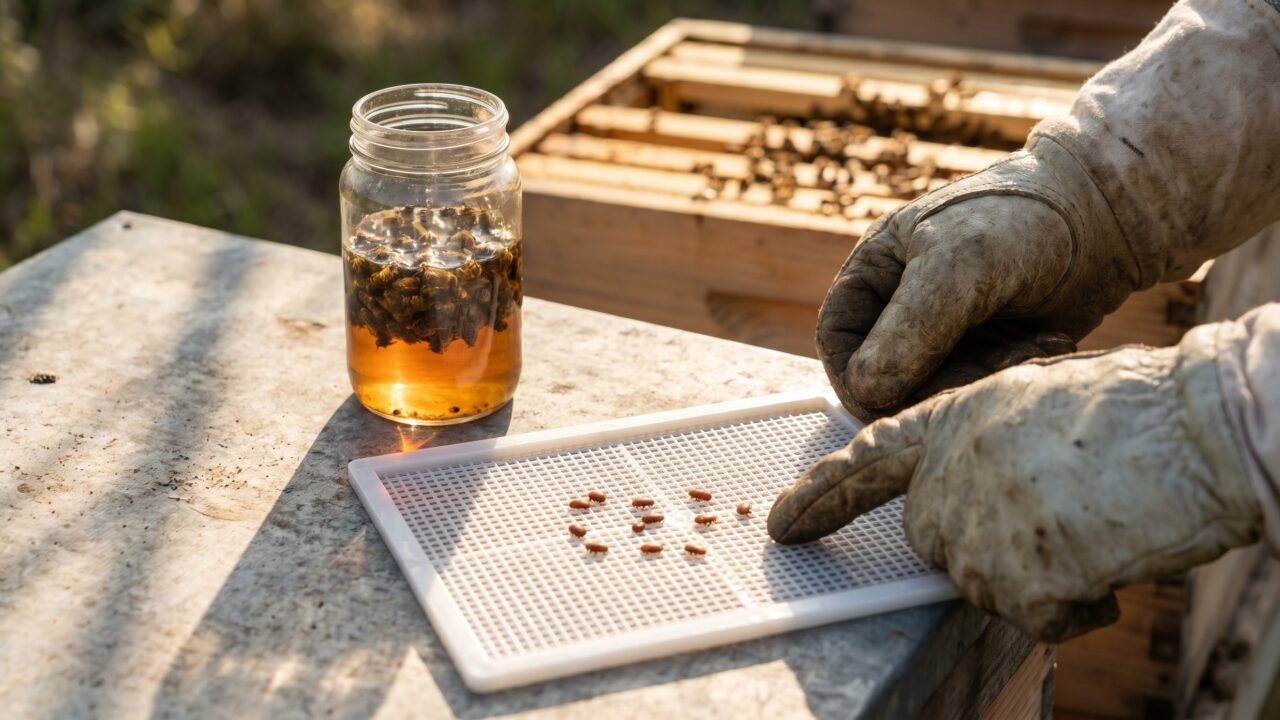
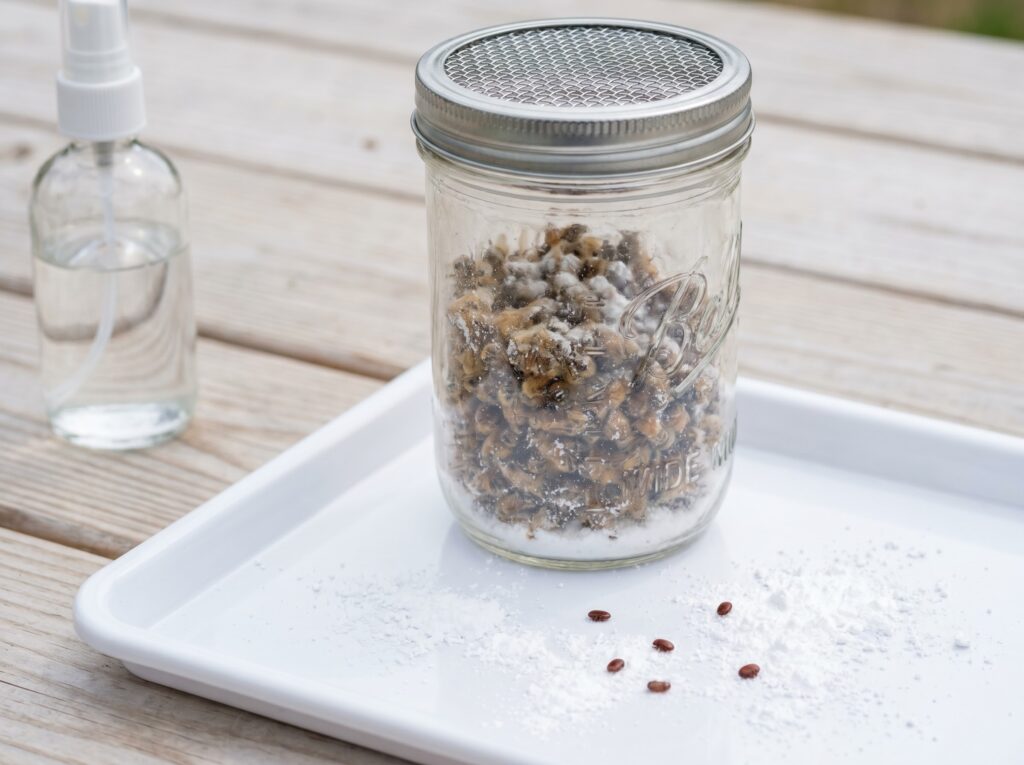
The sugar roll keeps the sampled bees alive. Bees are shaken into a jar, then approximately two tablespoons of fresh dry powdered sugar are added through the mesh lid until the bees are completely coated. The jar is then rolled gently for two minutes - this is the coating step, not the mite-dislodging step. To actually dislodge the mites, you invert the jar over a white basin and shake it vigorously up and down for 60 seconds. The sugar-coated mites fall through the mesh into the basin and are counted there. Penn State's sugar roll guide describes this two-step process and counts a half-cup scoop as roughly 300 bees, setting the action level at "2% or less - so, if you counted more than 6 mites, you need to act." The bees can be returned to the hive after shaking.
The limitation is undercounting. Powdered sugar does not dislodge every mite the way alcohol does, so sugar rolls tend to read lower than the true infestation rate. A count just under the threshold is worth confirming with an alcohol wash - a second sugar roll carries the same undercounting bias and will not resolve the uncertainty. For the critical late-summer check before winter bees are reared, most experienced beekeepers accept the small bee loss from a wash rather than risk a false low reading at the worst possible time in the season.
Which to choose
The table below puts the two methods side by side for the decisions a beginner actually faces.
| Factor | Alcohol wash | Sugar roll |
|---|---|---|
| Accuracy | Highest (Penn State Extension) | Good; tends to undercount |
| Sampled bees survive? | No | Yes - can return to hive |
| Typical half-cup sample | About 300 bees | About 300 bees (Penn State) |
| Action threshold (late summer/fall) | 2 mites per 100 bees (current HBHC guidance) | 2% or more than 6 mites per 300-bee sample (Penn State) |
| Core materials | 70% isopropyl alcohol, mesh-lid jar, white pan | Powdered sugar, mesh-lid jar, white basin |
| Best for | Any decision where accuracy counts, especially late summer | Mid-season spot checks; keepers who prefer not to kill sample bees |
| Beginner error rate | Low - the kill-count is reliable | Higher - easy to miss mites in sugar |
What to actually buy (and what you can assemble at home)
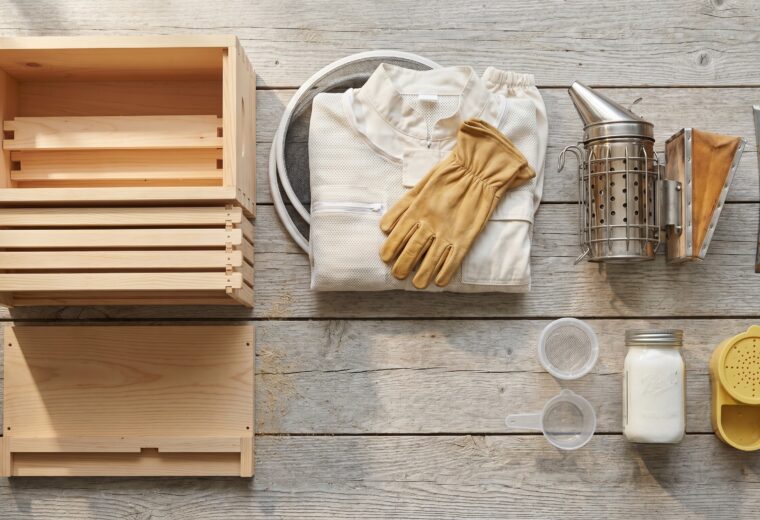
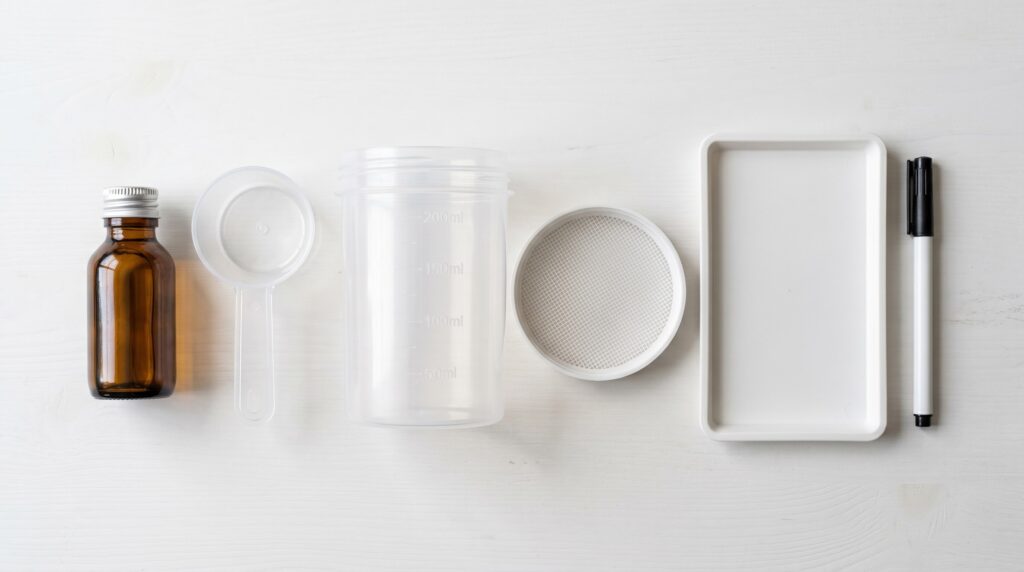
A dedicated varroa test kit from a beekeeping supplier is a purpose-built container - typically a 200 ml two-chamber jar with a graduated mesh insert - that holds your bee sample and strains the mites in one unit. The mesh is sized to let mites through while holding bees back. Brands sold by Mann Lake, Betterbee, and Dadant run roughly $15 to $30 for the jar alone, with some kits including a small bottle of alcohol or powdered sugar. These containers are well-made and convenient, but they are not the only option.
For the alcohol wash, you can get equivalent results from a mason jar with a piece of hardware cloth (about eight squares per inch) cut to fit under the lid ring. The jar needs to be clear so you can see the sample. A white plastic plate or a light-colored paint tray serves as the counting surface. Add a bottle of 70% isopropyl alcohol from any pharmacy and a half-cup measuring scoop, and the whole setup costs under $10. If you already keep hives, you probably have most of it.
For the sugar roll, you need a dry clean jar, the same mesh-lid setup, a bag of powdered (confectioners') sugar, and a white basin for counting. Penn State notes that if the mites are hard to see in the sugar, a little water sprayed into the basin dissolves the sugar and makes the reddish mites stand out clearly against the white surface. No alcohol is needed, and the whole assembly is genuinely zero additional cost if you cook.
Where purpose-built kits earn their price is convenience and consistency. The graduated marks on a commercial container help you eyeball a half-cup sample without needing a separate measure. The mesh size is pre-verified. And the two-chamber design lets you agitate and strain without transferring anything to a second container. If you test several hives, that matters. If you have one or two hives and do not mind using a mason jar, the savings are real and the accuracy is identical.
For a full list of what you need in the apiary beyond mite monitoring, our equipment list covers protective gear, hive tools, and feeders alongside testing supplies.
The beginner mistake that costs colonies
The single highest-frequency beginner failure is not buying the wrong jar. It is buying the jar and then not using it consistently. A test kit on the shelf in July does not help a colony in August.
MSU Extension recommends sampling "at least twice a year, in early February and early July," with a February threshold of 1 mite per 100 bees. The late-summer and fall action threshold - the most critical one to watch before winter bees are reared - is about 2 mites per 100 bees, per current Honey Bee Health Coalition guidance, which Penn State's year-round target also reflects. Many experienced beekeepers test monthly from June through September because that is when mite populations climb fastest. Check the state of the colony more often than you think you need to - the colony gives almost no outward warning until the damage is done.
The other failure is treating a borderline number and then not re-testing after treatment to confirm the mites came down. A treatment that did not work, or that was applied outside its effective temperature window, leaves a colony just as exposed as if it had never been treated. The test kit is how you close that loop. The step-by-step mechanics of pulling and counting a sample are in our guide on running a mite test, and once you have a number in hand, our piece on deciding whether to treat walks through what to do with it.
Converting your count to an action
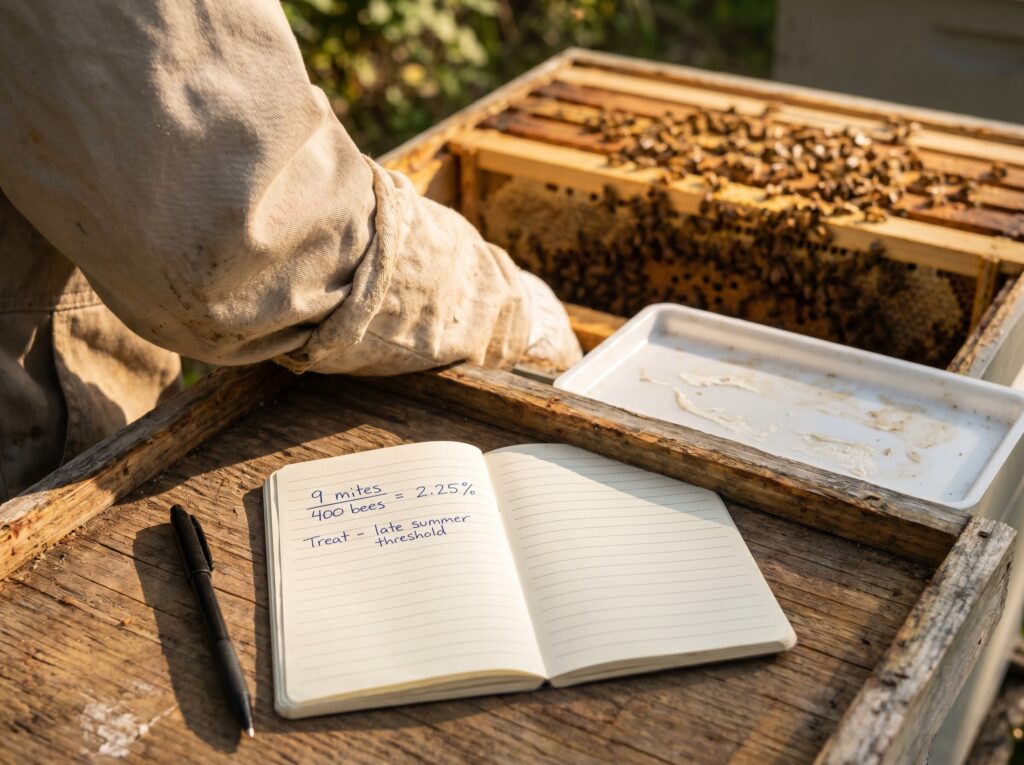
The arithmetic is short. Divide mite count by bees sampled, then multiply by 100.
- Example: 9 mites from a 300-bee sugar roll sample = 9 / 300 x 100 = 3%. Above the 2% action threshold, treatment warranted.
- Example: 9 mites from a 300-bee alcohol wash = 9 / 300 x 100 = 3%. Above the late-summer action threshold of 2 per 100 bees. In late summer, this would prompt immediate treatment.
- Example: 9 mites from a 300-bee alcohol wash in February = 3%. Well above the winter threshold of 1 per 100 - treat before the spring build-up.
Notice how the same physical count - nine mites - means different things depending on the sample size and the time of year. That is why writing down both the mite count and the bee count is worth the extra ten seconds. A number in isolation, "nine mites," does not make a decision. The rate per 100 does.
The broader picture of how thresholds shift with the season, and what to do when you land right on the line, is in our article on deciding whether to treat for mites.
Questions answered
Can I use rubbing alcohol from the drugstore, or does it need to be specific?
Standard 70% isopropyl rubbing alcohol works exactly as the method requires. Higher concentrations (90%+) are often available but offer no advantage for mite testing. Mississippi State University Extension specifies 70% alcohol in their published protocol. The main things to avoid are scented rubbing alcohols or products with added ingredients, since you are reading the liquid for mites, not treating anything.
How many bees is a half cup, really?
A standard half-cup scoop holds roughly 300 bees, which is the figure Penn State Extension uses and the number this site applies to both methods. In practice it can vary slightly by colony, bee size, and how the bees pack into the cup. What matters operationally is dividing your mite count by the actual number of bees you sampled. If you weigh or count your sample and get a different figure, use that.
Do I need to sample from the brood nest specifically?
Yes. Varroa mites prefer nurse bees (younger bees that tend brood), so mite rates on forager bees near the hive entrance will read artificially low. Mississippi State Extension advises choosing "combs with adhering nurse bees, as mites prefer riding on these younger bees" from the broodnest. Sampling from foragers gives you a number that underestimates the true colony infestation rate and can lead to a false decision to skip treatment.
Can I test with honey supers on the hive?
You can, but you need to pull your sample from a brood frame, not from a super. Lift a super aside temporarily, find a frame of capped brood with nurse bees in the brood nest, and collect your sample from there. Mite counts from frames in a honey super will read artificially low because foragers - who spend little time in the brood nest where mites reproduce - tend to cluster near and above the queen excluder. The nurse bees in the brood nest carry the mites you are actually trying to count. If your supers are heavy or the hive is difficult to open fully, the alcohol wash requires only one brood frame to be accessible; the sugar roll needs the same access level.
- Penn State Extension, "Methods to Control Varroa Mites: An Integrated Pest Management Approach"used for the finding that alcohol washes are the most accurate monitoring method, the action threshold of around 2 mites per 100 bees, and the critical importance of fall treatment timing
- Penn State Extension, "Organic Honey Bee Colony Management: How to Do a Sugar Roll"used for the sugar roll method steps, the half-cup sample count of roughly 300 bees, the 2% action threshold, and materials needed
- Mississippi State University Extension, "Sampling for Varroa Mites Using an Alcohol Wash"used for the step-by-step wash protocol, the February threshold of 1 mite per 100 bees, and the wash method overview
- van Dooremalen et al., PLoS ONE, "Winter Survival of Individual Honey Bees and Honey Bee Colonies Depends on Level of Varroa destructor Infestation"used for the finding that bees infested by varroa as pupae do not develop into proper long-lived winter bees, directly linking late-summer mite loads to winter colony loss
- Apiary Inspectors of America / Auburn University, 2024-2025 US Beekeeping Surveyused for the 51.4% backyard beekeeper colony loss rate and the 14-year average annual loss rate of 41.4%