Varroa mites: the beginner's survival guide to testing, deciding, and treating
Varroa is the top killer of backyard hives. Learn to test, read the threshold by season, and time treatment before winter bees, all cited.
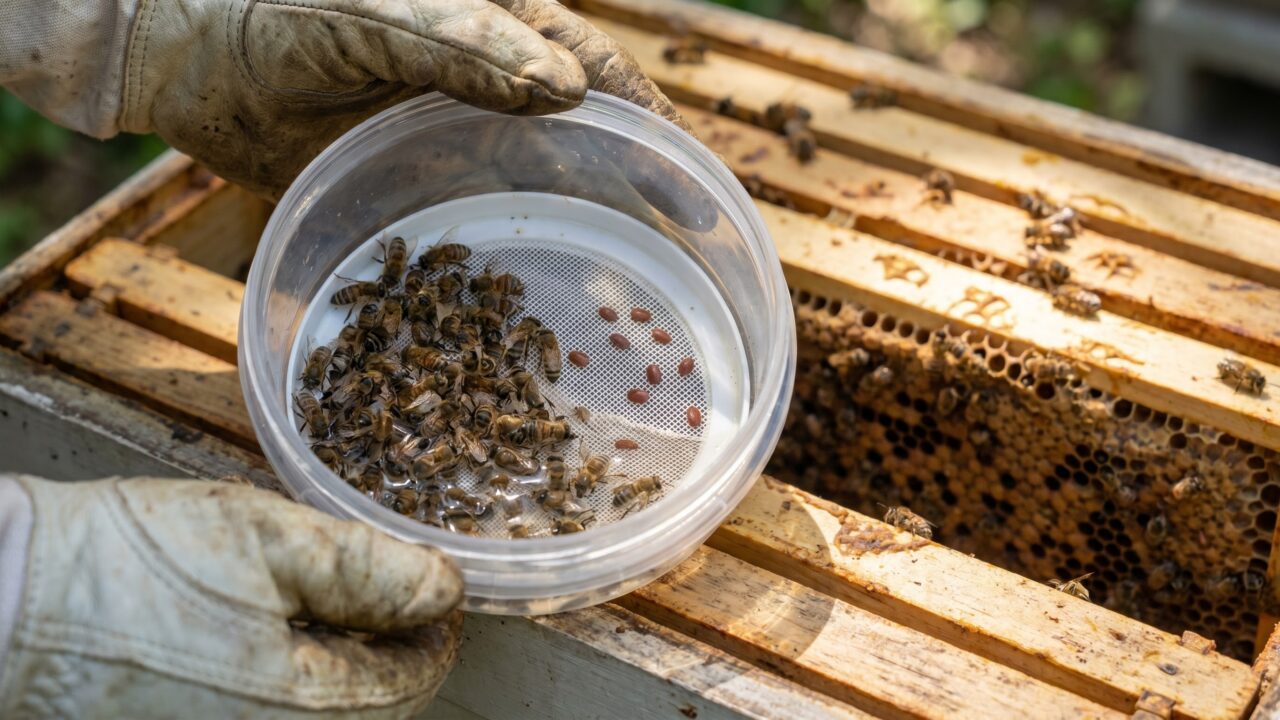
If you keep bees and do nothing else this year, learn to measure your varroa load and act on the number. This one parasite, a reddish, pinhead-sized mite called Varroa destructor, is the single biggest reason backyard colonies die over winter. It feeds on adult and developing bees and spreads a set of lethal viruses, and Penn State Extension notes that viral load climbs alongside mite load from spring to fall. A hive can look strong in August and be a pile of dead bees by February because the mites that doomed it were invisible to the naked eye.
The good news is that varroa is the one big threat you can actually measure and manage at home. The whole job comes down to a three-step rhythm you repeat through the season: test, decide, treat. Get that rhythm right and you give your bees a real shot at spring.
Why varroa is the number one colony killer
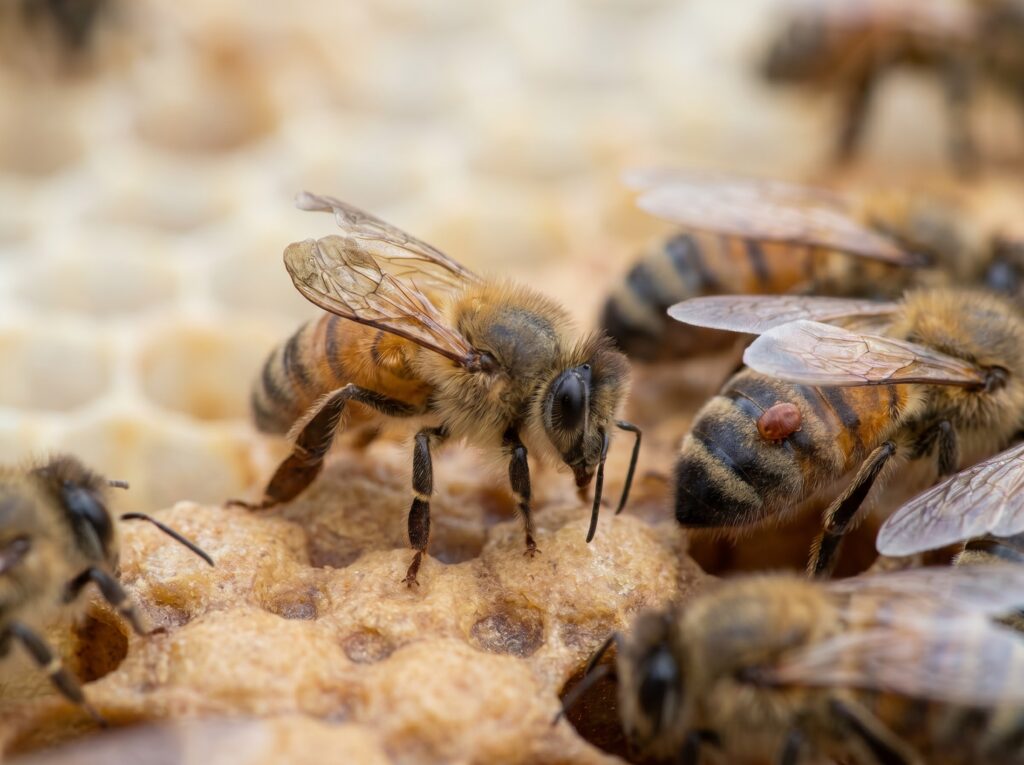
Varroa mites do their damage two ways. They physically drain bees, feeding on the hemolymph and the fat body, the organ a bee relies on to survive long stretches without foraging, including winter. And they act as a dirty needle, injecting viruses every time they feed. Deformed wing virus is the most familiar: bees emerge with crumpled, useless wings and die young. Penn State Extension is direct that mites "transmit a number of lethal viruses," and that viral titers rise right along with the mite count as the season goes on.
Here is why that matters for the colony, not just the individual bee. A peer-reviewed study tracking infested versus treated hives found that the bees raised in fall, the long-lived "winter bees" that must carry the colony through to spring, never develop properly when mites parasitize them as pupae. Those bees simply do not live long enough to see spring. A mite problem in September quietly becomes a dead-out in January, and the beekeeper blames the cold. The survey numbers back this up. Over 2024-2025, US backyard beekeepers lost 51.4% of their colonies for the year, well above the 14-year running average of 41.4%. Varroa is not the only thing driving those losses, but it is the one that turns a manageable winter into a fatal one. If you want the broader picture of how hives fail, our breakdown of why a hive dies walks through varroa alongside starvation and moisture.
The test, decide, treat system
Treating a hive without testing it first is guesswork, and guesswork either wastes a treatment you did not need or skips one you did. The whole system is three plain steps you cycle through the active season.
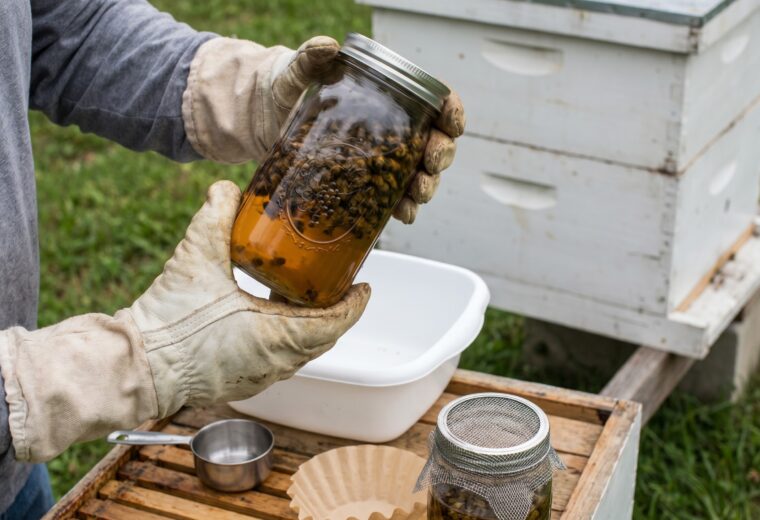
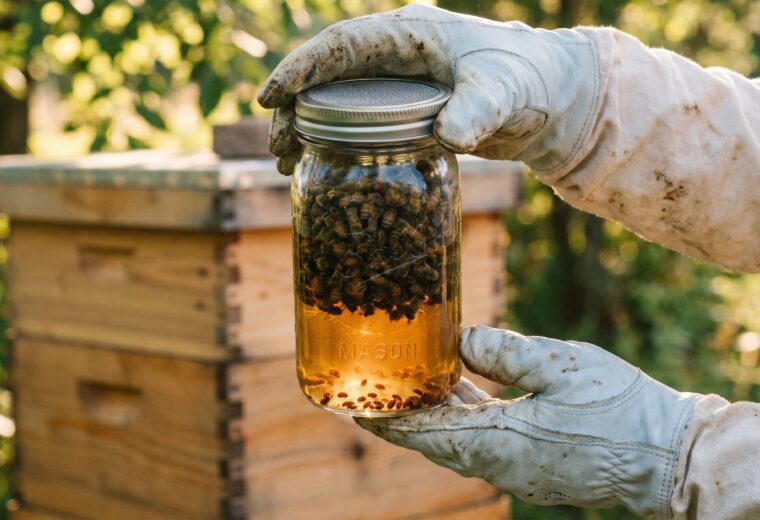
- Test. Sample about 300 bees (a half cup) from a brood frame and count the mites. An alcohol wash is the most accurate method; a sugar roll is gentler on the bees and keeps them alive.
- Decide. Convert your count to mites per 100 bees and compare it to the season's threshold. That number, not a hunch, tells you whether to treat.
- Treat. If you are over threshold, choose a product that fits the temperature and whether honey supers are on, and follow the label exactly.
None of these steps is hard, but the order is what makes it work. The mechanics of pulling and washing a sample are worth doing right the first time, so the step-by-step on running a mite test is the place to start if you have never done one. If you would rather buy a ready-made sampling jar and alcohol than assemble your own, our notes on a mite test kit cover what is actually in one.
The thresholds change with the season
A mite count means nothing until you compare it to a threshold, and the threshold is not fixed all year. The action level published by university extensions and the Honey Bee Health Coalition sits around 2 mites per 100 bees, and it is most critical in late summer and fall because the bees being raised then are the winter bees you cannot afford to lose. The table below turns the count into a decision.
| Season | What the colony is doing | Action level (mites / 100 bees) | What to do at or above it |
|---|---|---|---|
| Spring (build-up) | Population climbing, brood expanding | About 1 to 2 | Plan a treatment; keep it low before the honey flow |
| Summer (peak) | Largest population, honey supers often on | About 2 to 3 | Treat with a supers-on product if needed |
| Late summer (supers off) | Winter bees being reared | About 2 (treat firmly) | The critical knockdown; do not skip |
| Fall / pre-winter | Cluster forming | About 1 to 2 | Final cleanup, ideally broodless |
Read the late-summer row twice. That is the window the whole year hinges on. Penn State Extension states plainly that "controlling mites in the fall is a major factor linked to overwintering survival in honey bees," and the Coalition's guidance is to drop mite levels before the winter bees are produced. Hit that knockdown when supers come off, usually in August in much of the US, and you protect the cohort that has to survive until spring. Miss it and a colony that looks fine in September can collapse in midwinter. To work a specific count through to a yes-or-no, our piece on reading mite thresholds takes you number by number.
A worked example: a 17-mite count in August
Say you wash a half-cup sample, roughly 300 bees, in late August and count 17 mites. (You will see a half cup counted as anywhere from about 300 to 400 bees; the rate per 100 is what matters, so use the number your sample actually was.) To get mites per 100 bees, divide the mites by the bees and multiply by 100: 17 divided by 300, times 100, comes to about 5.7. That is a 5.7% infestation. The late-summer action level is around 2, so 5.7 sits roughly three times over the line, and these are the very bees that have to raise your winter bees. This colony needs treatment now, not after the next inspection. Run the same arithmetic on a count of 5 mites and you get about 1.7 per 100 bees, just under threshold, and the call is to monitor again in two weeks rather than treat. The decision falls straight out of the arithmetic, which is exactly why the test comes first. If you are still unsure whether your number means "treat," our guide on deciding whether to treat is built around that judgment.
Choosing a treatment: read the label, watch the weather
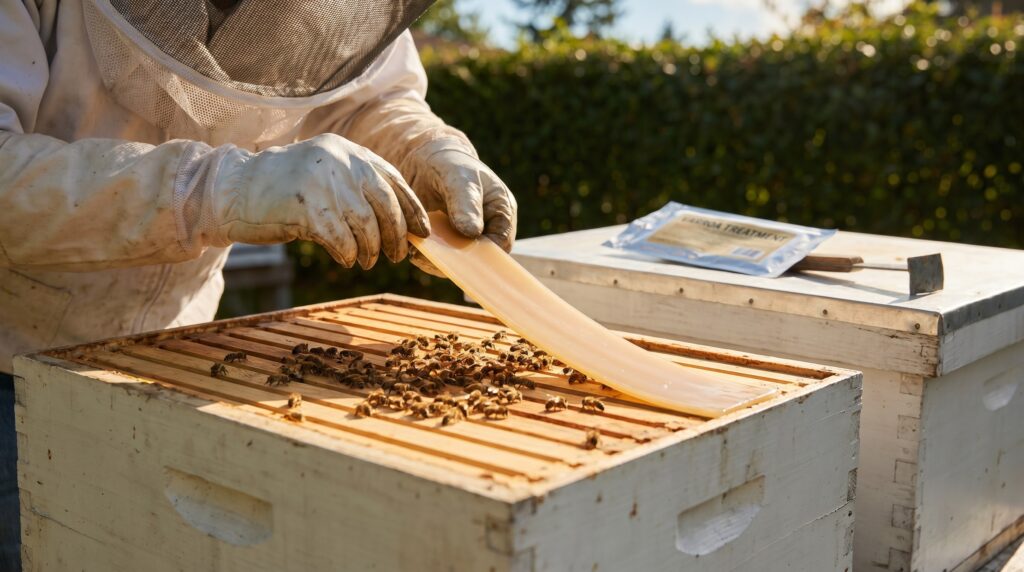
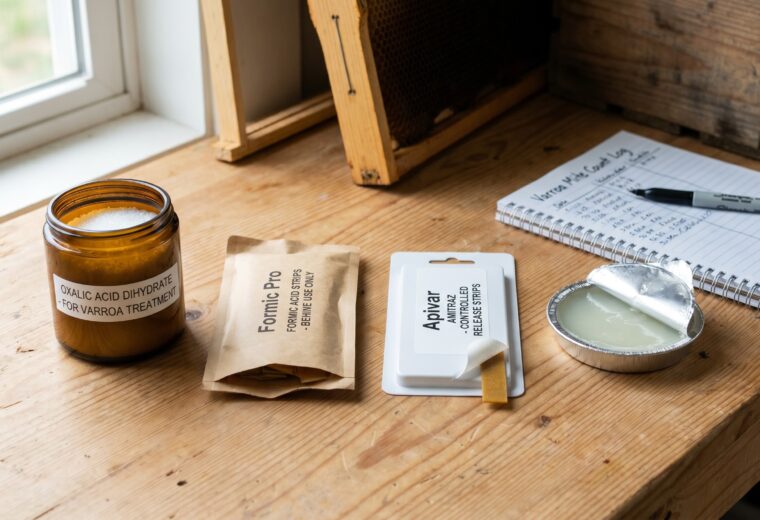
Once you are over threshold, the question is which product, and the answer depends on two things: the air temperature and whether honey supers are on the hive. The chemistry of each treatment is set by the label, which is a legal document, not a suggestion. Dosing, application, and protective equipment are spelled out there, and a beekeeping desk like ours points you to the authority rather than ruling on your specific dose. What we can do is map the common options to the conditions they suit.
| Treatment | Active ingredient | Supers on? | Temperature note | Best used |
|---|---|---|---|---|
| Formic Pro | Formic acid | Yes (per label) | About 50 to 85F; damage risk above 85F, weak below 50F | Summer, when you need to treat with supers on |
| Oxalic acid (dribble or vapor) | Oxalic acid | No | Works in cool weather; needs PPE | Broodless periods, late fall or early spring |
| Apivar | Amitraz | No | Wide temperature window | Late summer knockdown after supers come off |
| Apiguard | Thymol | No | Needs warm days to vaporize | Late summer, warmer climates |
Two points from Penn State Extension anchor that table. Formic acid is temperature-dependent: above 85F it can raise brood mortality and risk the queen, and below 50F it loses efficacy. Oxalic acid does not penetrate the wax cappings over brood, so it shines when the colony is broodless and the mites are all out on adult bees, which is why it is a winter or early-spring tool. Because these products work in different windows and against different mite stages, most beekeepers rotate them over the year rather than leaning on one. The full side-by-side, with the trade-offs and when each one fails, lives in our comparison of varroa treatments.
The first-year mistake to avoid
The most common beginner failure is not picking the wrong miticide. It is never testing at all, assuming a busy, good-looking hive must be healthy. Mite damage hides until it is too late. The colony grows faster than the mites do until late summer, then the bee population peaks and starts to fall while the mite population keeps climbing. That crossover is when infestation rates spike, and it lands right when the winter bees are being made. A colony can go from "looks great" to "doomed" in a few weeks, with no outward warning until bees with deformed wings start appearing, by which point the load is already severe.
So the discipline is simple: monitor at least four times a year, including the moment supers come off, and let the count make the decision. New beekeepers sometimes ask whether they even need to bother in year one. They do. A first-year package or nuc is just as vulnerable, and an untreated first-year colony is a classic spring dead-out.
When to step outside husbandry
Two topics sit outside ordinary hive management, and we handle both by pointing you to the right authority. The first is chemical dosing: never guess a dose or mix products off-label. The label and the manufacturer's instructions govern application and safety equipment, and your state's apiary inspector or extension office can advise on local specifics.
The second is your own safety. Working a hive means stings, and most are a normal local reaction: a sharp burning pain, redness, swelling, and itch at the spot, per the Cleveland Clinic. A systemic reaction is different and is a medical emergency. The Cleveland Clinic advises calling 911 or going to the emergency room right away for trouble breathing, a tight chest, difficulty swallowing, hives or swelling away from the sting site, dizziness, or stomach upset after a sting. If you know you are allergic and carry an epinephrine auto-injector, use it first, then call 911. Our overview of bee sting allergy goes into the difference between a local and a systemic reaction in more detail, but the emergency rule is the one to memorize before you ever open a hive.
Questions answered
Alcohol wash or sugar roll: which test should I use?
Both pull mites off a half-cup sample and give you a count you convert to mites per 100 bees. The difference is accuracy versus mortality. Penn State Extension calls the alcohol wash the most accurate method, because the alcohol dislodges nearly every mite; the cost is that the sampled bees die. A sugar roll keeps those bees alive but tends to undercount, since not every mite shakes loose, so a borderline sugar-roll reading is worth confirming. For the one test that decides your treatment, the late-summer check before winter bees, most beekeepers favor the wash and accept the small loss of bees for a number they can trust.
My count came back just under threshold. Do I wait or treat?
Just under the line in spring or early summer usually means recheck rather than treat, but shorten the interval: test again in about two weeks instead of waiting for the next routine inspection, because mite loads climb fastest in late summer. The closer you are to the winter-bee window, the less margin you have, so a borderline reading in August is treated more like a yes than a no. Also watch for reinfestation: when a nearby untreated colony collapses, your bees rob it out and carry its mites home, a "mite bomb" that can push a hive back over threshold within days of a clean test. That is one more reason the next check is two weeks out, not two months.
Can I treat in the dead of winter when there is no brood?
A broodless cold spell is one of the best treatment windows of the year, and oxalic acid is the tool built for it. Penn State Extension notes that oxalic acid does not penetrate the wax cappings, so it works best when no brood is sealed and every mite is riding on an adult bee, exactly the situation in a broodless winter cluster. A single well-timed broodless application can knock the load down hard going into the worst of the cold. Follow the product label for the method and dose, and only open or disturb the cluster when conditions allow.
Can I treat with honey supers on the hive?
Only with a product labeled for it. Formic Pro (formic acid) can be used with supers on within its temperature window of about 50 to 85F. Amitraz (Apivar) and thymol (Apiguard) require supers off. Always follow the label, which is the legal authority on use.
- Penn State Extension, "Methods to Control Varroa Mites: An Integrated Pest Management Approach"used for the action threshold (about 2 mites per 100 bees), virus transmission, fall-timing importance, and the formic and oxalic acid temperature and broodless notes
- Honey Bee Health Coalition, "Tools for Varroa Management"used for the test-decide-treat cadence, monitoring at least four times a year, and the 2 percent treatment threshold
- Mississippi State University Extension, "Sampling for Varroa Mites Using an Alcohol Wash"used for the half-cup nurse-bee sample method and converting a mite count to a percentage
- van Dooremalen et al., PLoS ONE, "Winter Survival of Individual Honey Bees and Honey Bee Colonies Depends on Level of Varroa destructor Infestation"used for the winter-bee mechanism linking late-summer mite loads to winter colony loss
- Cleveland Clinic, "Bee Sting"used for distinguishing a normal local sting reaction from a systemic one and the call-911 emergency signs