Swarming and queens: spring management for new beekeepers
Why bees swarm, how to read queen cells, prevent and catch swarms, split a hive, and requeen, with a swarm-risk checker for your spring hive.
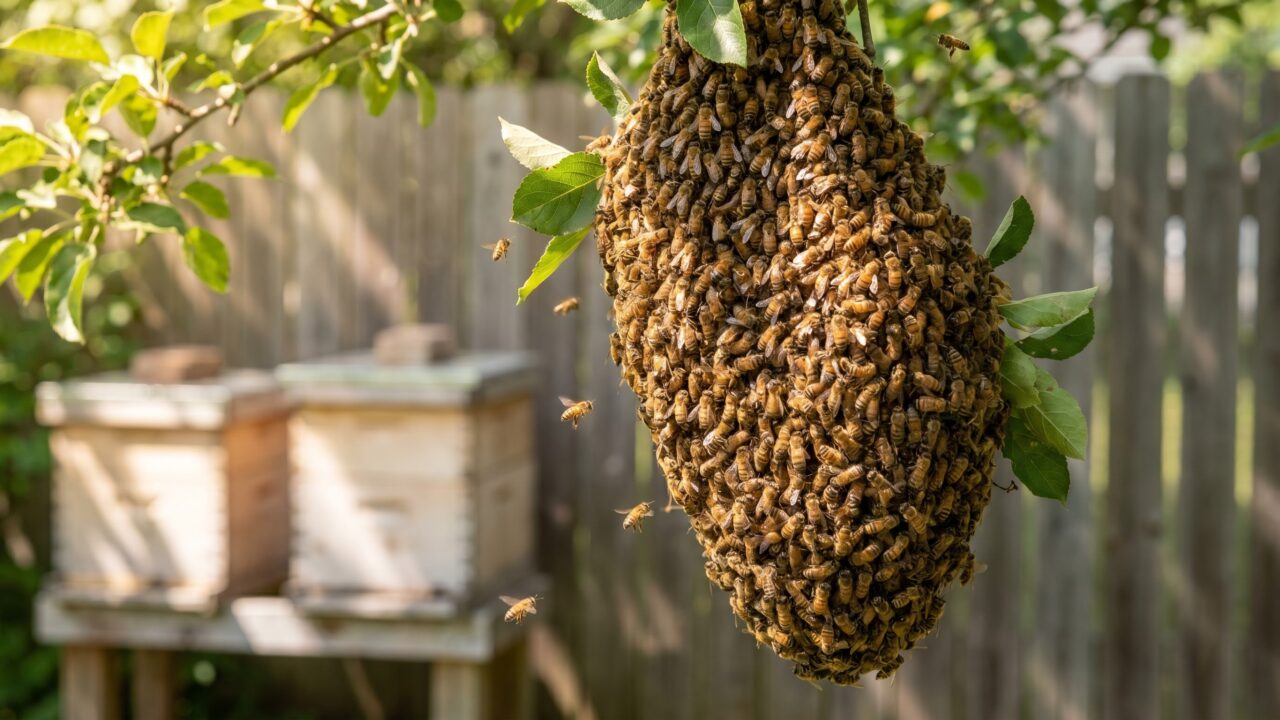
A swarm is not your colony misbehaving. It is your colony reproducing. On a warm spring afternoon, often midday, about half the bees and the old queen pour out the front, swirl into a cloud, and settle into a hanging cluster on a branch or fence post while scouts hunt for a new home. The hive you started with does not die. It stays behind with a fresh queen on the way and a thinner crew. So spring beekeeping is really one question asked five ways: will my bees feel crowded enough to leave, and what do I do about it?
This page is the map for that whole spring. It covers why colonies swarm, how to spot the warning signs early, how to prevent a swarm, how to catch one if it happens anyway, how to split a hive on purpose, and how to fix a queen who has gone wrong. Each of those gets its own deeper article, linked as we go. The honest headline first: once your bees commit to swarming, your power to stop them shrinks fast, so spring management is mostly about timing and space, not heroics at the last minute.
Why a healthy colony decides to leave
Swarming is how a honey bee colony makes a copy of itself. UF/IFAS Extension describes it plainly: swarms are colony-level reproduction, and when a colony swarms it splits into two colonies. One queen, two households. That is the goal from the bees' point of view, and a colony that swarms is usually a strong, well-fed one, not a sick one.
The trigger is congestion. When the brood nest fills with bees, brood, honey, and pollen, the queen runs out of empty cells to lay in and her crowding pheromone gets diluted through the press of bodies. The colony reads that as a signal to reproduce. In most of the country this peaks in mid to late spring, when flowering trees flood the hive with nectar and pollen and the population climbs fast. Penn State Extension ties the timing to that bloom: the spring flow drives a rapid increase in brood rearing and colony population, and queen rearing for swarming follows.
One thing to hold onto, because new beekeepers brace for the wrong fear: a swarm is a reproductive event, not an aggressive one. The flying cloud looks alarming and sounds worse. The bees in it are loaded with honey for the journey and have no nest, no brood, and no stores to defend. The full story of the biology, and why your own bees swarming is a sign you did something right, lives in our breakdown of why bees swarm.
Reading the warning signs in time
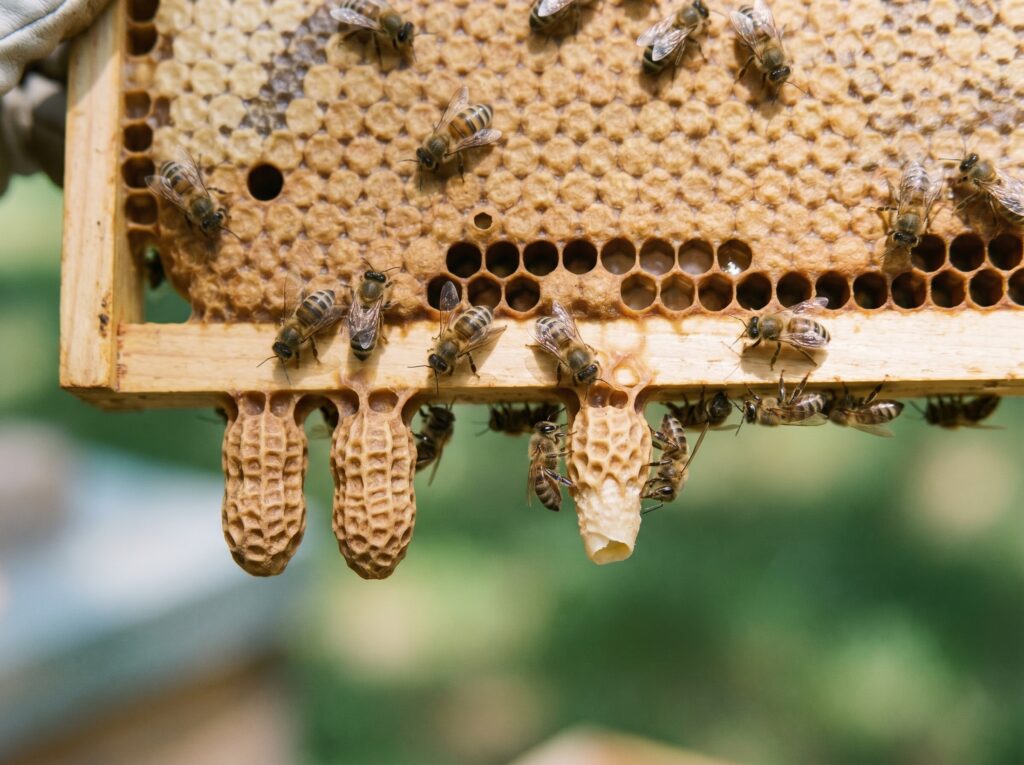
Your whole spring hinges on catching the colony's intent before it acts. The bees telegraph the plan, and the clearest telegraph is queen cells. These are peanut-shaped, ribbed cells that hang down off the comb, much bigger than a normal worker cell. When a colony plans to swarm, it builds a batch of them, often along the bottom and outer edges of the frames. Penn State Extension calls a large number of reared queen cells the first visual cue that swarming is imminent. Other early tells: a brood nest packed wall to wall with no open cells for the queen, bees clustered idle on the front porch on a mild day (called bearding), and lots of new drones.
Not every queen cell means a swarm, and confusing the three kinds is the most common rookie panic. Here is the quick read, with the source distinction baked in.
| What you see | Where it sits | What it usually means | What to do first |
|---|---|---|---|
| Several cells, capped or building | Bottom and outer edges of frames | Swarm cells: the colony wants to reproduce | Act now (space or a split); the clock is short |
| One or a few cells | On the face of the brood pattern | Supersedure cells: bees are replacing a failing queen | Usually leave them; the colony is self-correcting |
| Cells torn open from the side or sitting in a gap where eggs vanished | Anywhere on brood comb, suddenly | Emergency cells: the queen was lost | Confirm queenless, then let them raise one or requeen |
UF/IFAS Extension draws that swarm-versus-supersedure line by position: swarm cells along the outer edges of the frame, supersedure cells at the perimeter of the brood pattern on the comb face. The timing pressure is the part beginners underestimate. New capped queen cells develop in only about seven to ten days, and once those cells are sealed it is difficult to stop the swarming behavior. The window between finding cells and the bees flying is narrow and easy to miss. That is why spring inspections run tighter than summer ones: every seven to ten days through swarm season, checking the bottom edges of brood frames specifically. (Penn State frames the routine slightly more relaxed, at least every two weeks; in active swarm weather, lean to the shorter interval.) Telling these cell types apart is worth its own walk-through, which is what our piece on queen cells does, photo by photo.
A swarm-risk check you can run at the open hive
Prevention beats reaction here, and prevention is about reading risk a few weeks ahead, not the morning of. Run this quick scoring pass during a spring inspection. It is built from the congestion and timing signals the extension sources flag, turned into something you can total in your head over the open box. Count one point for each true statement.
| Signal at this inspection | Score if true |
|---|---|
| It is within 2 to 4 weeks before your main nectar flow (or the flow is on) | 1 |
| The colony fills two or more boxes and feels crowded | 1 |
| 7 or more of the 10 frames in the top box are drawn and covered with bees | 1 |
| The brood nest is solid with little or no empty cell space for the queen to lay | 1 |
| You see plenty of adult drones flying and dandelions or similar are in bloom | 1 |
| You found queen cups with eggs or larvae, or true queen cells, on the lower edges | 2 |
Read your total honestly. A score of 0 to 1 means low risk: keep inspecting on the seven-to-ten-day rhythm. A 2 to 3 means rising risk: add space this week and plan a split. A 4 or more, especially with any points from the last row, means the colony is committed or close to it; move to a split now rather than betting you can prevent it. Treat that last row as a near-override. Capped swarm cells on the bottom bars usually mean the impulse is already locked in, and your job shifts from prevention to managing the split on your terms.
How to prevent a swarm
Three levers stop most swarms, and they all come down to relieving congestion before the bees feel it. First, give them room ahead of need. UF/IFAS Extension puts the principle simply: add empty supers, because bees prefer empty space above them. A useful trigger is the seven-of-ten rule. When seven of the ten frames in the top box are drawn and full of bees, the next box should already be on. Adding space after they feel crowded is too late.
Second, open the brood nest. Slipping an empty drawn frame or a foundation frame into the middle of a packed brood area gives the queen somewhere to lay and breaks up the wall-to-wall congestion that sets off the impulse. Third, and most reliable once queen rearing has started, make a split. Penn State Extension is direct that splitting is the most effective method to manage swarming after the colony begins rearing queens. A split is simply a planned swarm you control: you take the increase instead of losing it over the fence.
Removing or cutting out queen cells buys a little time, but on its own it rarely works for long. The colony just builds more, and if you miss one capped cell on a bottom bar, they leave anyway. Cell removal only helps when you pair it with real space or a split. The full preventive playbook, including the dilemma of an overcrowded single-box colony, is laid out in our swarm-prevention guide.
If they swarm anyway: catching the cluster
Even careful beekeepers lose a swarm now and then, and a hanging cluster is one of the calmest things in beekeeping to handle. Bee Health (the eXtension Foundation) notes that for the first 24 to 36 hours after landing, the bees are very docile because they have no nest to protect. A low cluster within reach is usually a matter of holding a box under it and giving the branch one sharp shake, then waiting for the stragglers to follow the queen's scent down into the box.
A few honest limits. A swarm 30 feet up a tree is not a beginner job, and bees that have moved into a wall void are a removal job, not a swarm catch. Catching your own escaped swarm, or a neighbor's, is the cheapest bees you will ever get, and the technique, gear, and the timing of when a cluster will and will not stay are covered step by step in how to catch a swarm.
Splitting a hive on purpose
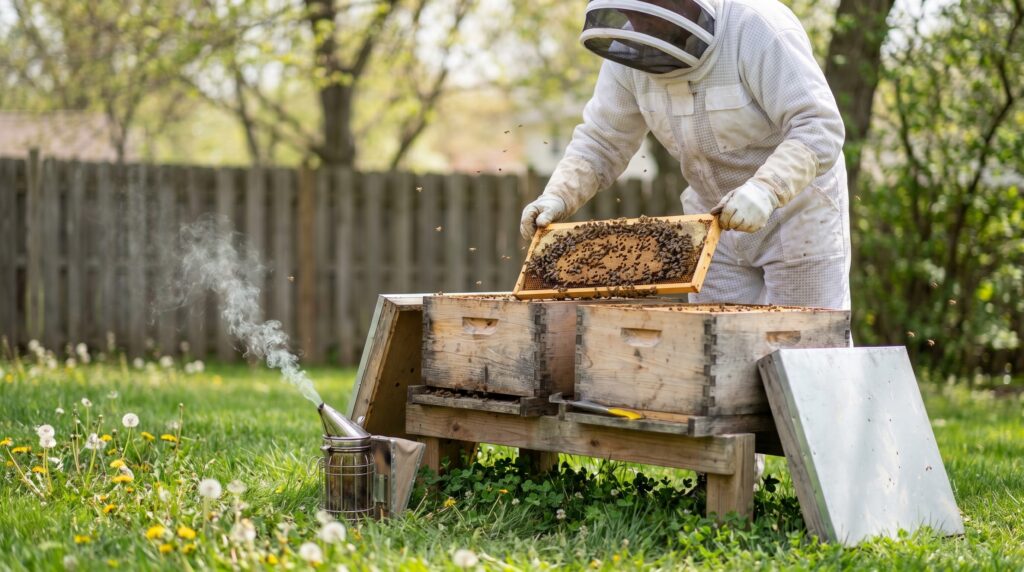
A split is swarm prevention and colony increase in one move, and it is the single most useful spring skill to learn. The plain version, drawn from Penn State Extension's colony-division method: find the queen, move her on her frame into a new box, and split the honey and pollen stores evenly between the two halves. The half that keeps the queen gets empty frames so she can keep laying. The queenless half keeps capped queen cells and brood and raises its own new queen, which will be laying in roughly a month once she emerges, mates, and starts up.
Timing makes or breaks it. Split before your major nectar flow so both halves rebound and you do not gut your honey crop, and wait until the colony is at least two hive bodies tall and genuinely crowded before you divide it. The reliable seasonal cue, true almost anywhere, is the presence of drones and dandelions; drones mean a new queen can mate, and dandelions mean forage is coming. The full method, including how many frames go where and how to make sure each half has eggs or cells to make a queen, is in our step-by-step on splitting a hive.
When the queen is the problem
Sometimes spring trouble is not about leaving, it is about the queen herself. She can fail, run out of stored sperm and start laying only drones, get injured, or simply slow down. A healthy queen lays a tight, solid brood pattern; UF/IFAS Extension uses a working rule of thumb that when more than about 20% of a brood frame is gappy unsealed brood, the pattern is poor enough to question her. A colony that turns aggressive often calms down within a brood cycle of getting a new, better-tempered queen.
Knowing what each problem looks like matters more than memorizing fixes. A truly queenless colony with no eggs and no cells in progress will not fix itself and needs a queen from you. Workers laying multiple eggs per cell, scattered and on the cell walls, mean laying workers have taken over, which is a harder fix that has to start with brood from another hive. UF/IFAS Extension recommends replacing the queen annually to keep her laying near her peak of up to about 2,000 eggs a day, and notes that buying a mated queen to introduce directly is usually the better route than letting a colony raise its own.
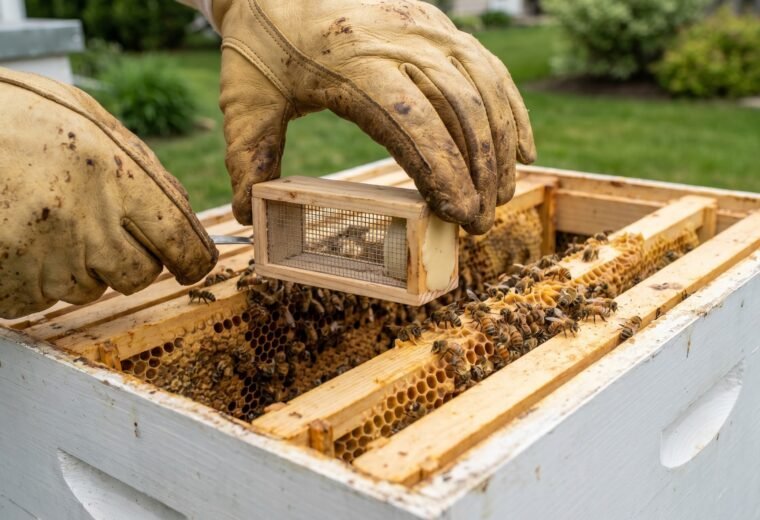
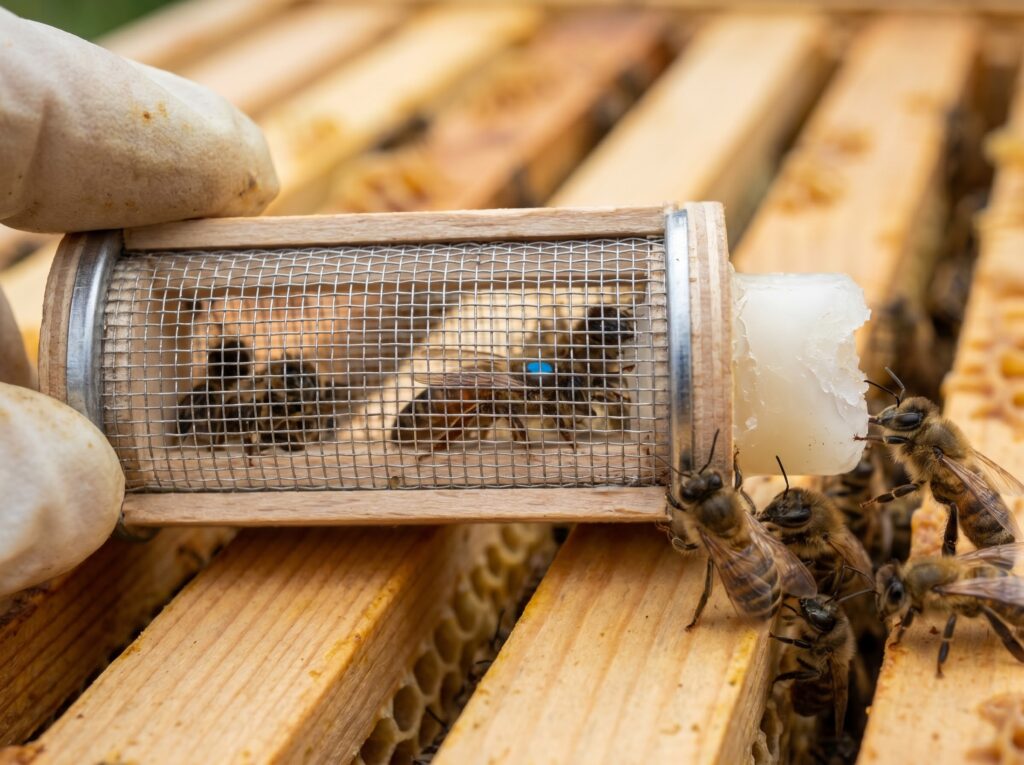
Requeening is mostly about patience at the cage. A purchased queen comes in a small cage plugged with candy; the colony eats through the plug and releases her slowly over a couple of days so they accept her scent instead of killing a stranger. Always follow the queen producer's release instructions, since methods vary. The whole sequence, from confirming you are actually queenless to a safe introduction, is covered in how to requeen a hive.
The spring cost and loss picture, honestly
Two numbers keep spring expectations realistic. First, losing colonies is normal and ongoing. The 14-year running average annual colony loss in the US is about 41%, and the most recent national survey put total managed-colony loss for April 2024 to April 2025 at 55.6%, the highest on record since tracking began in 2010. Commercial operations fared worse still: a separate Project Apis m. survey covering June 2024 to February 2025 put their losses at around 62%. Replacing dead-outs, and buying the bees and gear to do it, is a recurring cost, not a one-time mistake. Splitting your own strong colonies in spring is the cheapest way to cover those losses.
Second, swarm season does not pause your mite work. Varroa is the leading manageable killer behind those losses, and a swarm or a split is a good moment to check, since a broodless new split can be easy to treat. Monitor with an alcohol wash on a sample of about 300 bees; Penn State Extension aims to keep mite levels at or below roughly 2 mites per 100 bees and times the critical knockdown before winter bees are reared. Mite dosing is label-only and outside this page; the monitoring and threshold detail sits with our guide to varroa mites. Spring is for building strong colonies, and strong colonies are the ones that both want to swarm and survive the winter, which is why reading them well in these few weeks pays off all year.
Questions answered
How long do I have once I find queen cells?
Not long. New queen cells become capped in about seven to ten days, and once they are sealed it is hard to stop the colony from swarming. The deadline that matters, though, is the cap, not the swarm date: colonies most often leave on the first warm, calm afternoon after the first cell is sealed, so an open cell with an egg or larva still buys you a few days to act, while a freshly capped one means days have already run out. If you find capped cells on the bottom edges, treat the colony as committed and split it rather than trying to prevent the swarm.
Will removing queen cells stop a swarm?
Rarely on its own. The bees simply build more, and one missed capped cell lets them leave anyway. Cells are easy to overlook too: they tuck into the seam between two frames or hide on the far face, so a quick scrape almost never gets them all. Cutting cells only helps when you pair it with real congestion relief the same day, adding space, opening the brood nest, or making a split, and even then you should plan to recheck in a week, because a colony still in the swarming mood will just start the batch over.
Is a swarm dangerous to me or my neighbors?
A clustered swarm is usually very docile for its first day or so because the bees have no nest, brood, or stores to defend. They are focused on finding a home, not guarding one. Bees that have moved into a wall are a different situation and a removal job, not a swarm catch.
Should I let my colony raise its own queen or buy one?
For a planned split, letting the queenless half raise a queen from existing cells works well. To fix a failing or aggressive queen quickly, buying a mated queen and introducing her directly is usually the better route, since a colony-raised queen adds about a month of waiting to mate and start laying.
- UF/IFAS Extension, Swarm Control for Managed Beehives (ENY-160)used for why colonies swarm, swarm versus supersedure cells, capped-cell timing, and adding space.
- Penn State Extension, Colony Division: An Easy Method to Split a Colonyused for the split method, even resource split, and the drones-and-dandelions timing cue.
- Penn State Extension, An Introduction to Queen Honey Bee Developmentused for the 16-day queen development time and the three reasons colonies rear a new queen.
- UF/IFAS Extension, The Basics of Queen Management (ENY2128)used for annual requeening, the up-to-2,000-eggs-a-day rate, and the poor-brood-pattern rule.
- Bee Health (eXtension Foundation), Collecting a Swarmused for swarm docility in the first 24 to 36 hours and basic cluster collection.
- Apiary Inspectors of America / Auburn University / Oregon State University, 2024-2025 US Beekeeping Surveyused for the 55.6% total managed-colony loss for April 2024 to April 2025, highest on record since tracking began in 2010-2011, and the 14-year running average of 41.4%.
- Honey Bee Health Coalition / Project Apis m., 2025 Colony Loss Surveyused for the approximately 62% average loss among commercial operations (500+ colonies) for June 2024 to February 2025.