How to read a frame: eggs, larvae, capped brood, and everything else you'll find in the box
Learn exactly what eggs, larvae, capped brood, pollen, nectar, and capped honey look like on a beehive frame, and what a healthy frame tells you.
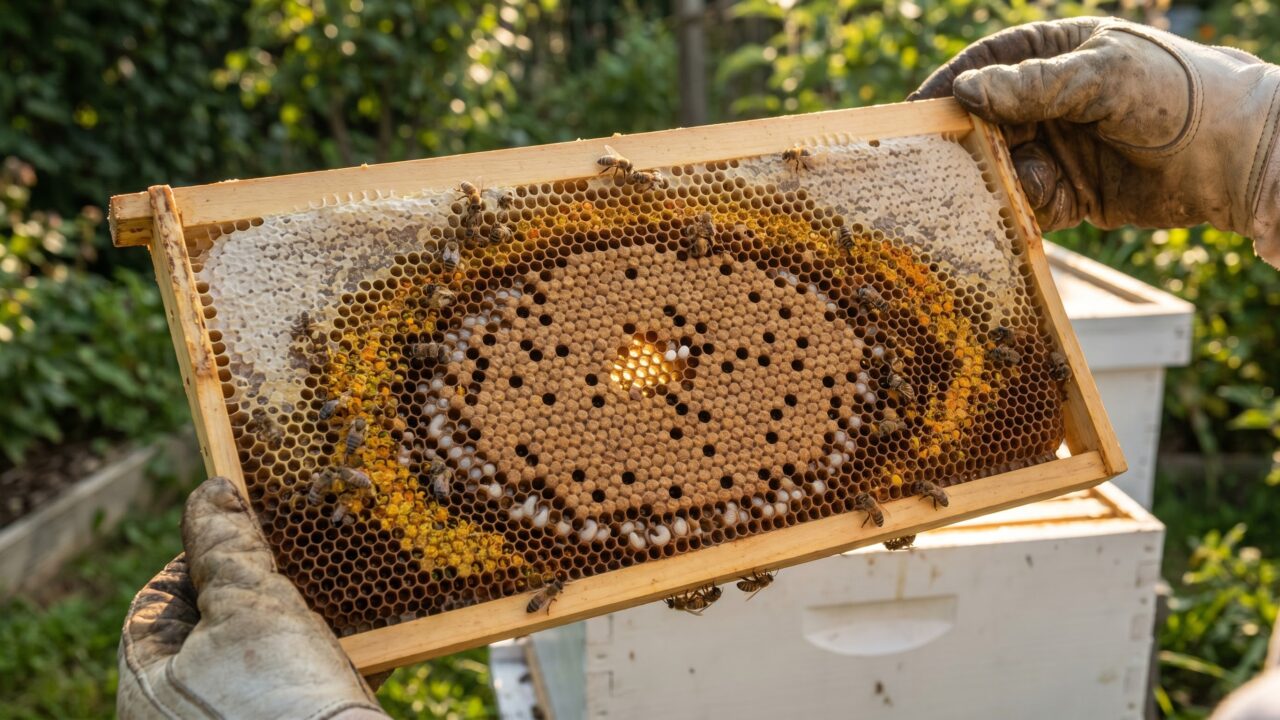
Pull a frame from a healthy hive and you're holding a lot of information at once. Knowing how to decode it separates a confident inspection from a guessing game. Every zone on that frame - eggs in the center, larvae curling outward, capped brood, a crescent of pollen, honey sealed at the top corners - tells you something specific about colony health, queen activity, and whether the hive needs any action from you.
This guide walks through each type of cell you'll find, where it sits on the frame, what it looks like, and what to conclude from it. A companion piece on how to inspect a beehive covers the inspection process itself - the sequence, the smoke, the body mechanics. Here the focus is purely on reading what the frame is showing you.
The geography of a frame: what goes where
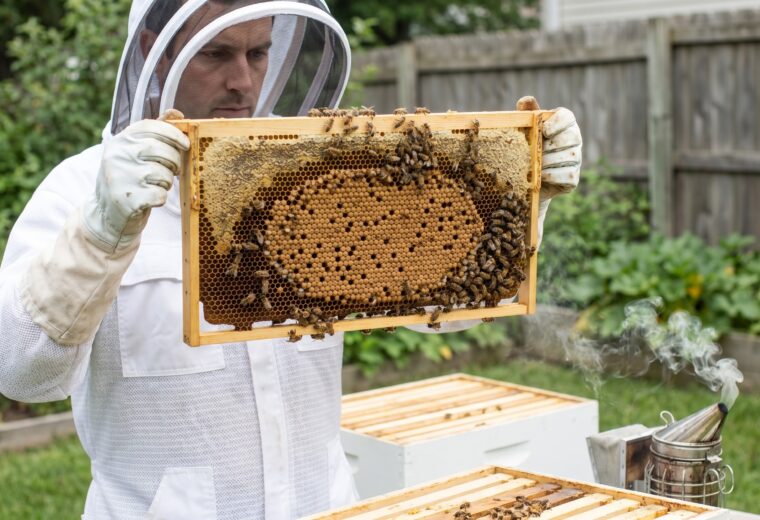
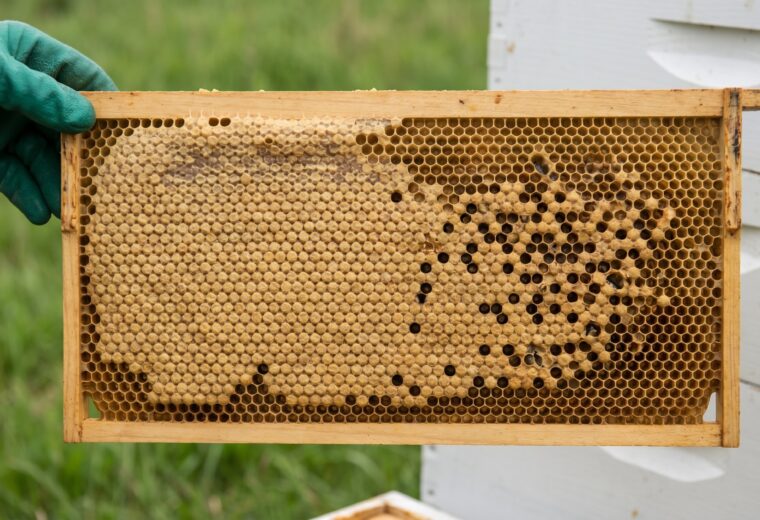
Bees arrange the brood nest with a logic that makes sense once you see it a few times. The queen lays from the center of a frame outward, so the youngest eggs cluster near the middle and the brood radiates concentrically from there - oldest capped brood toward the edges, youngest open cells toward the center. Around that brood core, workers pack a band of pollen (sometimes called bee bread). Beyond the pollen, nectar and capped honey fill the cells that arch above and outside the brood zone. Think of a single frame as a cross-section through a roughly oval nest: brood in the heart, stores wrapping the outside like insulation.
Across multiple frames in the box, the brood nest takes on a football shape - tallest in the center frame, tapering toward the outer frames. Drone brood, which you'll recognize by its larger, dome-shaped cappings, tends to cluster at the margins of brood comb rather than in the main laying zone. If you pull frame seven of ten and it's solid worker brood wall to wall, you're at the center of the nest. Frame two is probably mostly honey with a crescent of capped brood at the bottom edge.
Reading the brood cells
Eggs: your three-day window into the queen
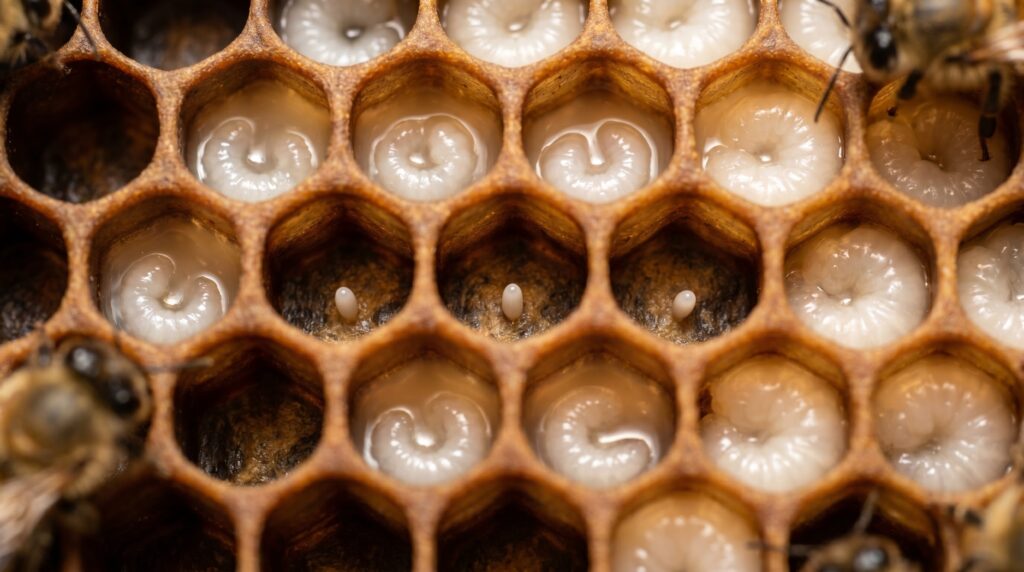
An egg is smaller than most new beekeepers expect. UF/IFAS describes it as looking like "a small grain of rice" standing upright at the bottom of the cell. On day one it stands nearly vertical; by day three it has tilted over and flattened to the cell floor, where it hatches into a larva. That three-day standing window is exactly why finding eggs tells you the queen was present and laying within the last three days - you don't have to spot her on the frame to know she was there recently.
Light matters enormously here. Hold the frame so sunlight or a bright headlamp strikes the cell bottoms at a low angle. Tilt the frame toward you. The eggs should appear as tiny white slivers standing in otherwise empty cells. One egg per cell is the rule; a healthy queen lays one and moves on. Multiple eggs in a single cell, or eggs stuck to cell walls rather than the bottom, point to a laying worker - a separate problem covered in the queenless hive guide.
Open larvae: the active feeding zone
At three days the egg hatches into a larva. Young larvae look like tiny pearly-white grubs curled in a C-shape at the bottom of their cell, floating in a pool of brood food that appears milky or glossy. MAAREC describes them as "pearly white in color with a glistening appearance." That gloss is the key word: healthy larvae shine. A larva that looks dull, yellowish, brownish, or has dried out is not healthy.
Workers feed each larva between 1,000 and 2,000 times during the roughly six days it stays open (UF/IFAS). As the larva grows, it curls tighter in the cell and eventually fills most of the space. Workers then cap the cell with wax, and the larva spins a silk cocoon before pupating.
The size of the open larval pool tells you something useful. A large crescent of curled white larvae alongside a tight brood center usually means the queen is laying well and the population is growing. A very thin ring of open larvae with a lot of empty or capped-only frames can mean laying has slowed - either seasonal or a sign of trouble worth investigating through brood pattern assessment.
Capped brood: where the colony hides its future
Once workers seal a brood cell, the cap should be slightly domed - convex, not sunken - and a warm tan or biscuit-brown color. MAAREC summarizes healthy worker-brood cappings as "medium brown, convex, and without punctures." The hexagonal cell shape is still visible through the wax, especially on newer comb.
Worker cells emerge in about 21 days from egg, queens in 16, drones in 24. This matters when you're counting forward from what you see: if you find eggs today and no open larvae, either the queen just started laying or something disrupted the larvae. If you have capped brood but no eggs and no young larvae at all, the queen has been gone for at least nine or ten days.
Drone cappings look noticeably different - they're larger cells and the cap puffs out more than worker caps, almost bullet-shaped. Seeing a modest amount of drone brood at the frame margins through spring and early summer is completely normal. A solid block of drone caps in the center of the brood nest is not normal, and is one sign of a failing or laying-worker situation.
The frame-reading reference table
The table below pulls the visual and positional cues into one place. A normal inspection moves fast once these are locked in.
| What you see | Appearance | Normal location on frame | What it tells you |
|---|---|---|---|
| Egg (days 1-3) | Tiny white sliver, upright to tilted, one per cell bottom | Center of brood nest | Queen laid within last 3 days |
| Young larva (days 3-6) | Pearly-white C-shaped grub, glistening, floating in milky food | Inner brood zone, around the egg area | Colony feeding and growing normally |
| Older larva (days 6-8) | Larger C-shaped grub nearly filling cell, still white and shiny | Outer ring of open brood | Brood development on track |
| Capped worker brood | Tan-brown, slightly domed caps; hexagonal cells visible | Main brood zone, inside pollen band | Pupae developing; queen was active 9+ days ago |
| Capped drone brood | Larger, bullet-domed dark-brown caps | Margins of brood comb | Normal seasonally; unusual in center |
| Pollen / bee bread | Bright multicolored granules (yellow, orange, red, sometimes blue-gray) in open cells | Band immediately outside active brood | Protein stores; colony feeding brood |
| Nectar (uncapped) | Watery, shimmery liquid filling cells; may drip if frame tilted sharply | Outside pollen band, upper frame areas | Incoming flow; not yet ripe honey |
| Capped honey | White to tan wax cap, slightly convex, often dry-looking | Upper corners and outer frames | Cured stores; moisture below ~18.6% (USDA Grade A maximum) |
| Empty / polished cells | Clean, slightly waxy-shiny walls, no contents | Anywhere; expanding brood zone edge | Ready for eggs or stores |
Pollen and stores: what the color bands mean
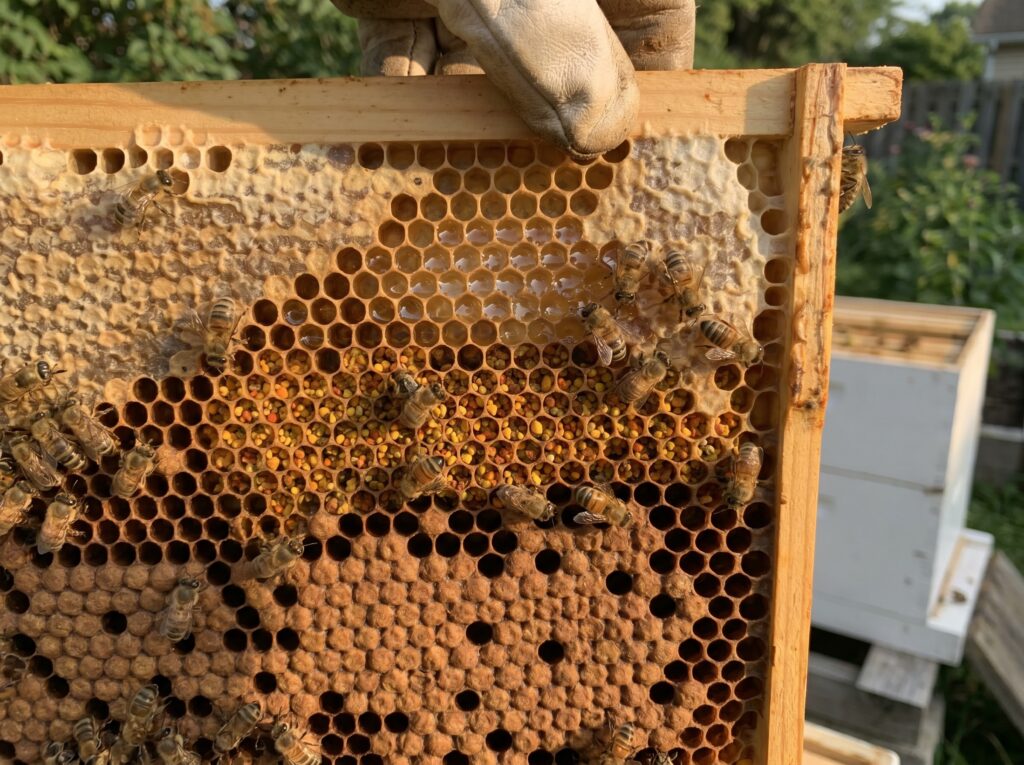
Pollen is the easiest thing to identify on a frame. It's the most colorful material in the comb - cells packed with bright yellow, orange, red, or occasionally blue-gray granules depending on which flowers are blooming nearby. The BeeMD (USDA/ARS) calls it "the most conspicuous, certainly the most colorful, material found in beeswax comb cells." You'll typically find pollen in a ring just outside the brood zone, because nurse bees need protein close at hand to make brood food. A wide, well-stocked pollen band in spring means foragers are working and the brood-rearing system has fuel.
Nectar looks completely different from pollen and from capped honey. It's a liquid, watery and slightly shimmery, sitting openly in cells. Hold the frame horizontally and look across the top; nectar cells often catch the light differently than empty cells. The BeeMD notes that "ripening nectar may drip out of cells if the comb is held vertically" - which is your practical field test. If nectar drips when you tilt a frame past vertical, the moisture content is still high and those cells will not be capped for a while yet.
Capped honey is nectar that the bees have reduced to below roughly 18.6% moisture - the USDA Grade A ceiling - and then sealed with wax. The cap is typically white to tan, slightly convex, and has a drier, more matte look than capped brood. Mann Lake's guidance is to wait for about 80-90% of a frame's cells to be capped before harvesting, because uncapped cells almost certainly still carry too much moisture and fermentation risk is real. Shaking the frame gently over the hive is the practical check: no liquid drips from uncapped cells means the honey is thick enough to be close to ready.
What a healthy frame actually looks like
A healthy frame in a well-managed hive has a pattern that is easy to recognize once you've seen it a few times. The brood area is solid - very few skipped cells in the main laying zone. MAAREC puts the standard as "a solid pattern with few cells missed." The cappings are consistent in color and shape, no sunken spots, no perforations. Within the open brood zone you can see all three developmental stages at once: eggs in the center, small larvae curling outward from there, older larvae at the outer edge of the open-brood ring. The ratio of eggs to larvae to capped pupae runs roughly 1:2:4 across the frame, because each successive stage takes longer - pupae need about 12 days in the capped cell while the egg stage is only three days.
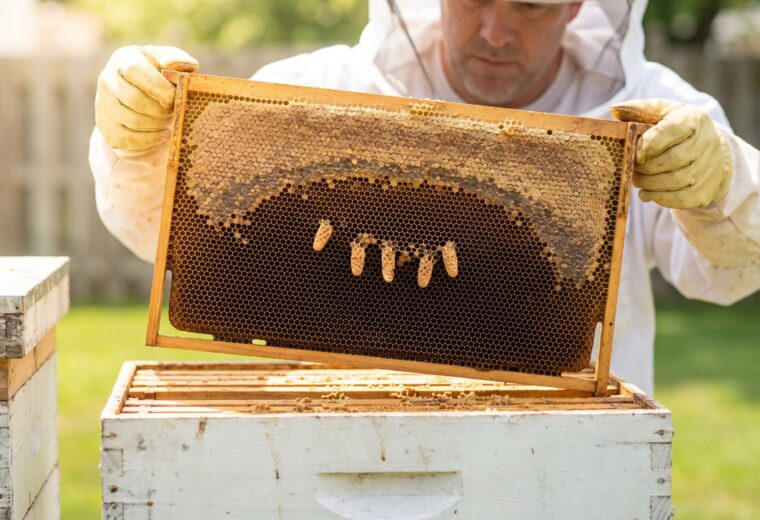
Brood comb color is also worth noting. Freshly drawn comb is bright white. Comb that has raised several generations of brood darkens progressively as larval cocoons accumulate in the cell walls, eventually going deep brown or near-black. Dark comb is normal as long as the pattern inside it is solid and the cappings are correct. The BeeMD recommends culling and replacing brood frames every three to five years regardless, because very old comb carries a higher pathogen and pesticide load.
For a systematic comparison of frames that are clearly healthy against frames showing specific warning signs, the normal vs. problem frames guide has side-by-side breakdowns.
Warning signs to catch early
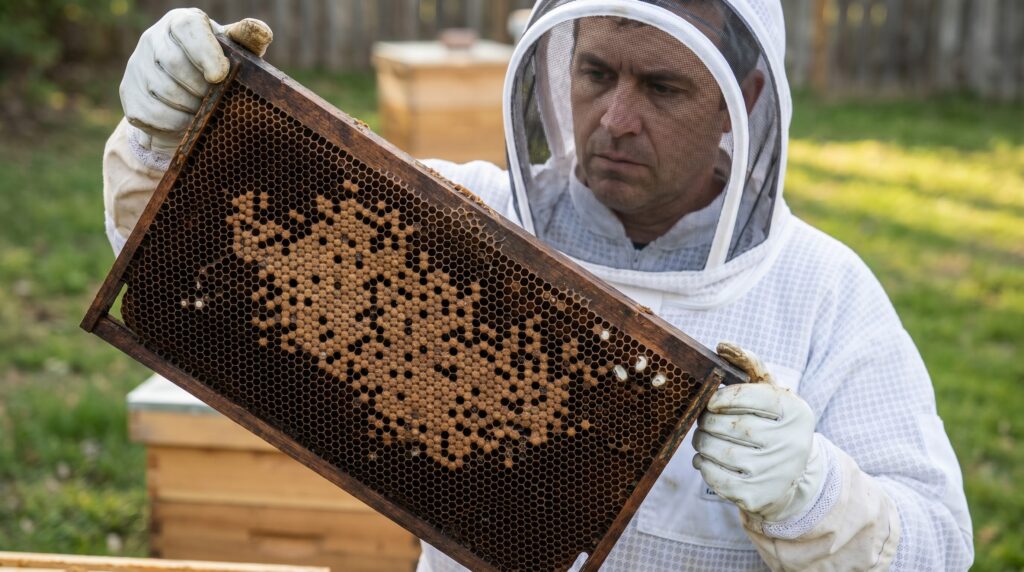
The biggest beginner mistake in a frame inspection is treating a problem sign as something to check on "next time." By the time most brood diseases are obvious, the colony has been compromised for weeks. Train yourself to flag these immediately:
- Sunken, perforated, or greasy-looking caps. This is the primary visual flag for American foulbrood (AFB). Penn State Extension describes the cappings as "sunken, dark, greasy, perforated." If you uncap a suspicious cell and insert a toothpick, AFB will rope out a brown, stringy mass half an inch or more as you withdraw it. AFB is a reportable disease in most states. Antibiotics (oxytetracycline, tylosin) suppress active bacteria but do not kill spores and the disease recurs after treatment stops - burning is the standard protocol. Contact your state apiarist.
- Rattling mummies. Larvae that died from chalkbrood harden into chalk-white or gray-to-black pellets inside cells. The Texas Apiary Inspection Service describes the material as "white cotton-like mycelium that will fill the entire brood cell," which then hardens and may darken. Shake a suspected frame over the hive - a rattle from underneath caps is diagnostic. Mild chalkbrood often resolves on its own with better ventilation and a stronger population, but it warrants monitoring.
- Fluid-filled "gondola" larvae. Sacbrood virus kills prepupae just after the cell is capped. The dead larva forms a sac of clear to yellow-brown fluid with its head end curved upward and darkening first - the characteristic "Chinese slipper" shape. Sacbrood at low levels is common and usually self-limiting, but a frame with many gondola-shaped dead larvae signals a stressed colony that needs attention.
- Spotty pattern with chilled-brood margins. A scattered, irregular pattern of cappings with many skipped cells can mean the queen is failing, or that a varroa infestation has reached the point where infested brood is being removed or dying in cell. The BeeMD notes that "chilled brood will likely initially show at the margins of the brood area" - so look at the outer edge of the brood zone first when the center looks normal but the count feels low. Varroa-related spotting is covered in the varroa mites overview, and if you need help confirming queenlessness, the article on how to find the queen walks through the confirmation steps.
Putting it together at the hive
A seven-to-ten-day inspection rhythm is reasonable through the active season; over-inspecting disrupts the colony more than it helps. When you pull a frame, look in this order: eggs first (confirms queen within 72 hours), then larvae (confirms healthy feeding and development), then capped brood pattern (confirms consistent laying across the last nine days or more), then stores (pollen band intact, nectar or capped honey in the arcs above). That sequence takes about 90 seconds per frame once you're practiced.
If you find eggs and solid brood across the center frames, you can move quickly. That is the whole job. If any part of that sequence breaks down - no eggs, no larvae, spotty caps, wrong-colored larvae, unusual-smelling cells - slow down and work methodically through what you're seeing before closing the hive. Most problems caught at this stage are correctable. Most problems missed for another inspection cycle are harder.
Questions answered
How do I tell a drone cell from a worker cell?
Drone cells are larger in diameter and the capped cell puffs outward noticeably more than a worker cap - almost bullet-shaped rather than slightly domed. You'll also usually find drone brood at the outer margins of the brood area, not in the solid center zone where the queen concentrates worker laying. Side by side, the size difference is clear even without a reference guide.
What if I can't see eggs no matter how hard I look?
Eggs are genuinely difficult to spot in low light or at certain angles. Try moving so direct sunlight falls into the cells at a low angle and tilt the top of the frame toward you. Many experienced beekeepers use a headlamp pointed into the cells. If you still can't find eggs but you do have young curled larvae (pearly white, C-shaped, in fresh-looking cells), the queen was almost certainly active within the last eight or nine days. Larvae that small confirm recent laying - eggs take three days to hatch, and worker larvae remain open for roughly five and a half days before capping.
Is it normal to have some empty cells in the brood nest?
A handful of empty or polished cells scattered through the brood zone is normal. The queen skips an occasional cell, bees sometimes remove emerging adults and haven't refilled the space yet, and some cells get polished and prepared for a new laying cycle. The concern is a distinctly spotty or irregular pattern - large islands of skipped cells with an overall inconsistency to the capping color and shape. That pattern is the signal to investigate further.
How do I know which part of the frame is brood and which is honey?
On most Langstroth brood frames, the brood occupies the lower two-thirds of the face and honey or nectar fills the top third to quarter. On outer frames you may find mostly stores with a small arc of brood at the bottom. The cappings look different too: capped honey tends to be lighter in color, somewhat whiter, and has a slightly dry, matte appearance. Capped brood is tan-brown with a slightly dome shape and a visible cell-wall pattern underneath the wax.
Can I harvest honey from a frame that also has some brood in it?
No. If a frame has any live brood, it stays in the hive. Honey supers placed above a queen excluder should not have brood at all - if they do, either the excluder failed or a queen slipped through. Frames from a honey super with exclusively capped honey and no brood or pollen are ready to harvest (using the 80-90% capped guideline). Never pull a brood frame from the brood box for extraction.
- The BeeMDUSDA/ARS honey bee diagnostic tool - used for egg development description, brood appearance, capping characteristics, nectar drip behavior, and comb darkening guidance
- MAAREC / University of DelawareThe Colony and Its Organization - used for larval appearance, capping color standards, brood ratios, and drone brood placement
- Penn State ExtensionHoney Bee Diseases: American Foulbrood - used for AFB visual signs (sunken/perforated cappings, ropiness test)
- Texas Apiary Inspection Service (TAMU)Chalk Brood and Sac Brood disease pages - used for chalkbrood mummy appearance and sacbrood prepupa description
- UF/IFASWelcome to the Hive! Honey Bee 4-H Project Book - used for egg appearance ("small grain of rice"), one-egg-per-cell rule, and larval feeding frequency
- USDA Agricultural Marketing ServiceHoney Grades and Standards - used for moisture threshold of 18.6% as the Grade A maximum; 20% moisture is Grade C where fermentation risk is high regardless of yeast count