Beekeeping month by month: a year in the apiary from spring buildup to winter cluster
A practical beekeeping calendar for the whole year, from spring buildup to winter cluster, with a region-by-region checklist so the timing fits your climate.
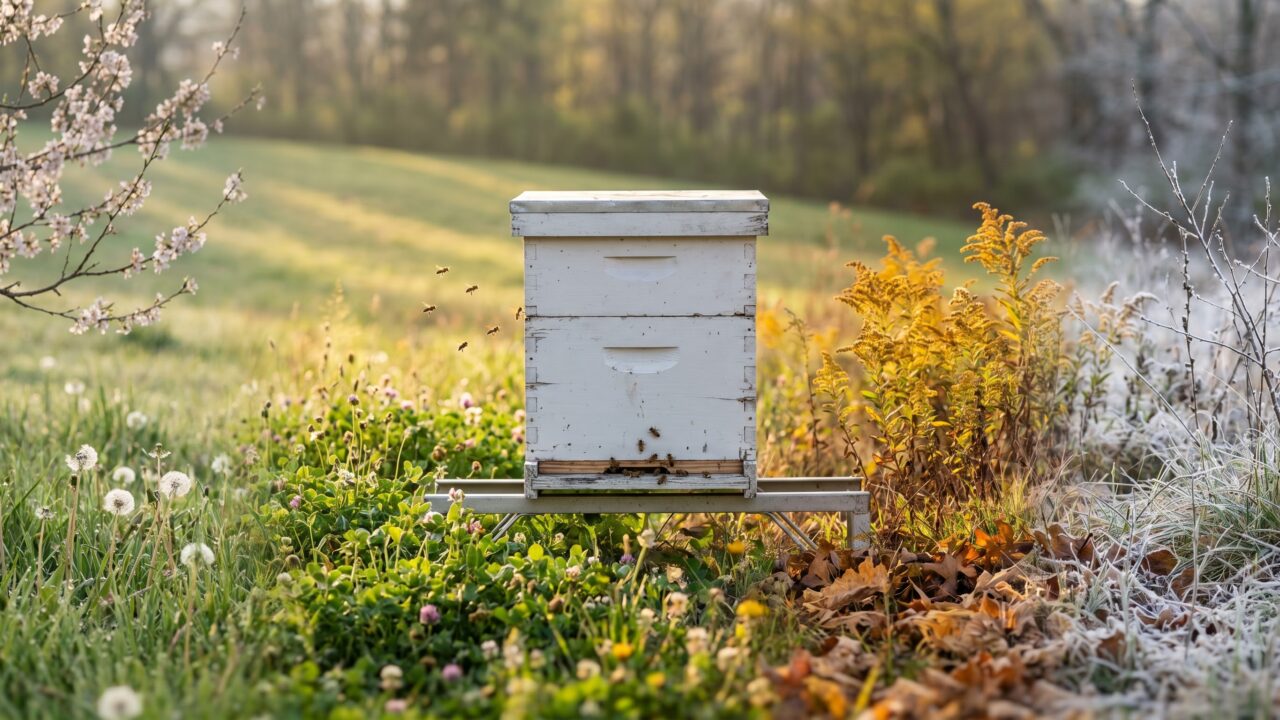
A beekeeping calendar is really four jobs that repeat every year: help the colony build up in spring, give it room and watch for swarming in early summer, knock down varroa and pack on winter stores in late summer and fall, then leave it alone to cluster through winter. The dates shift with your climate. A hive in coastal Georgia is rearing brood while a hive in Vermont is still buried in snow, so the smart move is to read the bees and the bloom, not the page of the calendar.
Below is the year laid out by season, what to notice before you act, and a region table so you can place each task in your own months. One honest warning up front. In your first year you will likely harvest no honey, and across the country roughly 40 to 55% of backyard colonies have died each year in recent surveys. The Apiary Inspectors of America and Project Apis m. reported a 51% loss for hobbyists, against a 56% national rate, in the 2024 to 2025 season. Good seasonal timing, especially on mites, is most of what keeps a colony alive.
How to turn this calendar into your calendar
The colony does not run on dates. It runs on day length, temperature, and what is blooming. Two landmarks anchor everything: your average last spring frost and your average first fall frost. If you know those two dates for your area, you can place every task in this guide without guessing.
Here is the method. Find your last-frost and first-frost dates (your county extension office or a frost-date lookup will give them). Then count from those landmarks:
- Spring buildup feeding starts about 4 to 6 weeks before last frost, when you first see pollen coming in on the bees' legs.
- Swarm season and queen-cell checks run from roughly last frost through about 6 weeks after, the colony's fastest growth.
- The critical varroa treatment lands in late summer, about 6 to 8 weeks before first frost, so the winter bees are reared on low-mite combs.
- Final feeding and wrapping happen in the few weeks around first frost, before nights drop into the 40s F.
- Winter, hands-off, is everything between first frost and the next spring's pollen.
Work those offsets against your own two frost dates and you have a calendar built for your yard, not for some average town a thousand miles away. The region table near the end gives a starting band if you do not know your frost dates yet.
Spring: the buildup
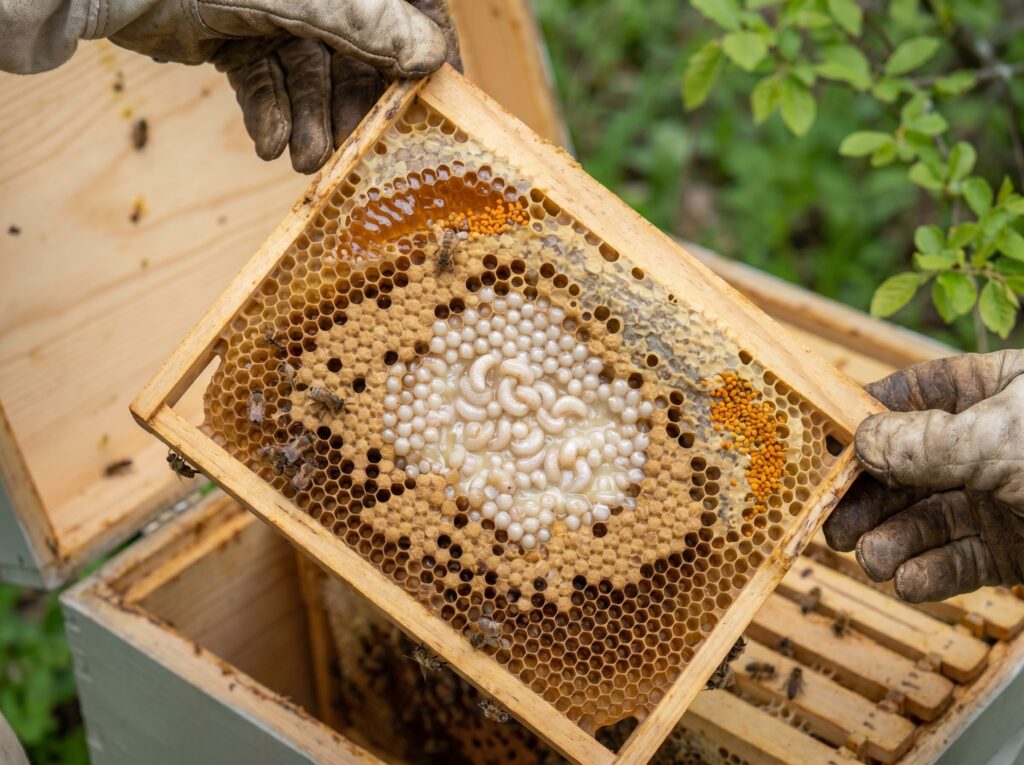
Spring is when the colony wakes up and grows fast, and your job is to keep it fed and uncrowded without chilling the brood. In late winter the queen has already restarted laying. Penn State Extension notes that as the season turns, "queens resume egg-laying and the colony initiates brood rearing," often weeks before you would guess from the weather outside.
The first real inspection waits for a calm, sunny day. Bees fly to forage once it is above roughly 61F and not raining, so wait for that kind of afternoon and work quickly while it lasts. You are checking three things: is the queen laying (eggs and tight brood), are there enough stores to bridge the gap until the flow, and is there room to grow. Eggs standing upright in the cells mean a queen laid within the last few days. That is the fastest way to confirm she is alive without hunting her down.
Feeding in spring is 1:1 sugar syrup, equal parts sugar and water by weight. That ratio mimics nectar and pushes the bees to draw comb, which a young or light colony badly needs. Stop the syrup once a real nectar flow is on or before you add honey supers, since you do not want sugar water ending up in jars you plan to eat from. Pollen, fresh or as a substitute patty, fuels brood rearing if natural pollen is still scarce.
This is also when packages and nucs get installed, because bees are a winter order for spring pickup. A package is loose bees with a caged queen starting from bare foundation; a nuc is a small working hive on drawn comb with a laying queen, a real head start. New colonies spend this whole first year drawing comb and building numbers, which is why year-one honey is usually zero. For the detailed work of an early-season takeoff, our walkthrough of how a colony ramps from late-winter brood to a full box covers the inspection-by-inspection rhythm.
Late spring and early summer: room, swarms, and supers
This stretch is the busiest on the calendar. The colony is growing faster than at any other time, and a crowded hive will try to swarm. Worker development sets the pace: it takes about three weeks for a worker to develop from an egg, then another three weeks before she becomes a forager. At peak a strong queen lays up to about 2,000 eggs a day, the population can roughly double in a month, and the colony climbs from a winter cluster of about 10,000 to 15,000 bees toward a summer peak near 60,000.
Swarming is the colony's way of reproducing, not a sign of aggression. A swarm cluster hanging in a tree is usually calm, full of bees that have gorged on honey and have no nest to defend. Your defense is space and timing. Add drawn comb or foundation before the brood nest jams up, and check often during this window: Penn State advises that beekeepers "check their colonies at least every two weeks to monitor for swarm prevention," which in practice means watching for queen cells. Find capped queen cells and a crowded box, and the colony has likely already decided. Splitting the hive, or pulling frames to relieve congestion, is how you keep the bees and the honey in your yard.
Honey supers go on when the main nectar flow starts and the colony is strong enough to fill them. These are the shallower boxes above the brood nest where surplus honey is stored for you. Keep syrup off the hive while supers are on. If you want a deeper look at reading capped cells and deciding whether to split or let a hive raise its own queen, that judgment call lives in our piece on why colonies swarm and how to stay ahead of it.
Late summer: the most important weeks of the year
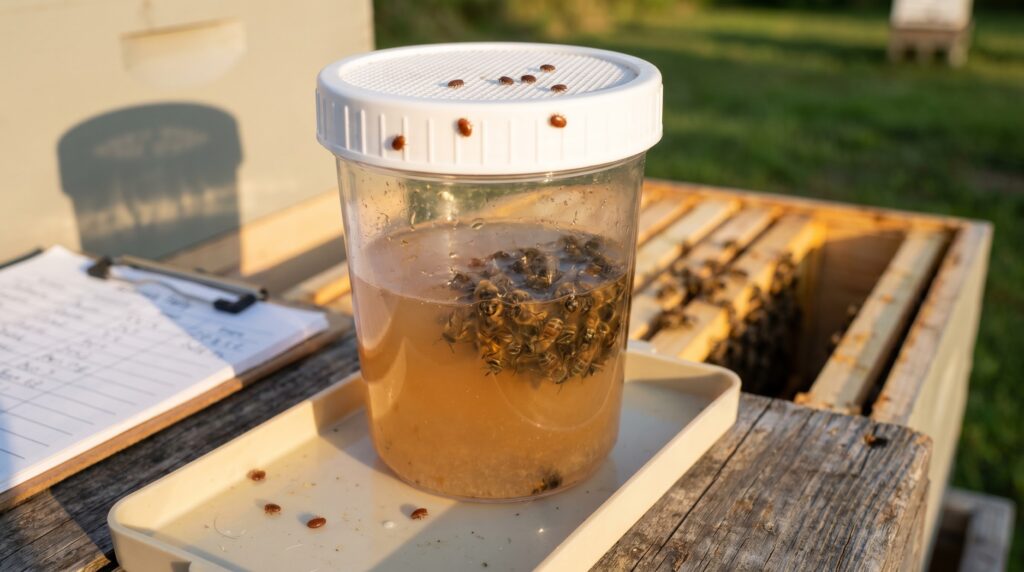
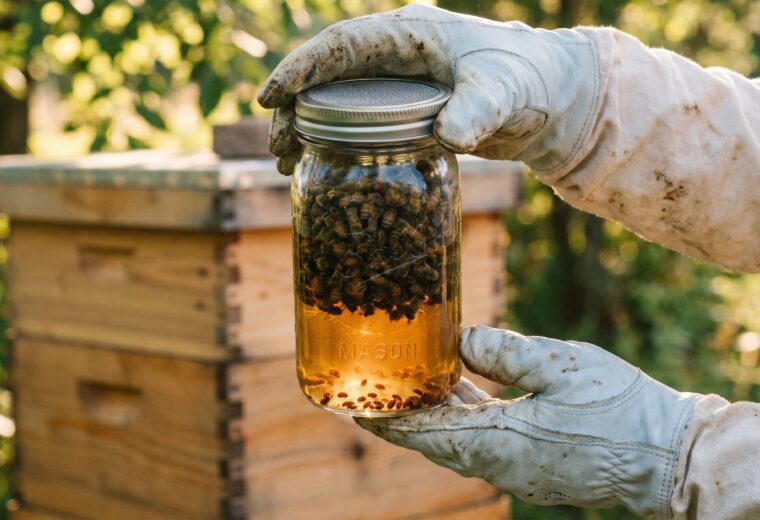
If you do only one thing right all year, make it the late-summer mite treatment, because this is when you decide whether the colony lives or dies over winter. Here is the biology that makes it urgent. In late summer the colony stops rearing short-lived summer bees and starts rearing winter bees, the fat, long-lived bees that must survive until spring. Penn State notes these winter bees "live much longer, up to six months versus six weeks for summer bees." Varroa mites feed on developing bees and spread viruses. If the mites are high while winter bees are being made, those bees emerge damaged and the cluster slowly fails in January, long after you stopped looking.
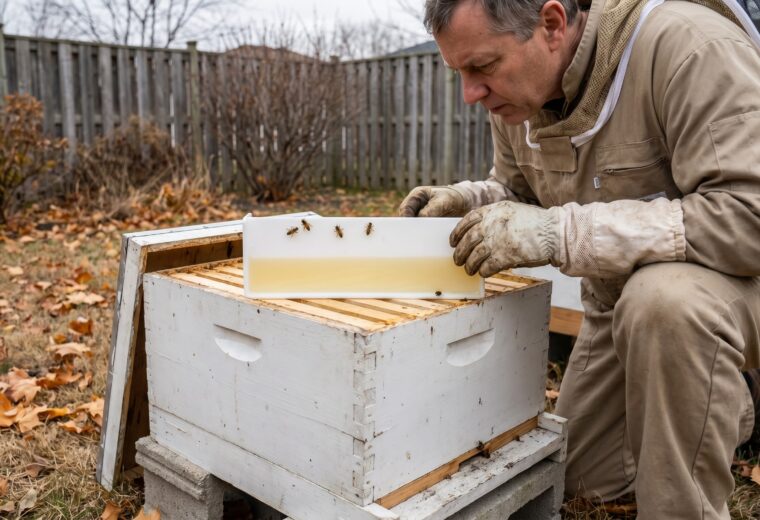
So the cadence is simple: monitor, then treat before the winter bees are reared, usually 6 to 8 weeks ahead of your first frost. Monitoring means an actual count, not a guess. The University of Minnesota Bee Lab method is to "measure 300 bees using 1/2 cup" into a wash, then count the mites that drop. The action point is low. That lab warns a "treatment may be warranted if levels are above 2%," which works out to about 2 mites per 100 bees, or 6 or more in the 300-bee sample. For picking a product once you cross that line, the Honey Bee Health Coalition's Tools for Varroa Management guide is the standard reference and worth keeping at the bench.
The figure that should be on every beekeeper's wall is this: monitor a clean 300-bee sample, and treat in late summer once you cross roughly 2 mites per 100. Our deeper article on where the action threshold sits and how it shifts by season walks through why fall counts matter more than spring ones.
Match the product to the weather and to whether supers are on. The table below sketches the common options; always follow the label, because these are registered pesticides and the label is the law.
| Treatment | Works best when | Supers on? | Key constraint |
|---|---|---|---|
| Oxalic acid (dribble or vapor) | Colony is broodless (late fall, or a split) | Yes, per label | Best with little or no capped brood; does not reach mites under cappings; PPE required |
| Formic acid (Formic Pro) | Daytime temps about 50 to 85F | Yes, per label | Temperature-sensitive; can stress a queen in heat |
| Amitraz (Apivar) | After the honey harvest | No (supers off) | Strips stay in for weeks; remove on schedule |
| Thymol (Apiguard) | Mild fall temperatures | No (supers off) | Less effective in cold; can interrupt laying |
Late summer also brings a nectar dearth in much of the country. Robbing gets fierce, so reduce entrances, avoid leaving comb out, and keep inspections short.
Fall: feed up and treat down
Fall has two goals, both about survival: make sure the colony is heavy with stores, and confirm the mites stayed down. The bees catch a last nectar flow in many regions and pack away winter food, but weigh the hive rather than hope, either by hefting the back or hooking a luggage scale under it. A full two-deep colony needs a minimum of about 80 lb of stores, commonly 70 to 90 lb by region, and Colorado State University Extension recommends leaving "80-100 pounds of honey in the hive" in colder climates. A small nuc going into winter wants no less than about 50 lb. Plan for less in the mild South and more in the frozen North.
If the hive is light, feed 2:1 syrup now, two parts sugar to one part water, because that thicker ratio stores well and the bees cure it faster with cool nights coming. There is a hard deadline on liquid feed: bees cannot take down cold syrup, so once nights are dropping into the 40s F, switch to solid feed. Our breakdown of how much fall syrup a light colony actually needs shows how to read the weight and convert it to pounds of sugar.
Confirm your mite treatment worked by monitoring again after it finishes. A treatment that did not knock the count below threshold is the same as no treatment for the winter bees. Drones get evicted from the colony in fall, which is normal; do not read it as a problem. The full pre-winter sequence, in order, is laid out in our step-by-step list for getting a colony buttoned up.
Winter: hands off, but not hands away
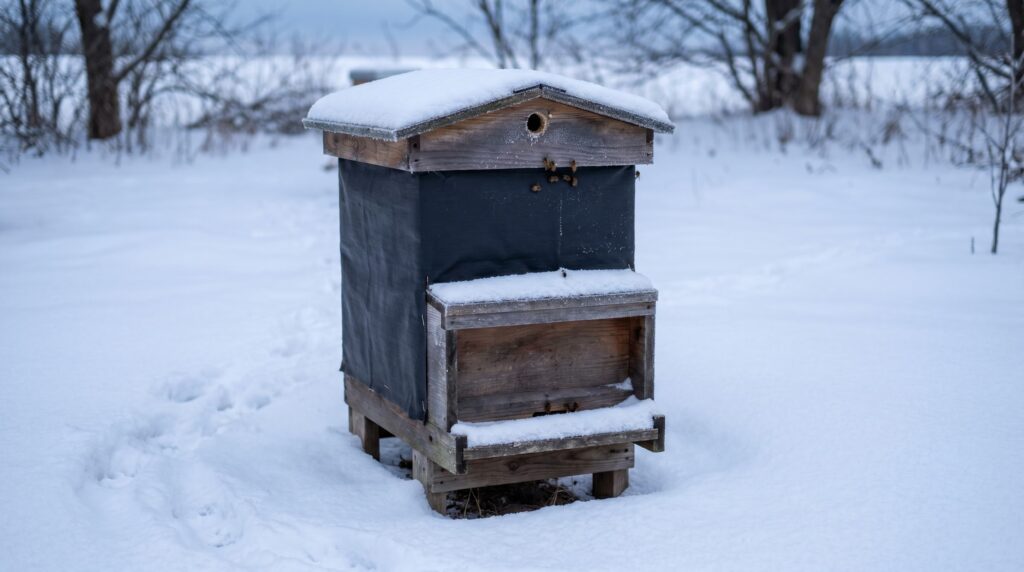
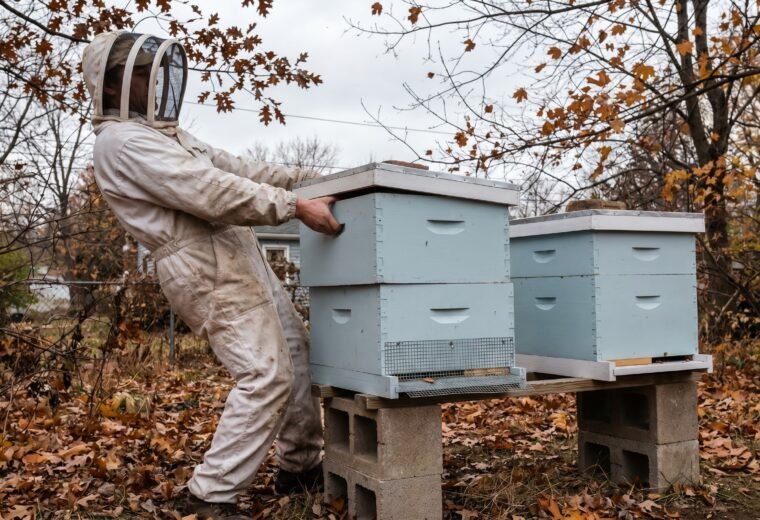
In winter the colony forms a cluster and waits, and your job shifts from managing to monitoring from the outside. Bees do not hibernate. As Colorado State University Extension puts it, "when temperatures start to drop, honey bees huddle together to make a cluster and shiver their wings," and that shivering can hold the cluster core near 91F even in deep cold. The cluster starts low in the hive and, in Penn State's words, "slowly moves laterally and vertically to access stores of honey" as it eats through the winter.
Most winter deaths are not from cold itself. They come from varroa damage carried in from late summer, from starvation when the cluster cannot reach honey, and from moisture. Bees give off water vapor as they metabolize honey; in a poorly ventilated hive that vapor condenses on the cold inner cover and rains back down on the cluster, and cold wet bees die fast. This is why an upper vent or a moisture-absorbing quilt usually matters more than heavy insulation. You are managing condensation, not trying to heat the box.
Two interventions are fair game in winter. First, emergency solid feed: on a top board you can lay fondant, a candy board, or dry sugar, since the bees cannot eat cold syrup. Second, a broodless oxalic acid treatment, which is highly effective because every mite is exposed on adult bees with no capped brood to hide in. The Bee Lab suggests treating "in late fall when bees are loosely clustered (about 40-50F)." Beyond that, resist opening up. Every cold inspection breaks the cluster's heat and sets it back.
The structural side of winter, wrapping, top entrances, moisture quilts, and bottom-board choices, is its own decision. Our guide to setting a hive up to survive the cold covers the build, and the broader strategy of getting colonies through to spring sits in our overview of what colony survival through winter actually depends on.
The year in one place, adjusted for your region
Use this table as a starting band, then refine it with your own frost dates using the offset method up top. "April" means very different things in Texas and Minnesota, so the rows are tied to what the colony is doing, with rough months filled in by climate band.
| Colony stage and your task | Deep South / coastal (zones 8-10) | Mid-latitude / transition (zones 6-7) | Northern / cold (zones 3-5) |
|---|---|---|---|
| Buildup begins; first inspection, 1:1 syrup, pollen | Feb | Mar to Apr | Apr to May |
| Install packages and nucs | Mar | Apr | Apr to May |
| Swarm season; add room, check queen cells every 1 to 2 weeks | Mar to May | Apr to Jun | May to Jun |
| Add honey supers on the main flow | Apr | May to Jun | Jun |
| Mid-summer dearth; reduce entrances, guard against robbing | Jun to Aug | Jul to Aug | Jul to Aug |
| Critical varroa monitor and treatment (winter bees) | Aug to Sep | Aug to Sep | Late Jul to Aug |
| Pull and harvest surplus honey | Jun to Sep | Jul to Sep | Aug to Sep |
| Feed up to winter weight (2:1), recheck mites | Sep to Oct | Sep to Oct | Aug to Sep |
| Final wrap, switch to solid feed, broodless oxalic | Nov to Dec | Oct to Nov | Sep to Oct |
| Winter cluster; hands off, monitor weight and ventilation | Dec to Jan | Nov to Feb | Oct to Mar |
Two regional notes worth saying plainly. In the Deep South the buildup is so early and long that swarm pressure is your year-round headache, and a small-hive-beetle problem can dwarf the mite calendar. In the far North the winter is so long that stores and ventilation decide everything, and you may not crack a hive for five months. Everyone, in every region, treats for varroa in late summer. That one is not optional.
What this calendar will not fix
A good calendar keeps a healthy colony healthy. It cannot rescue a colony that started weak, queenless, or already loaded with mites, and it cannot make year-one bees produce surplus honey. Set the expectation honestly: year one is comb-building and learning, year two is when a well-wintered hive can give you 30 to 60 lb in a good flow. Plan your first season around getting the colony alive to next spring, and the honey takes care of itself after that.
For anything involving the chemistry of treatments, the precise dose, interval, and temperature window, work from the product label and the Honey Bee Health Coalition guidance, never from memory or a forum. And for the human side, a sting reaction that spreads beyond the sting site, causes trouble breathing, or brings on dizziness is a medical emergency; call emergency services and seek care rather than waiting it out.
- Penn State Extension, Honey Bee Management by Seasonused for the seasonal colony cycle, spring buildup, swarm-season inspection cadence, winter-bee lifespan, and winter cluster movement
- University of Minnesota Bee Lab, Varroa Mite Testing and Managementused for the 300-bee alcohol-wash method, the above-2% action threshold, and late-summer and late-fall treatment timing
- Honey Bee Health Coalition, Tools for Varroa Management Guide (8th Edition)used as the standard reference for selecting varroa monitoring and treatment methods
- Colorado State University Extension, Meant to Bee: Overwintering Strategies for Beesused for clustering behavior, winter stores of 80 to 100 lb in cold climates, and the 91F cluster core
- Apiary Inspectors of America and Project Apis m., 2024-2025 U.S. Beekeeping Surveyused for recent backyard and hobbyist colony loss rates